
TL;DR:
- Club fitting benefits golfers of all skill levels by tailoring clubs to their unique swings and body measurements. Proper fitting can add 15–25 yards, improve shot dispersion, and boost confidence, especially for amateur players. Preparing with current clubs, clear goals, and a warm-up ensures an efficient, personalized fitting experience.
Most golfers assume club fitting is reserved for tour pros or scratch players with money to burn. That assumption is costing you strokes. What is club fitting, really? It’s the process of matching your clubs to your actual swing, your body measurements, and your performance goals, not to some generic standard designed for the average player who doesn’t exist. Whether you shoot 72 or 112, playing clubs built for someone else is like wearing shoes two sizes off. You can still walk, but you’ll never move as well as you could.
Table of Contents
- Key takeaways
- What club fitting actually means
- How club fitting works, step by step
- Benefits of club fitting for all golfers
- Professional fitting vs. off-the-rack clubs
- How to prepare for your club fitting
- My honest take on club fitting
- Take your fitted clubs to the next level with Golf-blab
- FAQ
Key takeaways
| Point | Details |
|---|---|
| Fitting is for every golfer | Club fitting suits all skill levels, not just low handicappers, because it matches clubs to your swing. |
| Multiple specs get adjusted | Shaft flex, lie angle, loft, length, and grip size all get dialed in during a professional session. |
| Real distance gains are measurable | Proper fitting can add 15–25 yards of distance by optimizing loft, shaft flex, and spin rate. |
| The process is systematic | Fitters isolate one variable at a time using launch monitor data to find your best combination. |
| Preparation matters | Bringing your current clubs and setting honest goals helps you get the most out of your fitting session. |
What club fitting actually means
Let’s get the club fitting basics straight. Club fitting is the process of analyzing your swing, body dimensions, and ball flight data to determine the exact specifications your clubs should have. The goal is simple: give you the best chance to hit the ball the way you actually swing it, not the way the instruction books say you should.
Custom club fitting addresses these core specifications:
- Shaft flex: Stiffer or more flexible based on your swing speed and tempo.
- Shaft length: Adjusted to your height and wrist-to-floor measurement so you’re standing in a natural, athletic posture.
- Lie angle: The angle between the shaft and the clubhead sole. Too upright or too flat and you’ll miss shots consistently in one direction no matter how well you swing.
- Loft: More or less loft changes your launch angle and spin rate, which directly controls distance and stopping power.
- Grip size: Underrated by most golfers. A grip that’s too thin encourages too much hand action. Too thick and you lose feel.
- Clubhead design: Blade vs. cavity back, forged vs. cast, offset vs. straight. The right head suits your ability and your miss tendencies.
Think of your swing as a fingerprint. No two are exactly alike. The right club specs tied to your unique swing characteristics are the difference between a club that fights you and one that works with you. Off-the-rack clubs are built for a hypothetical middle-of-the-road golfer, and that person probably isn’t you. For a deeper look at how types of golf clubs affect your performance, it’s worth understanding what each one is designed to do before you even step into a fitting.
How club fitting works, step by step
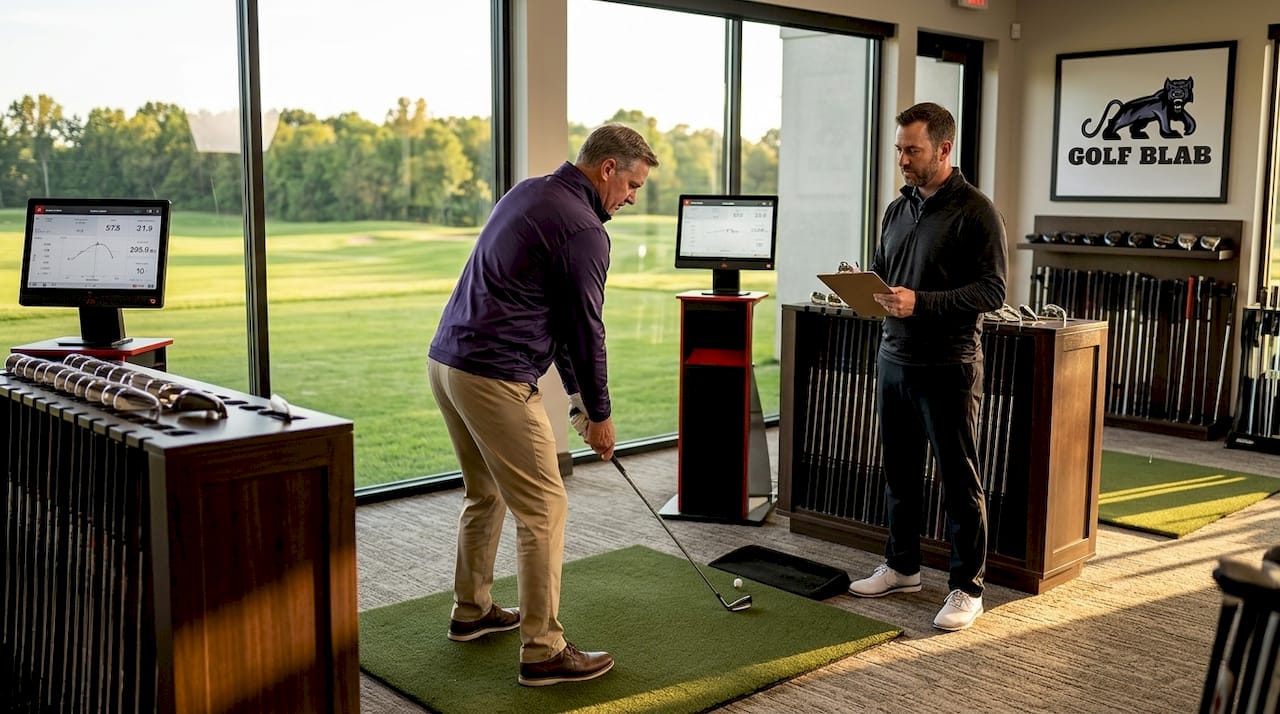
Walking into a fitting session unprepared can feel intimidating. It doesn’t need to be. Here’s exactly what to expect in a typical club fitting:
- Initial interview. The fitter asks about your goals, your current clubs, your handicap, and where your shots typically miss. This sets the direction for everything that follows. Don’t hold back here.
- Static measurements. Your height and wrist-to-floor distance get recorded. These measurements determine your baseline shaft length and lie angle starting point before you hit a single ball.
- Baseline swings. You hit 8–12 shots with your current clubs on a launch monitor. This establishes your real numbers: ball speed, spin rate, launch angle, and dispersion pattern.
- Systematic variable testing. The fitter swaps one variable at a time, typically starting with shaft flex, then clubhead design, then loft and lie adjustments. You hit 5–8 swings with each new configuration so the data is statistically meaningful, not a fluke.
- Data comparison and selection. The fitter compares the numbers from every combination and identifies which setup produced the best combination of distance, accuracy, and consistency for your swing.
- Fine-tuning. Grip size gets confirmed. Final loft and lie tweaks are made. The fitter may run one more validation round to confirm your numbers hold up under fatigue or pressure.
A full session for a driver or single iron set typically runs 60 to 90 minutes. A full-bag fitting can take three to four hours. That’s a morning well spent if it earns you 10 more years of better golf. Using a launch monitor like a TrackMan or GCQuad isn’t just for show. Those key performance metrics translate directly into decisions that affect every shot you take on the course.
Benefits of club fitting for all golfers
Here’s the naked truth: the golfer who benefits most from fitting isn’t the scratch player. It’s the 18-handicap who has been fighting a slice for three years with the wrong shaft flex. Fitting matches clubs to your swing, not your score.
The performance gains are real and documented:
- Distance. A good fitting can add 15–25 yards simply by dialing in loft, shaft flex, and spin rate. You don’t need to swing harder. You need the right setup.
- Tighter misses. Proper lie angle and shaft weight can tighten shot dispersion by 10–30% for recreational golfers. That’s the difference between hitting the green and being in the rough.
- Consistency. When your clubs match your swing, you repeat good shots more easily. The feedback loop between effort and result becomes honest.
- Confidence. There’s a psychological component to playing with fitted clubs that nobody talks about enough. When you step up to a shot knowing your equipment isn’t fighting you, your decision-making gets cleaner.
Beginners actually get a disproportionate benefit from fitting. When you start with clubs that fit, you build swing habits around honest feedback. The ball goes where it goes because of your swing, not because of equipment error. That’s how you choose golf clubs that actually support your development. And if you want to understand how updating your equipment can shift your confidence on the course, that’s a separate but connected conversation worth having.
Pro Tip: Don’t wait until you’re a better golfer to get fitted. Get fitted now, and use proper equipment to become a better golfer faster.

Professional fitting vs. off-the-rack clubs
Most golfers buy clubs the same way they buy shoes at an airport. Whatever fits well enough gets taken home. Professional fitting is nothing like that.

| Factor | Off-the-rack clubs | Professional fitting |
|---|---|---|
| Club options | Limited to store inventory | Over 65,000 combinations of heads and shafts |
| Fitting technology | None or basic swing analyzers | TrackMan, GCQuad, high-precision launch monitors |
| Data interpretation | Customer reads numbers alone | Expert fitter interprets patterns and advises |
| Customization | Standard specs only | Shaft flex, length, lie angle, loft, and grip all adjusted |
| Cost | $300–$700 per club set | Free to $400+ depending on scope |
Consumer launch monitors are getting better every year. They can narrow your options and give you real data to work with. But consumer devices lack the combination of extensive club inventory, experienced interpretation, and validated testing protocol that a professional fitter brings. A number on a screen tells you what happened. A skilled fitter tells you why it happened and what to change.
The cost concern is legitimate but often misunderstood. Many fitting centers credit the fitting fee toward your equipment purchase, so you’re essentially paying for the service only if you walk away without buying. A standalone driver fitting typically runs $100 to $150. For most golfers, that’s less than one bad purchase decision.
How to prepare for your club fitting
Going into a fitting cold leads to generic results. A little preparation turns a decent session into a great one.
- Bring your current clubs. The fitter needs to see what you’ve been playing to understand your baseline and your miss patterns. Don’t leave them in the trunk.
- Know your goals. Do you want more distance off the tee? Tighter iron dispersion? Better feel around the greens? Be specific. A vague goal gets a vague solution.
- Warm up first. Show up swinging like yourself, not like someone who just rolled out of bed. Hit the range for 15 minutes before the session starts.
- Ask about brand neutrality. The best fitters are agnostic. They care about your numbers, not which manufacturer’s logo ends up on the bag. Ask directly whether they carry products from multiple brands.
- Ask about their technology. What launch monitor do they use? How many shaft options do they have in the fitting cart? These questions tell you whether you’re walking into a professional setup or a sales pitch with a simulator.
- Follow up with gradual adjustment. If you’re changing multiple specs at once, give yourself time to adapt. Drastic changes in shaft length or lie angle take a few weeks to feel natural.
Pro Tip: Go into your fitting with your most common miss in mind. Tell the fitter about it upfront. That single piece of information can cut testing time in half and get you to the right spec faster.
My honest take on club fitting
I’ve seen golfers spend thousands on lessons trying to fix problems that were always 50 percent equipment. That frustrates me. Not because lessons are bad. Because nobody told them the other half of the equation existed.
In my experience, fitting is the most underdiscussed performance variable in recreational golf. The industry sells clubs the way car dealers sell cars. Here’s what we have. Does it feel good? Sign here. Nobody asks whether the shaft flex matches your tempo or whether the lie angle suits your setup.
What I’ve learned after years around this game is that fitting doesn’t just change your numbers. It changes how you think about your swing. When a fitter shows you that your current driver is adding 200 RPM of unwanted spin because the loft is wrong for your attack angle, something clicks. You stop blaming your body and start understanding the system.
The golfers who tell me fitting is only for pros are the same ones who have been playing the same slice for a decade. Fitting is a diagnostic process. It tells you the truth about your swing and your equipment, and then it gives you a path forward. Every golfer deserves that. Not just the ones with single-digit handicaps.
— Michael
Take your fitted clubs to the next level with Golf-blab

Getting fitted is the smartest move you can make for your game. But once those clubs are optimized for your swing, the next step is making them truly yours. At Golf-blab, we’re big on golf club personalization as a way to own your equipment, not just carry it. Our custom golf club labels let you organize, identify, and personalize your fitted set so it looks and functions exactly the way you want it to. Beyond labels, the Golf-blab shop carries accessories, gear, and tools built for golfers who take their performance seriously. When your equipment fits your swing and reflects your style, you show up differently. Browse what we have and build the bag you actually deserve.
FAQ
What is club fitting in golf?
Club fitting is the process of adjusting golf club specifications, including shaft flex, length, lie angle, loft, and grip size, to match a golfer’s individual swing characteristics and body measurements. The goal is to improve distance, accuracy, and consistency by removing equipment-related variables from your misses.
Is club fitting only for low handicap golfers?
No. Club fitting benefits golfers of all levels, and beginners may actually gain the most because they build their swing habits around clubs that give honest feedback from the start.
How long does a club fitting session take?
A single-club fitting, such as driver or irons, typically takes 45 to 90 minutes. A full-bag fitting can run three to four hours depending on the number of clubs tested.
How much does a professional club fitting cost?
Costs range from free at some retail shops to $400 or more for premium full-bag sessions. Many fitting centers apply the fitting fee as a credit toward your club purchase, which reduces the out-of-pocket cost significantly.
What should I bring to a club fitting?
Bring your current clubs, wear the shoes you typically play in, and be ready to describe your most common miss. Arriving warmed up and with specific performance goals helps your fitter find your ideal specs faster.