
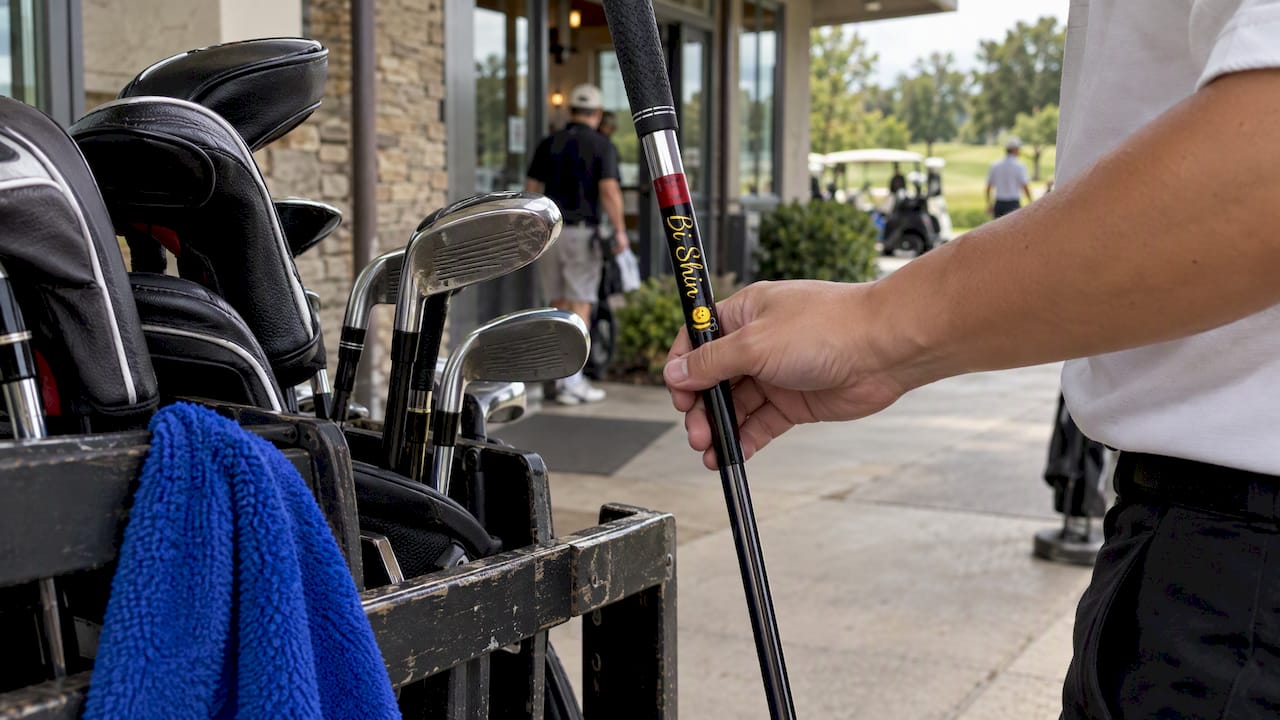
The fastest way to stop losing golf clubs is a combined system: a consistent bag setup, durable identification labels, a Bluetooth proximity tag, and a two-minute checklist before and after every round. The Equipment Rules (USGA) restrict attachments on the clubface, but labels placed on the shaft or hosel are generally fine. We build durable custom labels that fit neatly into this approach.
TL;DR:
- Using a consistent bag setup with designated slots and pockets makes it easy to identify if a club is missing within seconds.
- Custom durable labels on the shaft or ferrule help recover lost clubs by providing identifiable information that lasts for multiple seasons.
- Bluetooth proximity tags are useful for detecting clubs left on the course but should be tested beforehand, as their range is affected by obstacles.
- Following a quick pre- and post-shot checklist, including counting clubs and replacing headcovers, significantly reduces the chances of leaving clubs behind.
- Proper travel cases with reinforced features and clear labeling are essential for protecting clubs during flights and car trips, preventing damage and loss.
Table of Contents
- A quick checklist to stop leaving clubs behind
- Bluetooth tags and trackers: what they actually do
- Labeling and marking methods that actually hold up
- Bag setup habits that make a missing club obvious
- Protecting your clubs during flights and car trips
- What the USGA actually allows on your clubs
- If a club goes missing: your recovery playbook
- A note from the author on what actually works
- How Golf Blab labels fit into this system
- FAQ
- Sources
A quick checklist to stop leaving clubs behind
Most lost clubs disappear in the quiet moments between shots, not in some dramatic mishap. A short routine closes that gap before it opens.
- Before you tee off, count your clubs against your scorecard total, confirm every headcover is on, check your pockets for valuables, and save the pro shop’s number in your phone.
- After every shot, return the headcover and slot the club back in the same spot every time, so a glance tells you something is missing.
- At the end of each hole, take three seconds to scan the bag before you walk or drive to the next tee.
- If you notice a club is missing mid-round, stop immediately, retrace your last two shots, check the cart floor and bag pockets, then tell your group and call the pro shop with the hole number and label details.
Keep a photo of your labeled clubs and your bag tag text saved in your phone. A short message like “Lost 7-iron, blue Golf Blab label reads ‘M. Marini, hole 11, cart path’” gets a faster response from the clubhouse than a vague description ever will.
Bluetooth tags and trackers: what they actually do
Bluetooth tags and GPS-style trackers add a layer of insurance that habits alone cannot provide, especially once a club leaves the course entirely. Two distinct categories solve two different problems.
- Proximity trackers sound an alert on your phone when a tagged club drifts outside a short Bluetooth range, which suits clubs left behind on the course itself.
- Community or long-range trackers rely on a network of nearby devices to report a location days later, which suits clubs lost during travel or theft.
- Battery life varies by model, and pairing can be finicky the first few times you set a tag up, so test the connection at home before your first round.
- Bluetooth signal weakens fast in thick rough, dense trees, or deep bunkers, which means a tag may stay silent exactly when you need it most.
Press coverage of golf gear has paired Bluetooth-based trackers with better bag systems as a practical combination, since the tracker speeds recovery but a solid bag routine prevents the loss in the first place. Treat a tag as a backup, not a guarantee: a dead battery or an unpaired device will not call out a missing club on its own. During group play or tournaments, keep tracker alerts on silent or vibrate so they do not interrupt another player’s swing.
Pro Tip: Test your tracker’s alert distance in your own backyard before trusting it on the course, since Bluetooth range claims rarely hold up once there is a tree line in the way.

Labeling and marking methods that actually hold up
A club with a name and contact detail on it gets returned. A blank club gets quietly claimed or forgotten in a cart well. The method and placement both matter.
- Adhesive custom labels wrap around the shaft or sit on the ferrule, staying visible without touching the clubface.
- Ferrule engraving etches initials or a short code directly into the plastic collar below the grip, which survives years of bag friction.
- Heat-shrink ID sleeves fit snugly around the shaft and resist peeling better than standard stickers in wet weather.
Look for laminated polyester material and UV-resistant ink, since ordinary paper labels fade and curl within a season. A durable club label applied correctly can last through four seasons of regular play, which matters far more than a cheap sticker that peels by midsummer.
Placement always stays on the shaft, ferrule, or grip butt, never the striking face. The Equipment Rules allow removable, non-permissible attachments to come off without penalty, but anything fixed to the clubface that could influence ball flight is not allowed at all. Our Custom Golf Club Labels are built around this exact placement and durability standard, and our guide to labeling golf clubs walks through application step by step.
Bag setup habits that make a missing club obvious
A bag organized the same way every round turns a missing club into something you notice in seconds, not after you have driven off the course.
- Slot clubs by length, with the driver and woods in the back, irons through the middle, and wedges and putter up front, using full-length dividers when your bag has them.
- Assign each pocket a single job, balls and tees in one, rain gear in another, valuables in a zippered pocket you check before leaving every hole.
- Replace headcovers immediately after every shot rather than tossing the club back bare, since an uncovered club is the one most likely to get left behind.
- On a cart, keep the bag secured against the rear bar and do a two-second visual check before pulling away from each green; walking players should glance at the bag the moment they pick it back up.
This kind of repeatable bag organization is one of the habits coaches most often recommend, precisely because it makes an absence visible at a glance rather than something you discover three holes later. A quick golf bag personalization pass, labeling pockets and dividers the same way you label clubs, reinforces the same muscle memory.
Protecting your clubs during flights and car trips
Travel is where otherwise careful golfers lose clubs, usually to damage or misrouted baggage rather than theft.
- Choose a travel case with a stiff arm, 360-degree padded head coverage, interior stability straps, a shock-absorbing wheelbase, and a TSA-approved lock, features that reputable travel bag manufacturers build in for exactly this reason.
- Pack headcovers on first, cinch every interior strap tight, and slip a luggage tag with your name and phone number inside the bag itself, not just on the outside handle.
- At the counter, declare high-value clubs and consider travel insurance if your set would be costly to replace.
- For short car trips, wedge the bag against a seat or cargo wall so it cannot tip, and make checking the trunk part of your “keys, phone, clubs” routine before you drive off.
What the USGA actually allows on your clubs
Rule 4 sets the boundaries that matter here, and they are simpler than most golfers assume.
- You may carry up to 14 clubs, and the rule restricts attachments that could affect how a club performs.
- Tape or any substance on the clubface that influences ball flight is prohibited outright.
- A label on the shaft or hosel that does not change the club’s playing characteristics is acceptable.
- If you discover a non-permissible attachment, such as a sticker stuck to the face, mid-round, USGA clarifications confirm you can remove it immediately and keep playing without penalty.
- Before a competitive round, run a quick visual check that every label and device sits away from the face and does not alter the clubhead.
If a club goes missing: your recovery playbook
A missing club is recoverable more often than golfers assume, provided you act fast.
- Retrace your last few shots immediately, checking the cart floor, bag pockets, and the rough near your last lie.
- Ask your playing partners, since someone often notices a club left behind before you do.
- Call the pro shop with the hole number, approximate time, and your label text, since a clear description like “Golf Blab label, blue ink, reads ‘M. Marini’” moves much faster than “a 7-iron.”
- If it does not turn up, file a lost-and-found report with the course, check local golf community groups, and weigh insurance or replacement if the club has real value. In tournament play, notify officials right away rather than waiting until the round ends.
A note from the author on what actually works
In years of watching golfers lose and recover clubs, the pattern repeats: it is almost never one dramatic event, just a missing routine. Small changes, a label, a checklist, a consistent slot, prevent most of it.
— Michael Marini
How Golf Blab labels fit into this system
Durable identification is the piece of this system most golfers skip, and it is the one we built our business around. Our Custom Golf Club Labels use laminated, UV-resistant material designed for shaft and ferrule placement, which keeps them fully clear of the clubface restrictions outlined above while standing up to four seasons of regular play. A set runs $29.99 at our shop.
Beyond labels, our shop carries items that round out a dependable setup, from the Innovate Tour Performance Golf Balls to the Golf Blab Adidas Sport Polo, alongside instructional offerings like Play Golf with a Tour Pro at $600 per person. None of this replaces the habits above, but a clearly labeled club is the single fastest way to get a lost one back. Browse the full lineup at our shop when you’re ready to set your bag up properly.

FAQ
What’s the 70/30 rule in golf?
The 70/30 rule is a swing or short-game concept some instructors use, typically describing weight distribution or shot-shaping ratios, and definitions vary by coach. It isn’t a formal USGA rule, so check with your own instructor for the specific version they teach.
What is the 24/38 rule in golf?
This isn’t a recognized USGA rule or a standard term in the sport. If you’ve heard it referenced locally, it likely refers to a club-specific pace-of-play or handicap guideline rather than an official Rules of Golf provision.
Why put Vaseline on your driver?
Some golfers apply a thin layer of petroleum jelly to a driver face during casual practice to reduce spin for mishit testing, but this has nothing to do with official play. Under the Equipment Rules, any substance on the clubface that could influence ball movement is not permitted during a round.
Is a 69 wedge illegal in golf?
Wedge loft itself isn’t restricted by a specific number under the Rules of Golf; conformity depends on groove specifications, bounce, and overall design meeting USGA equipment standards. Any wedge must meet the same conformity standards as other clubs.
Can I remove a non-permissible sticker from my club mid-round?
Yes. USGA clarifications confirm you can remove a non-permissible attachment, like a sticker on the clubface, at any point during a round without penalty and continue playing with that club.
Sources
- The Equipment Rules (USGA)
- Pro Traveler: Shop the Pro Level Golf Travel Bag | Club Glove
- How to organize your golf bag: a complete guide to setup and storage