
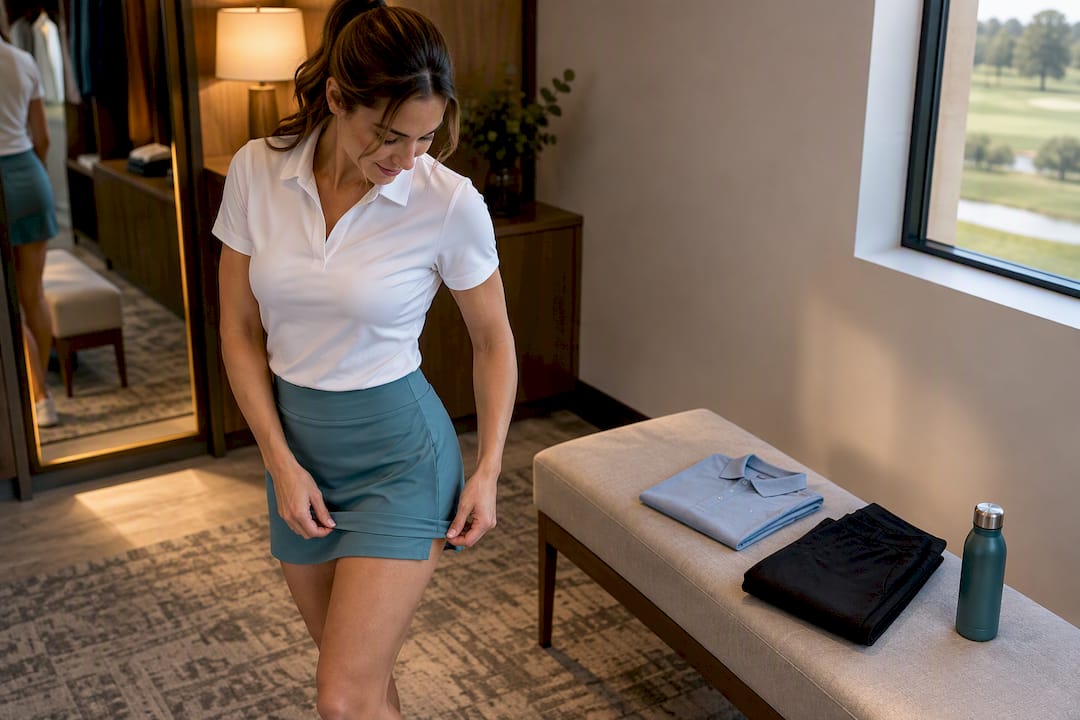
Most courses expect women golfers in collared or approved sleeveless tops, tailored skirts, skorts, shorts or pants of a reasonable length, and proper golf shoes, while denim, workout wear and swimwear stay off the fairway unless a course says otherwise. Private clubs and tour events tend to hold a firmer line than municipal courses, so when the rulebook feels ambiguous, a quick call to the pro shop settles it before you ever tee off.
TL;DR:
- Most courses require women to wear collared or approved sleeveless tops, with private clubs and tournaments enforcing stricter standards than municipal courses.
- Golfer shoes must be specifically designed for the sport, as regular trainers can slip during impact and compromise stability.
- Dress code policies vary significantly, so calling ahead or checking posted guidelines ensures compliance, especially at private clubs and tournaments with stricter rules.
- Fabrics with an 88/12 polyester-spandex blend provide necessary stretch and durability for movement during a round, while fit and inseam length prevent riding up or excess dragging.
- Traditional dress standards have evolved from historical modesty norms to modern athletic performance, but aim still focus on practicality, comfort, and proper appearance for each venue.
Table of Contents
- 1. What to wear: tops, bottoms, shoes and accessories
- 2. How dress codes vary by venue
- 3. Fit, fabric and technical details worth knowing
- 4. Enforcement and etiquette: what to expect and how to respond
- 5. How Golf Blab helps you dress and play with confidence
- 6. Historical and cultural context of women’s golf dress codes
- 7. Impact of dress code on performance and comfort
- 8. Seasonal and weather considerations in women’s golf attire
- 9. Author perspective: balancing style and rules
- 10. Quick call-to-action: Golf Blab offerings to help you prepare
- Sources
- FAQ
1. What to wear: tops, bottoms, shoes and accessories
A collared shirt remains the safest choice anywhere you play, an old standby that never draws a second glance from a starter or a club official. Many courses now welcome sleeveless tops and mock-collar styles, though spaghetti straps and boldly athletic crop tops can raise eyebrows at more traditional venues, so it helps to read the room, or better yet, the posted policy, before you commit.
Bottoms carry their own quiet code. Skirts, skorts, shorts and tailored pants are all fair game, provided the hemline sits at a length the club considers presentable rather than beach-bound. Built-in shorts beneath a skort solve the modesty question outright, and a well-cut pair of golf pants gives you coverage without sacrificing the swing.
Shoes matter more than most first-time golfers expect. Golf-specific shoes, whether spiked or spikeless, grip the turf through a full swing and protect the greens in a way ordinary sneakers cannot. A casual trainer might feel fine walking to the cart, but it slips at the exact moment your weight shifts through impact.
Accessories round out the look and often solve a practical problem at the same time:
- A wide-brim hat or visor cuts glare and shields your face through a long round.
- Golf gloves improve grip, especially in humid or damp conditions.
- Compression sleeves ease repetitive strain for players logging back-to-back rounds.
- Lightweight sun-protective layers cover shoulders without adding bulk to your swing.
Pro Tip: Keep one collared, sleeve-friendly top and a pair of tailored shorts in your bag year-round. It solves nine out of ten dress-code surprises before they happen.
For a deeper look at how professional players balance compliance with personal style, style-focused outfit guidance breaks down seasonal looks that pass muster at nearly any club.
2. How dress codes vary by venue
Municipal and public courses tend to run the most relaxed policies, though relaxed rarely means anything goes. Swimwear and gym clothes are still turned away at most facilities, even when denim gets a pass at others, which means the smart move is always to double-check rather than assume.
Private clubs draw a tighter circle. Collared shirts are frequently mandatory, leggings and workout clothes are commonly barred outright, and skirt or short length gets measured with real scrutiny rather than a passing glance.
Tournament and LPGA-level play sits at the strict end of the spectrum. Sponsor obligations and brand partnerships shape what players wear, and LPGA’s tournament dress-code guidance has at times prohibited items like leggings and joggers entirely, a reminder that tour apparel answers to more than personal taste. Reading how professional players navigate these expectations offers a useful preview of what stricter enforcement looks like in practice.
Before you pack your bag, a few habits save you the embarrassment of a wardrobe rejection at the first tee:
- Call the pro shop directly and ask, “What’s your dress code for women, and are there any exceptions for weather or events?”
- Look for a posted policy on the club’s website or clubhouse bulletin board.
- When a club’s site is vague, err toward the stricter interpretation rather than the loosest one.
3. Fit, fabric and technical details worth knowing
A common industry recommendation is an 88/12 polyester-spandex blend for golf shirts, chosen for its stretch and durability. Fabric specs from golf apparel guidance show why that ratio strikes a balance most cotton blends cannot match: enough stretch to follow your swing, enough structure to hold its shape across eighteen holes.
Fit deserves the same attention fabric gets. Bonded waistbands and internal grip details keep a skort or short from rolling or riding up mid-swing, a small design choice that spares you the mid-round adjustment nobody wants to make on the fourth fairway. A proper inseam matters just as much: too short and it rides, too long and it drags against your follow-through.

Pro Tip: Try on golf bottoms while mimicking a full swing in the fitting room. If the waistband shifts or the hem catches, it will do the same thing on hole twelve.
Equipment rules apply to garments too, more than most golfers realize. USGA equipment standards state that clothing must not include features designed to assist alignment or enhance movement beyond what the body does naturally, though standard compression garments and sports bras remain permitted. That distinction rarely comes up for casual players, but it matters for anyone eyeing a specialized posture aid or alignment-assist garment before a sanctioned round.
4. Enforcement and etiquette: what to expect and how to respond
Most dress-code moments unfold quietly rather than dramatically. A starter or pro shop attendant will typically make a polite request first, sometimes offering loaner apparel to smooth things over. Outright refusals to play remain rare outside the strictest private clubs.
A little preparation keeps the moment from happening at all:
- Call ahead the day before, especially at a club you have not played, and ask specifically about women’s dress requirements.
- Pack a backup layer, a lightweight collared top or a pair of tailored shorts folded into your golf bag costs nothing and solves everything.
- Follow staff instructions calmly if a question comes up; arguing at the first tee rarely ends in your favor.
A simple script works almost anywhere: “I want to make sure I’m dressed appropriately, could you tell me your policy on skirt length and sleeveless tops?” Most pro shops answer that question warmly, since it saves them the awkward conversation too.
5. How Golf Blab helps you dress and play with confidence
Golf Blab treats wardrobe compliance as one piece of a larger picture: looking like you belong while playing like you mean it. Beyond style breakdowns, the platform’s educational resources on personalization and identity connect the practical side of dress codes to the deeper appeal of building a recognizable presence on the course.
A few resources worth exploring before your next round:
- Fabric and fit specs for choosing shirts and bottoms that move with your swing instead of against it.
- Custom Golf Club Labels, a way to mark your clubs as unmistakably yours the moment you pull them from the bag.
- A program offering etiquette coaching alongside practical wardrobe guidance for players stepping onto a new course for the first time.
Guidance is informed by insights connected to perspectives from professional golf, grounding the advice in experience rather than simply written analysis.
6. Historical and cultural context of women’s golf dress codes
Women’s golf attire carries more history in its hemlines than most players realize. Early twentieth-century golfers played in ankle-length skirts and corseted blouses, an outfit dictated less by the sport than by the era’s broader expectations of women in public life. The mid-century shift toward shorter skirts and tailored trousers tracked alongside wider social change, each inch of hemline a small negotiation between tradition and practicality.
Private clubs held onto conservative standards longer than public course culture did, a divide that still echoes in today’s stricter private-club policies versus looser municipal ones. The rise of women’s professional golf pushed the conversation further: tour players needed clothing that performed athletically while still satisfying sponsor and broadcast expectations, a tension that shaped much of modern golf apparel design.
What reads today as a simple dress code is really the residue of decades spent arguing over how much a woman golfer should be allowed to move, and how she was expected to look while doing it. Recognizing that history reframes the modern rulebook as evolution rather than arbitrary restriction, a set of guidelines still catching up to how women actually play the game.
7. Impact of dress code on performance and comfort
Clothing that fights your swing costs you more than comfort, it can cost you the shot itself. A waistband that rolls mid-backswing or a hemline that catches on a follow-through pulls focus away from the ball at the exact moment you need it most.
Breathable, stretch-forward fabrics solve a real performance problem, not just a style one. Polyester-spandex blends move with your torso rotation instead of restricting it, and moisture-wicking properties keep grip and comfort steady across four hours in the sun. A cotton blouse that feels fine on the first tee often feels heavy and damp by the back nine.
Proper golf shoes carry their own performance weight. The traction spiked or spikeless soles provide through impact stabilizes your lower body in a way flat-soled sneakers cannot, and that stability translates directly into more consistent contact.
None of this means dress codes exist purely for performance reasons, most were never designed with biomechanics in mind. But the overlap is real: clothing built to satisfy a dress code often turns out to be the same clothing that helps you play your best round, which is as close to a rare win-win as golf attire gets.

8. Seasonal and weather considerations in women’s golf attire
Golf attire has to answer to the weather as much as to any rulebook. Warm-weather rounds call for lightweight, breathable fabrics and sun protection that does not sacrifice compliance, a wide-brim hat and a UPF-rated collared shirt cover both concerns at once.
Cooler rounds bring their own layering logic. A lightweight quarter-zip or vest over a collared base layer keeps you warm without violating a course’s top requirements, and thermal leggings under a skort solve the cold without abandoning skirt-length expectations. Rain gear deserves the same scrutiny: a proper golf rain jacket sheds water without ballooning into something that restricts your swing.
Wind adds a wrinkle few golfers plan for. Looser layers flap and distract, while fitted, wind-resistant fabrics stay quiet against a swing in gusty conditions, another case where the comfortable choice and the compliant choice end up being the same one.
Packing for an unfamiliar season or climate rewards a little foresight. A packing checklist built around layers, not one bulky item, gives you the flexibility to peel off or add on as the round and the weather shift beneath you.
9. Author perspective: balancing style and rules
I have watched plenty of golfers overthink their outfits and just as many underthink them, and the players who look most at ease usually did neither. Pick one statement piece, a bold hat, a sharp skort pattern, a standout glove, and let everything else stay understated. That single choice reads as intentional rather than risky, and it almost never runs afoul of a posted policy.
Tour styling and club styling are not the same conversation. What works under LPGA sponsor obligations rarely translates to a Saturday round at your home course, and trying to dress like a broadcast rather than a golfer usually backfires. Check the policy, then dress like yourself within it.
— Michael Marini
10. Quick call-to-action: Golf Blab offerings to help you prepare
Confidence on the course starts before you ever reach the first tee, and Play Golf with a Tour Pro pairs real etiquette coaching with practical wardrobe guidance built for players who want to walk in knowing exactly what to wear and how to act. Custom Golf Club Labels turn a compliant outfit into a personal one, marking your clubs the moment they leave the bag. Ready to prepare properly? Book Play Golf with a Tour Pro or browse the full shop for labels, apparel and gift cards.
Sources
FAQ
What do female golfers wear under their skirts?
Most women golfers wear built-in compression shorts sewn into the skort itself, which handles modesty and mobility in one piece. Standard athletic underwear or bike shorts work as an alternative when a skort lacks a built-in liner.
What should a woman wear golfing for the first time?
A collared or approved sleeveless top, a skort or tailored shorts of moderate length, and proper golf shoes cover nearly every course’s baseline requirement. Calling the pro shop ahead of your first round confirms any specific rules before you arrive.
Can girls wear spaghetti straps to golf courses?
It depends on the venue: some public and municipal courses allow spaghetti straps, while private clubs and tournament settings often do not. Checking the posted policy or calling ahead avoids an awkward moment at the first tee.
What is the dress code for the LPGA Tour in 2026?
LPGA’s official guidance sets tour-level appearance standards that go beyond typical club rules, at times prohibiting items like leggings or joggers, and sponsor obligations shape much of what players wear. Public course dress codes are almost always more relaxed than tour-level requirements.