
TL;DR:
- Both self-taught and instructor-led golf have unique strengths and limitations that affect the speed of improvement. Feedback frequency and accuracy are key factors, with instructors providing immediate corrections and technology enhancing self-practice through detailed data. A balanced, structured approach that incorporates lessons, deliberate self-practice, and technology yields the best long-term results.
You’ve been grinding on the range for months. You’ve watched the YouTube videos, you’ve tried the tips from your playing partners, and yet your handicap barely moves. Sound familiar? A lot of golfers hit that wall and start asking the same uncomfortable question: would lessons actually fix this, or is the problem something only you can solve through reps? The honest answer is more nuanced than either camp will admit. Both self-taught and instructor-led golf have real strengths, real blind spots, and real consequences for how fast you actually improve. Let’s cut through the noise and figure out which path makes sense for where your game is right now.
Table of Contents
- How self-taught and instructor-led golf differ in feedback and progress
- The science of feedback: Why cues and guidance matter
- Structuring self-taught golf for real improvement
- Instructor-led golf: When and why it delivers best results
- The hybrid approach: How most golfers actually improve
- Our take: Why blending approaches outperforms extremes
- Take your practice further with Golf Blab resources
- Frequently asked questions
Key Takeaways
| Point | Details |
|---|---|
| Instructor feedback advantage | Personalized, real-time coaching corrects errors faster and prevents bad habits. |
| Self-taught success requires structure | Deliberate practice with benchmarks is vital for progress without lessons. |
| Feedback frequency boosts learning | Higher feedback density—via tech or self-review—accelerates improvement. |
| Most golfers benefit from a hybrid | Blending self-reps with expert input often leads to the best results. |
| Choose your method based on goals | Evaluate your needs: fast progress, flexibility, or long-term consistency. |
How self-taught and instructor-led golf differ in feedback and progress
Now that you know the big-picture problem, let’s get specific about how feedback and improvement processes actually work in each approach.
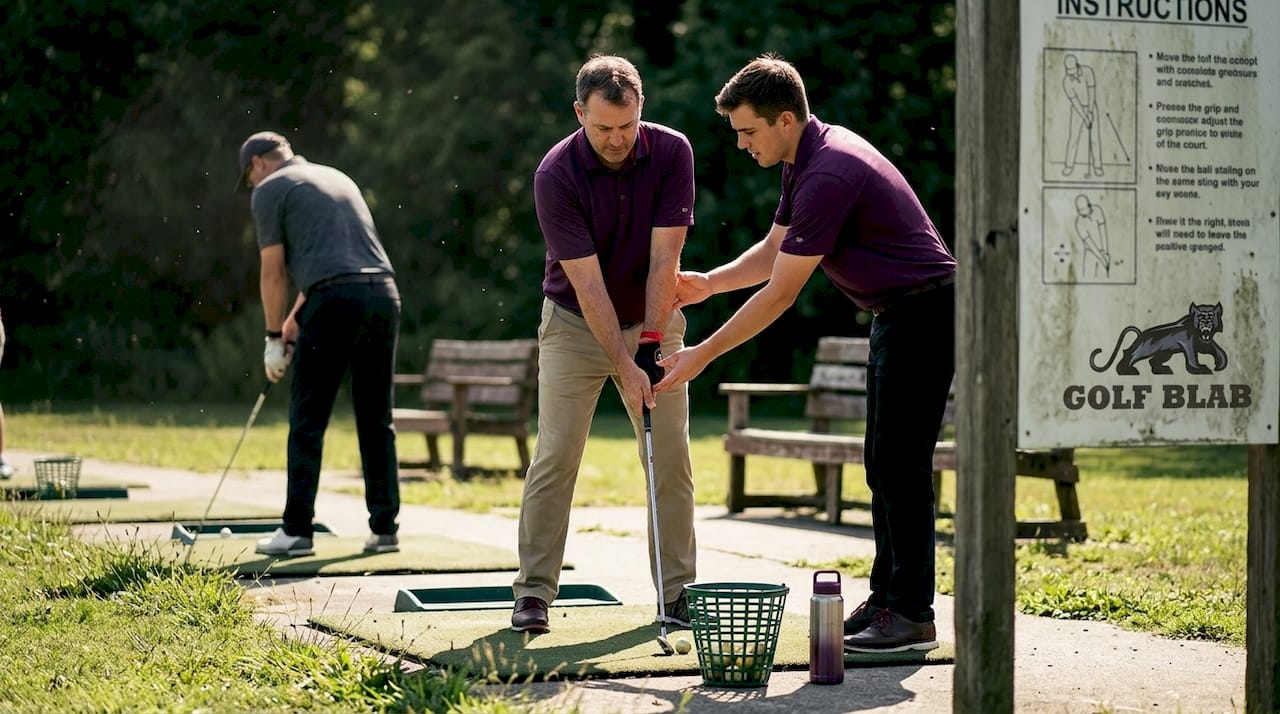
The single biggest difference between the two paths is feedback. When you work with an instructor, you get immediate, targeted corrections. They watch you swing, they see what you can’t see, and they tell you right then and there what needs to change. That loop is tight and efficient. Instructor-led golf directly addresses swing mechanics errors through real-time feedback, which dramatically reduces the risk of reinforcing bad patterns.

Self-teaching flips that loop wide open. You hit a shot, you guess at what went wrong, and you try something different next time. Sometimes you get it right. More often, you spend 200 reps ingraining a compensating move that creates a whole new problem. The frustrating part is that it doesn’t feel wrong while you’re doing it. Bad habits are comfortable. That’s why they stick.
That said, self-taught golf can still be effective when paired with structured practice, clear benchmarks, and deliberate self-feedback systems. The keyword is structured. Without that structure, you’re essentially practicing your mistakes.
Here’s a quick comparison of where each approach tends to win and lose:
| Factor | Self-taught | Instructor-led |
|---|---|---|
| Feedback speed | Slow, often delayed | Immediate and specific |
| Error correction | Risk of reinforcing mistakes | Caught early |
| Flexibility | High | Lower |
| Cost | Low | Higher |
| Consistency of progress | Uneven | More predictable |
| Long-term efficiency | Depends on structure | Generally faster |
A few honest observations about the self-taught path:
- You can develop real feel and creativity on your own, which some instructors actually stifle.
- You are far more likely to practice things you’re already decent at, avoiding the hard stuff.
- Without external eyes, your mental model of your own swing is almost always wrong.
- Understanding what a golf clinics vs private lessons setup actually offers can save you from wasting money on the wrong format.
Pro Tip: Film your swing from face-on and down-the-line every single session, even if you never show it to an instructor. Watching yourself back is the closest thing to external feedback you’ll get on your own.
“The moment I stopped assuming I knew what my swing looked like and started watching the video, I realized I was fighting a completely different problem than I thought.” This is the honest experience of nearly every golfer who finally picks up a camera.
Learning what a golf coach really does for your game can also reframe your expectations before you ever book a session.
The science of feedback: Why cues and guidance matter
With the basics of feedback covered, let’s look at the science behind why structured guidance, whether from people or technology, actually helps you get better faster.
Motor learning research is clear on this point. Guidance cues improve learning outcomes in tasks like golf putting compared to no-guidance control conditions. In plain language: when you have something helping you feel or understand the right pattern, you learn it faster and retain it better. That’s not opinion. That’s controlled research.
One concept worth understanding here is feedback density, which simply means how many useful feedback events you get per hour of practice. A traditional weekly lesson gives you maybe 60 minutes of guided time, but then you’re on your own for the rest of the week. That’s a relatively low feedback density overall. Instructor-led learning provides lower feedback density per total practice hour compared to self-driven systems that use high-frequency tech or structured drills.
Here’s how different practice methods stack up on feedback density:
| Practice method | Feedback events per hour | Error correction speed |
|---|---|---|
| Weekly lesson only | Low | Once a week |
| Self-practice, no tools | Very low | Rarely |
| Video self-review | Moderate | Session by session |
| Launch monitor use | High | Shot by shot |
| Lesson plus tech tools | Very high | Continuous |
Golfers who use technology in their practice consistently report faster gains when that feedback is specific and actionable. We’re talking 3 to 5 times faster improvement on targeted skills compared to unguided range sessions.
A few things that genuinely accelerate the feedback loop:
- Launch monitors that show ball speed, spin rate, and launch angle after every shot
- Putting mirrors and alignment sticks for immediate visual cues during drills
- Smartphone video apps with slow-motion and overlay features
- Structured pre-shot routines that create repeatable conditions for honest comparison
Pro Tip: You don’t need expensive technology to boost your feedback density. A free slow-motion camera app and one alignment stick can triple the quality of information you get from a single practice session.
The naked truth is this: it’s not lessons versus self-teaching that determines your progress rate. It’s feedback. The more of it you get, the faster you improve, as long as it’s accurate.
Structuring self-taught golf for real improvement
Self-guided learning can work, but only if it’s structured. Here’s how to make self-teaching actually produce results, instead of confusion.
The biggest trap in self-taught golf is random practice. You hit drivers, then chip a few, then go back to iron shots, then try that new grip tip you read about. Forty-five minutes later, you haven’t actually practiced anything. You’ve just swung a club in a lot of different directions and called it a session.
Real self-improvement follows a framework. Here’s one that works:
- Identify one specific, measurable problem. Not “I’m hitting it badly” but “I’m losing 15 yards left with my 7-iron off the toe.” Specific problems have specific solutions.
- Find or design a drill that isolates that problem. One drill. Not five.
- Set a measurable benchmark before you start. For example, hit ten shots and record your result. Video and launch monitor data are ideal, but even a simple hit-and-count method works.
- Practice that drill exclusively for at least two full sessions before evaluating any change.
- Review before-and-after evidence honestly. Video doesn’t lie. If the pattern didn’t change, the drill isn’t the right one.
Jon Sherman’s approach to improvement emphasizes that self-taught progress without clear benchmarks and feedback systems is slower and more error-prone. Most golfers skip step three entirely, which means they never know if they actually improved or just got lucky on a few shots.
Practicing golf at home is also more viable than most people think, especially for short game feel and putting. And establishing golf practice routines that you stick to consistently beats ad hoc range sessions every single time.
Most tour players who appear self-reliant actually use a hybrid model. They own their own swing and do the bulk of daily experimentation themselves, but they bring in expert eyes at specific moments, like before a major stretch or when something feels suddenly off.
Pro Tip: Use a simple notes app on your phone to log each session. Write down what you worked on, what you observed, and what you’ll check next time. This turns random practice into a learning journal.
Instructor-led golf: When and why it delivers best results
With the self-taught route mapped out, let’s see when professional guidance is the smartest choice and how it can fast-track your improvement.

There are moments in a golfer’s development where lessons aren’t just helpful, they’re genuinely the fastest path forward. Trying to break a stubborn habit without external feedback is like trying to cut your own hair in a mirror while wearing oven mitts. You can do it, sort of, but the result is rarely what you had in mind.
Professional instruction directly addresses swing mechanics problems with personalized, real-time diagnosis. That outside perspective is irreplaceable in specific situations. Here’s when instructor-led learning is clearly the smartest investment:
- You’re a beginner and haven’t yet established a repeatable swing pattern
- You’ve been stuck at the same handicap for two or more seasons despite consistent practice
- You’ve recently made a swing change that’s made things worse, not better
- You’re dealing with a chronic ball flight issue (persistent slice, chronic fat contact) that hasn’t responded to self-correction
- You’re returning to golf after an injury and need to rebuild mechanics safely
Understanding why adult golfers take lessons is actually revealing. It’s rarely about being a complete beginner. More often, it’s about getting unstuck from a pattern that self-practice has only reinforced.
“Expert eyes spot subtle flaws you’re unlikely to fix alone.” This is especially true of sequencing problems in the swing, where what feels like a grip issue is actually a transition problem, and what feels like a weight shift error is actually a setup fault.
Pro Tip: When booking a lesson, come prepared with a specific complaint, not a vague request to “get better.” Tell your instructor exactly what’s happening with the ball and when. That specificity cuts your lesson time in half because the coach can go straight to the root cause.
Even elite tour players lean on their coaches when something drifts. Nobody outgrows the value of an expert second opinion.
The hybrid approach: How most golfers actually improve
So what does the real-world improvement journey look like? Here’s how top golfers balance both strategies for long-term gains.
The all-or-nothing framing around lessons versus self-teaching is a false choice. In practice, the golfers who improve fastest aren’t purely self-taught or purely lesson-dependent. They blend both, and they’re intentional about which tool they reach for at which moment.
Even Scottie Scheffler’s development reflects this hybrid reality. Elite players rely heavily on their own experimentation and feel during daily practice, but they still bring in targeted expert critique when specific problems emerge. That’s not a coincidence. That’s an effective model.
Here’s what a smart hybrid approach looks like for most recreational golfers:
- Start with a lesson or two to establish a sound foundation and identify your biggest limiting factor
- Use structured self-practice between sessions to build reps and explore feel
- Integrate technology like video or a basic launch monitor to maintain feedback quality
- Return to an instructor when progress stalls or when you’re making a deliberate swing change
- Treat lessons as recalibration sessions, not a replacement for doing the work yourself
The role of what a golf coach really does shifts in this model. Instead of a weekly dependency, your coach becomes a strategic advisor you check in with periodically. That’s not a downgrade. That’s a more sophisticated relationship.
Pro Tip: Schedule a standing “check-in” lesson every 6 to 8 weeks, even when things feel like they’re going well. Drift happens slowly and invisibly, and catching it early is far less painful than unraveling three months of ingrained compensations.
The key insight is this: neither pure self-teaching nor pure lessons maximizes your potential. The blend does.
Our take: Why blending approaches outperforms extremes
Here’s the honest truth most golf content won’t say plainly: golfers tend to overrate lessons early in their journey, expecting one session to fix everything, and then underrate the challenge of productive self-coaching later, once they’ve built some confidence. Both mistakes cost real time and real money.
We’ve seen it play out in the same way, over and over. A beginner takes a few lessons, gets some improvement, then stops because “they’ve got it now.” Six months later, they’re back at square one with newly reinforced bad habits on top of the original ones. Or a more experienced player grinds away on their own for years, making marginal gains, convinced that more reps will eventually crack the code. They don’t.
What actually works is starting with expert eyes to build a foundation you can trust, then putting in the self-driven reps and using technology to stay honest between calibration sessions. This approach reduces wasted practice time, speeds up real results, and, honestly, keeps golf more fun. Because grinding in the dark without knowing if you’re making progress is the fastest way to burn out.
The Golf Blab Learning Center is built around this exact philosophy: give golfers the knowledge and tools to practice smarter, whether they’re working with a coach or figuring things out on their own.
Take your practice further with Golf Blab resources
If you’re ready to put these strategies into play, here’s how Golf Blab can support your progress at every stage. At Golf Blab, we’ve built a home for golfers who want to improve without wading through generic advice that doesn’t translate to the course. Whether you’re deep into self-coaching or gearing up for your first lesson, the Golf Blab Learning Center has instructional content that meets you where you are. Want to add some personality to your setup while you work on your game? Explore golf club personalization options that let your gear reflect who you are on the course. And when you’re ready to gear up properly, check out the Golf Blab shop for accessories, apparel, and tools designed with real golfers in mind.
Frequently asked questions
Is self-taught golf ever as effective as lessons?
Self-taught golf can produce improvement when backed by structured practice and clear benchmarks, but it’s generally slower and more error-prone than working with an instructor.
How can I tell if I need a golf instructor?
If the same faults keep showing up despite consistent practice, that’s your signal. Professional instruction directly diagnoses swing mechanics problems that are nearly impossible to see or correct on your own.
What’s the risk of learning golf without feedback?
Without expert or technological feedback, bad habits build quietly and then compound. Periodic expert review prevents the kind of ingrained patterns that take months to undo.
Can technology really replace a human instructor?
Not fully. Technology can improve direction control and other measurable swing elements, but it still lacks the diagnostic intuition of a skilled coach who can see the whole picture.
What’s the most effective learning strategy for most golfers?
A hybrid of self-driven practice and scheduled expert feedback produces the most lasting gains. Even top players seek targeted critique for specific problems while owning the bulk of their own development.