
TL;DR:
- Recording and reviewing your swing reveals discrepancies between how you feel and your actual mechanics.
- Analyzing key positions like address impact and finish helps identify specific flaws for targeted improvement.
- Consistent self-recording and applying structured feedback accelerate progress and build confidence.
Here’s something that surprises almost every golfer the first time they watch themselves on video: your swing feels nothing like it looks. You feel tall, balanced, and smooth. The video shows something else entirely. That gap between feel and real is one of the biggest obstacles standing between you and a better game, and most golfers never even know it exists. In this guide, we’ll break down why recording your swing is one of the smartest moves you can make, what to look for in your footage, how to set up your camera, and how to turn what you see into actual improvement on the course.
Table of Contents
- The power of seeing your golf swing
- What to look for: Key elements in swing videos
- How to record and review: Simple setups for all levels
- Turning footage into feedback: Learning and improving faster
- A fresh perspective: The hidden value in recording every swing
- Ready to take your golf improvement to the next level?
- Frequently asked questions
Key Takeaways
| Point | Details |
|---|---|
| See the real swing | Recording your swing reveals flaws and strengths you can’t detect by feel alone. |
| Know what to analyze | Focus on key points like setup, top, impact, and finish for targeted improvement. |
| Simple tools work | A smartphone and a tripod are enough to capture useful footage at any skill level. |
| Feedback drives progress | Using videos with checklists or coach input helps achieve measurable results. |
| Make it a habit | Regular recording leads to more consistent gains than occasional checks. |
The power of seeing your golf swing
Let’s be honest about something. Your memory of your own swing is almost always wrong. Not slightly wrong. Significantly wrong. The human brain is wired to fill in gaps, and when you’re mid-swing, moving at a blistering rate of speed, your nervous system is focused on balance and contact, not accuracy. What you feel in your hands, hips, and shoulders rarely matches what’s actually happening.
This is where video changes everything. Visual feedback increases skill acquisition and correction effectiveness in ways that verbal instruction alone simply cannot match. When you watch yourself swing, you stop guessing. You start knowing.
Here’s what golfers routinely discover when they see their swing for the first time:
- Their backswing is shorter than they thought, often by a significant margin
- Their head moves laterally during the downswing, causing inconsistent contact
- Their weight stays on the back foot through impact instead of shifting forward
- Their club path is outside-in, producing weak pulls and frustrating slices
- Their finish position collapses early, robbing them of power and direction
Take a typical mid-handicapper as an example. He’s been playing for years and genuinely believes his swing path is straight. He films himself for the first time and discovers his club is coming over the top on nearly every full shot. That one revelation, visible only on video, explains months of pulled iron shots and weak drives. No amount of range time without that footage would have uncovered the real issue.
Pros use video analysis for golfers constantly, reviewing slow-motion footage from multiple angles after every session. They’re not doing it because something feels wrong. They’re doing it because they know feel is unreliable. If you want to lower your golf scores, seeing the truth about your mechanics is the first real step.
“The camera never lies. Your body does. That’s why every serious golfer needs to see what they’re actually doing, not just what they think they’re doing.”
What to look for: Key elements in swing videos
Understanding what to look for makes recording your swing truly effective. Let’s break down these elements so you know exactly what to analyze.

Professional coaches follow specific checkpoints when analyzing swings, and you can use the same framework. There are four key positions every swing passes through, and each one tells a different story.
| Swing checkpoint | What to look for | Common amateur error |
|---|---|---|
| Address | Posture, spine angle, ball position | Standing too upright or too hunched |
| Top of backswing | Club position, shoulder turn, hip rotation | Over-rotation or short backswing |
| Impact | Hip position, head behind ball, shaft lean | Flipping the hands, early extension |
| Finish | Balance, weight transfer, follow-through | Falling backward, incomplete rotation |
Here’s a simple numbered checklist you can follow every time you sit down to review your footage:
- Check your setup first. Pause the video at address and look at your setup and stance tips before anything else. A bad setup creates bad swings.
- Watch the club path from the face-on angle. Is it tracking on plane or going over the top?
- Freeze the frame at impact. Your hands should be slightly ahead of the ball. Your hips should be open to the target.
- Review the finish position. Are you balanced on your front foot? Is your belt buckle facing the target?
- Look for patterns across multiple swings. One bad swing is noise. Three bad swings with the same flaw is a pattern worth fixing.
The difference between amateur and professional analysis comes down to specificity. Amateurs watch the ball flight and work backward. Coaches watch the checkpoints for swing analysis and work forward. That shift in perspective alone will change how you practice.
Pro Tip: Many free apps let you draw lines directly on your swing video. Use them to trace your club path and check your spine angle at address versus impact. A simple line tells you more than ten minutes of guessing.
How to record and review: Simple setups for all levels
Knowing the theory is one thing, but setting up your own recording is surprisingly simple with modern tools. You don’t need expensive equipment or a professional studio. A smartphone and a little know-how will get you most of the way there.
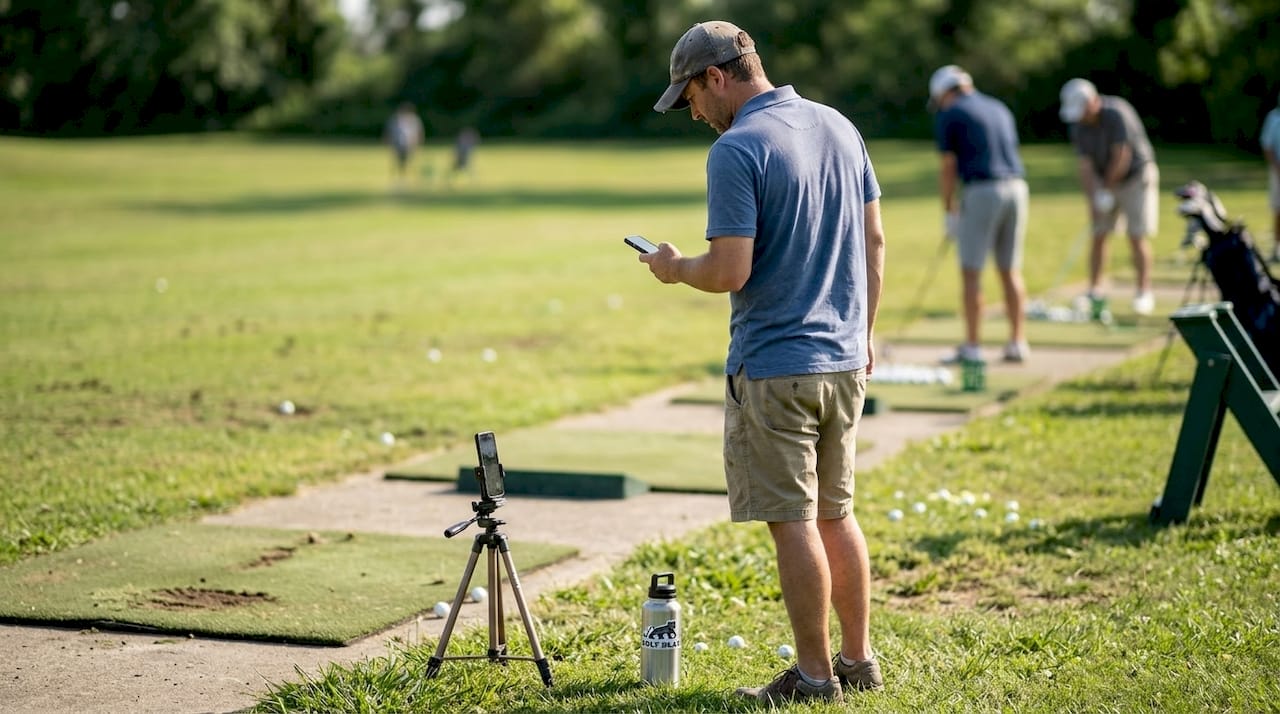
Smartphones with slow-motion video are widely used by top instructors, and for good reason. Modern phones shoot at 240 frames per second in slow motion, which is more than enough to see every detail of your swing. Pair that with a basic tripod or a portable phone stand, and you’re ready to go.

Here are the three most useful recording angles and what each one reveals:
| Camera angle | Position | Best for analyzing |
|---|---|---|
| Down-the-line | Behind the golfer, aligned with the ball and target | Club path, shaft plane, spine tilt |
| Face-on | Perpendicular to the target line, level with the hands | Weight shift, hip turn, head position |
| Rear angle | Behind the golfer, facing the target | Shoulder turn, follow-through, balance |
Here’s a quick list of do’s and don’ts to make sure your footage is actually useful:
- Do position the camera at hip height for face-on and down-the-line shots
- Do film in natural light or well-lit conditions so the footage is clear
- Do record multiple swings in a row to spot patterns
- Don’t zoom in with your phone camera. Zoom distorts angles and makes analysis unreliable
- Don’t film from too far away. You want the full body in frame, not just the upper half
- Don’t rely on a single angle. Two angles give you a much fuller picture
For more structured guidance on building your skills with the right tools, the golf learning center at Golf Blab is a great place to explore additional resources.
Pro Tip: Always film in good light and avoid using your phone’s digital zoom. Natural angles give you accurate feedback. Zoom changes perspective in ways that make your swing look different than it really is.
Turning footage into feedback: Learning and improving faster
You’ve collected and reviewed your swing footage. Now let’s translate those insights into real game improvement.
Golfers who reviewed weekly swing videos reported measurable handicap improvement over time, and the process doesn’t have to be complicated. Here’s how to turn what you see into what you do on the range:
- Identify one flaw per session. Trying to fix everything at once is a fast path to frustration. Pick the most glaring issue and focus there.
- Create a specific practice drill that targets that flaw. If your weight is staying back, do slow-motion impact drills with a focus on front foot pressure.
- Record again after your practice session. Did the flaw improve? Stay the same? Get worse? The video tells you.
- Build a simple video library. Save footage from each session so you can compare month to month. Seeing your own progress is genuinely motivating.
- Share footage with a coach or trusted playing partner. Fresh eyes catch things you’ll miss when you’re too close to your own swing.
Side-by-side comparison is one of the most powerful tools available. Many free apps let you load two videos next to each other so you can see your swing from two weeks ago versus today. That kind of visual progress tracking keeps you honest and keeps you motivated.
“Record every session, not just the ones where something feels off. Consistency in recording is what reveals the patterns that actually matter.” — Golf instructor perspective on building a self-coaching habit
Avoid these common mistakes when self-analyzing your footage:
- Focusing only on the bad swings. Your good swings teach you just as much.
- Changing too many things at once based on a single video review
- Ignoring the setup. Most swing flaws are born before the club ever moves
- Quitting after one session. Improvement with video review is cumulative, not instant
If you want a structured path forward, the swing like a pro lessons at Golf Blab give you a framework to apply what you’re seeing in your videos. And if you want to master every type of golf shot, understanding your swing mechanics through footage is the foundation everything else builds on.
A fresh perspective: The hidden value in recording every swing
Here’s something most golfers get backwards. They pull out the camera when something feels wrong, record a few swings, find the problem, fix it, and then put the camera away. That’s treating video like a fire extinguisher instead of a smoke detector.
The golfers who improve the fastest are the ones who record consistently, even when things feel great. Why? Because your best swings reveal patterns just as clearly as your worst ones. When you watch yourself hitting it well, you start to understand what right actually looks like for your body, your tempo, and your natural tendencies.
There’s also a confidence angle that nobody talks about. Watching yourself make a clean, powerful swing is genuinely motivating. It builds a mental image of what you’re capable of, and that image matters on the course when the pressure is on.
Visit the golf learning tips section at Golf Blab to build a consistent review habit alongside structured instruction. Over time, you develop a kind of pattern recognition that makes you your own best coach. That’s a skill worth far more than any single swing fix.
Ready to take your golf improvement to the next level?
Recording your swing is the starting point. What you do with that footage determines how fast you improve.

At Golf Blab, we’ve built a full ecosystem to help you go from footage to real results. The Swing Like a Pro program gives you a structured challenge to apply everything you’ve learned about swing analysis in a guided, motivating format. While you’re building your game, don’t overlook the details that set serious golfers apart. Our golf shaft labels keep your equipment organized and looking sharp. And for ongoing lessons, drills, and strategy content, the golf learning resources hub has everything you need to keep moving forward.
Frequently asked questions
What are the best camera angles for recording my golf swing?
The best angles are down-the-line, face-on, and rear. Each reveals different mechanics, and camera angle is critical for getting useful feedback from your swing analysis.
How often should I record my golf swing?
Record every practice session if you can, or at minimum every few weeks. Consistent recording leads to measurable progress by helping you spot trends before they become habits.
Do professional golfers use video analysis regularly?
Absolutely. Virtually every tour-level player and top instructor relies on frequent video review. Tour pros depend on slow-motion footage for ongoing technical refinement, not just when something goes wrong.
Can I improve on my own just by recording my swing?
Yes, self-recording combined with a structured checklist can lead to real improvement. Amateurs can improve through self-review, especially when they know what checkpoints to look for and track changes over time.