
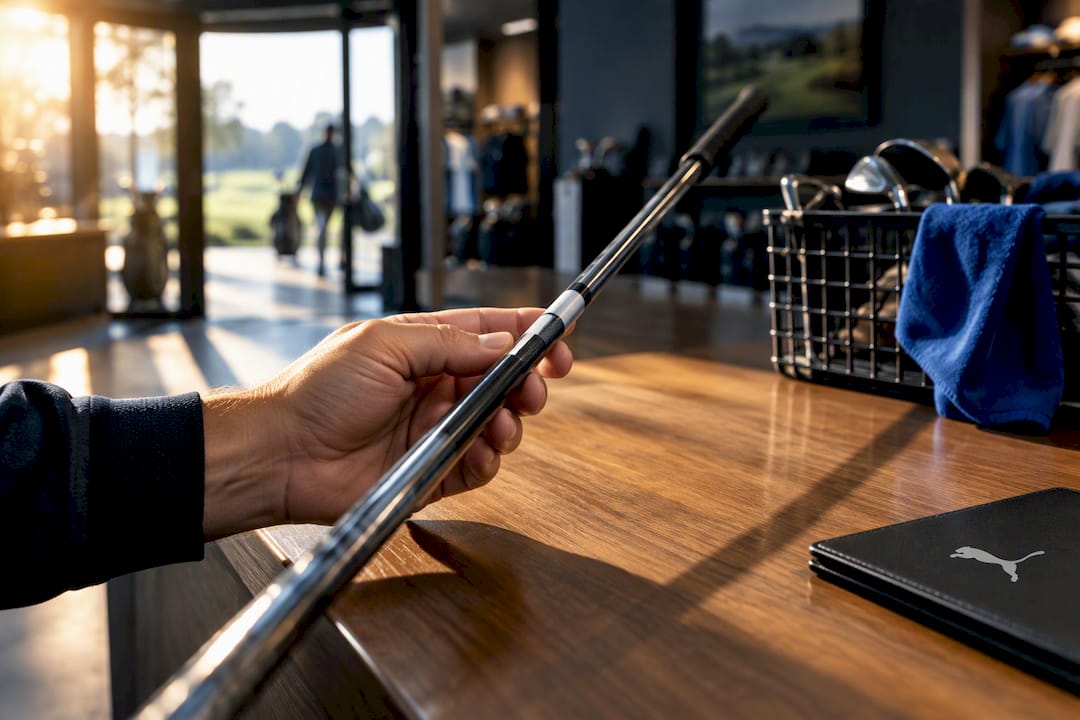
The fastest way to get a lost golf club back is a waterproof shaft label placed just below the grip, listing your name and phone number or a QR return link. Label your wedges and putter first, since they leave the bag most often, and pair the labels with a bag tracker for full coverage. Keep any attachment identification only, never performance related, to stay clear of USGA scrutiny during competition.
TL;DR:
- Labeling wedges and putters with waterproof vinyl tags and a phone number allows quick police response, often returning clubs within hours.
- Applying labels correctly involves cleaning the shaft, positioning just below the grip, pressing out air bubbles, and letting the adhesive cure overnight for durability.
- Prioritize labeling high-loss clubs first, mainly wedges and putters, then higher-value irons or hybrids, and consider minimal labeling on woods to avoid competition issues.
- USGA rules permit temporary labels as long as they do not emit light, vibrate, or serve additional functions, ensuring legal compliance during sanctioned play.
- Replacing faded or peeling labels before each round and keeping a travel-ready inventory of clubs increases chances of early retrieval and minimizes loss risks.
Table of Contents
- Why Identification Labels and Simple Trackers Actually Bring Clubs Home
- How to Mark a Golf Club So It Gets Returned
- Which Clubs Deserve a Label First
- What USGA Rules Say About Identification Marks
- Keeping Labels Readable Through Rain, Rounds, and Travel
- How to Register a Lost Club With a Course’s Lost and Found
- What Actually Happens When You Report a Lost Club on Course
- Tools and Services That Help You Track Lost Golf Gear
- What to Do in the First Hour After Losing a Club
- Why Recovering a Lost Club Is Harder Than It Should Be
- How Long Does It Take to Get a Lost Club Back?
- Why Style-Forward Labels Beat Generic Stickers
- Protect Your Set Before the Next Round Costs You a Club
- Sources
- FAQ
Why Identification Labels and Simple Trackers Actually Bring Clubs Home
Most people who find an abandoned wedge near the fifth green do not go hunting for a lost and found office. They glance at the shaft, and if a name and number are staring back at them, they call or hand the club to the pro shop attendant on their way past. That single moment of low friction decides whether your club comes home tonight or disappears into a cart barn forever.
The tradeoff worth understanding: a printed phone number gets the fastest response because anyone can dial it without an app or a second thought. A QR code that links to a private return form protects your personal information but adds a step, since the finder needs a smartphone camera and a reason to bother scanning it. Practical labeling guides recommend placing that information right below the grip, exactly where a curious finder’s eyes land first.
Bag trackers, the AirTag-style devices clipped to a strap or zipper pocket, solve a different problem entirely. They help you locate an entire bag left behind at a bag drop or a rental cart, but they do nothing for the single 8-iron you’re left leaning against a bunker rake. Think of labels and trackers as two separate insurance policies:
- Shaft labels protect individual clubs against the most common loss, a wedge or putter set down and forgotten.
- Bag trackers protect the whole set against the rarer but costlier loss of an entire bag.
- QR codes trade a little speed for privacy, useful if you would rather not print your number on a shaft in plain sight.
Pro Tip: A label with just a first name and number beats a full return address every time. Finders want to act fast, not read a paragraph.
How to Mark a Golf Club So It Gets Returned
Preparing a club for identification takes about ten minutes once you have the right materials on hand. Skip a step and you risk a label that peels off in the first wet round, which defeats the entire point.
Start by gathering what you need:
- Waterproof vinyl labels with your name and phone number, or a QR code linking to a return page.
- A clear protective cover to shield the label from grip friction and club-to-club contact in the bag.
- Rubbing alcohol and a lint-free cloth to strip oil and grip residue off the shaft before application.
- A flat, well-lit surface so you can align the label without wrinkles or trapped air.
Once you have your materials, follow this sequence:
- Wipe the shaft section just below the grip with alcohol and let it dry completely.
- Position the label so its top edge sits below the grip cap, never overlapping the grip itself.
- Press from the center outward, working air bubbles toward the edges rather than trapping them underneath.
- Smooth every edge firmly with your thumb, paying extra attention to the seam that meets the shaft’s curve.
- Let the adhesive cure for at least a few hours, ideally overnight, before your next round.
This sequence follows the same logic OnlineLabels recommends for durable application: clean, center, press outward, then let the bond set before stress-testing it on the course.
A few cautions matter as much as the steps themselves. Never place a label inside the actual grip zone, since sweat and hand pressure will lift it within a round. Avoid any label design that protrudes from the shaft or creates a raised edge, since an official could question whether it functions as an alignment aid. After your first eighteen holes with a freshly applied label, check the corners for lifting. Catching a loose edge early saves you from reapplying the whole thing later.

Which Clubs Deserve a Label First
Not every club in your bag carries equal risk. Wedges and putters get set down constantly, whether it is a bunker rake moment or a quick tap-in, and they are the clubs most often left behind entirely. Practical guides point to this pattern consistently: separation happens near greens, not off the tee.
Prioritize labeling in this order:
- Wedges and putter first. These leave your hands most often during a round and have the highest separation risk.
- Hybrids and higher-value irons next. They rarely get set down mid-hole, but replacement cost makes them worth the extra label.
- Driver and fairway woods last, if at all, since they typically stay clipped in the bag between shots.
Your wording depends on what you value more. If privacy matters most, use initials paired with a small QR code that routes to a return form without broadcasting your number. If speed matters most, go with a first name, mobile number, and a short “Reward if found” line. That line does not need a dollar figure attached to work, since simply signaling a reward tends to nudge an honest finder toward acting rather than shrugging.
What USGA Rules Say About Identification Marks
Competitive golfers understandably worry that any sticker or attachment could draw a rules official’s attention. The good news: identification is explicitly addressed, and the guidance is more permissive than most players assume.
Temporary, non-permanent identification decals on the shaft or club head are generally acceptable, and electronic devices may carry owner contact or inventory information, as long as the device does not vibrate, emit light or sound, or serve any additional function.
That is the core standard from the USGA’s equipment rules interpretations, and it draws a clean line. A flat vinyl label with your name and number stays well inside the boundary. Trouble starts when an attachment does something beyond identification, whether that is a raised edge that could double as an alignment reference or an electronic device with extra functions built in.
The broader Rules of Golf also restrict equipment that provides artificial help during a stroke, so any identification piece that could be read as a targeting aid risks a conversation with an official you would rather not have. If you are stepping into a sanctioned event and want zero ambiguity, keep your label discreet, flat, and clearly non-functional, or peel it off before you tee it up. When in doubt, a quick check against the current Rules of Golf beats guessing on the first tee.
Keeping Labels Readable Through Rain, Rounds, and Travel
A label that fades after three rounds is worse than no label at all, since it gives you false confidence right up until the moment you actually need it. Material choice determines almost everything here.
Look for labels rated waterproof and UV-resistant, since sun exposure degrades cheap adhesive and ink faster than most golfers expect. A clear protective sleeve over the label adds real life to shafts that see heavy grip friction, particularly on clubs you reg rip often.
- Inspect every label after a round, not just when you remember to.
- Reapply or replace the moment an edge starts to lift, rather than layering a second piece of tape over it.
- Never stack tape on top of an existing label, since trapped moisture underneath speeds up peeling rather than preventing it.
- Add a bag tag and an external tracker for travel days, when clubs face baggage handlers and rental carts instead of just fairways.
Pro Tip: Keep a spare label or two in your golf bag’s zipper pocket. Reapplying on the course beats discovering a peeled label after your putter has already gone missing.
For a deeper look at material choices that survive an entire season, Golf Blab’s guide on making labels last four seasons breaks down which adhesives and coatings hold up best against sun and sweat.
How to Register a Lost Club With a Course’s Lost and Found
Most golf courses run some version of a lost and found, though the sophistication varies wildly from a shoebox behind the pro shop counter to a logged digital system. Start by calling the course directly, ideally the same day, and ask specifically for the pro shop or starter, since that is where wandering equipment typically lands first.
Describe the club precisely: brand, model, shaft flex if you know it, and any distinguishing marks, including your label if it was still attached. Courses that see frequent lost equipment often keep a simple written log, and giving a detailed description moves your item to the top of that list rather than getting lumped in with generic descriptions.
If the course has an online contact form or a Facebook page, use it as a backup to your phone call. A written record gives staff something to reference on their next shift, especially if the person who answered your call was not the one who logged the item.
Some higher-traffic clubs and resorts route lost items through a centralized regional lost and found service rather than handling it in-house. Ask directly whether that is the case, since it changes where your inquiry actually needs to go. Persistence matters here more than most golfers expect. A follow-up call two or three days later, after staff has had time to sort through what came in during that stretch, often surfaces items that got missed on the first pass.
What Actually Happens When You Report a Lost Club on Course
Reporting a lost club well starts with timing. Report it the same day, ideally before you have even left the parking lot, since staff turnover between shifts means information gets lost the longer you wait.
Give the starter or pro shop attendant the hole number where you last remember using the club, not just a vague “somewhere on the back nine.” Course staff often send a cart out to sweep specific greens or tee boxes during slow stretches, and a precise location dramatically improves the odds someone actually looks in the right spot.
Most courses follow a similar internal flow once you report a loss:
- Staff logs your contact information alongside a description of the club.
- If a cart or ranger is available, they check the reported hole area, particularly around greens and bunkers where wedges commonly get left.
- Found items get stored, typically behind the pro shop counter or in a marked bin, until someone claims them or a set period passes.
- Some clubs will call you proactively if a labeled club turns up, which is exactly why a readable label matters so much at this stage.
Courses without a formal system still tend to have an informal one, usually the head pro or a longtime staff member who simply remembers what came through. Ask that person directly if you sense the front desk process is thin. A club with your name and number visible on the shaft removes the guesswork from every step in this chain, since staff do not need to cross-reference anything. They just dial the number.
Tools and Services That Help You Track Lost Golf Gear
Beyond a shaft label, a small layer of technology can close gaps that labeling alone cannot cover. Bag-level trackers, the same AirTag-style devices golfers clip inside a pocket or attach to a strap, use Bluetooth and crowd-sourced location networks to help you find a bag left in a cart barn, a clubhouse corner, or a rideshare trunk. They will not tell you which specific club fell out of a side pocket on the ninth fairway, but they solve the higher-stakes problem of an entire bag going missing.

Some courses now use digital lost and found logging tools internally, letting staff photograph and catalog items as they come in rather than relying on a handwritten list. If a course mentions this kind of system when you call, ask whether they can search it by club type or brand, since that speeds up matching your description to what is actually sitting in their storage.
For golfers who travel frequently to different courses, a simple habit works better than any app: keep a phone note with your set’s makeup, including brand, model, and shaft specs for each club. If something goes missing, you can describe it accurately to any course staff member on the first call instead of fumbling through memory. Combine that habit with visible shaft labels and a bag tracker, and you have built a layered system that covers the three most common ways golfers lose equipment: an individual club left near a green, a full bag misplaced during transport, and a club that separates from the bag without you noticing until you are three holes further along.
What to Do in the First Hour After Losing a Club
The first sixty minutes after you notice a club missing matter more than anything you do afterward. Retrace your last few holes mentally and identify the specific spot where you last definitely had the club in hand, whether that was a bunker shot, a chip near the green, or a cart stop.
Call the course immediately if you are still on property or have just left. Staff can often send a ranger to check the area before another group plays through and either finds it themselves or, less fortunately, moves it out of sight without reporting it.
If you are already off the course, call anyway. Describe the hole, the approximate time, and the club itself in detail. Follow that call with a written note through any online contact form the course offers, since that creates a second record independent of whoever answered the phone.
Check your own cart and bag pockets before assuming the club is truly gone. It sounds obvious, but a surprising number of “lost” clubs turn out to be tucked into an unfamiliar pocket or left in a cart that has not yet been returned to the barn.
If your club carries a visible label with your name and number, mention that detail explicitly when you call. Staff will know exactly what to look for, and if a fellow golfer already found it, your number is likely already ringing.
Why Recovering a Lost Club Is Harder Than It Should Be
The single biggest obstacle to recovering a lost club is simple: most clubs carry no identifying information at all, so a finder has no way to return them even if they want to. A club with no name, no number, and no distinguishing mark becomes an anonymous object the moment it separates from your bag, and anonymous objects tend to stay lost.
Timing works against you too. The longer a club sits unclaimed, the more likely it gets picked up by another golfer, moved by course maintenance, or swept into a general lost and found bin where it loses any connection to the specific hole or time you lost it.
Course turnover adds another layer of difficulty. Staff shifts change, and the person who answered your call in the morning may not be the one sorting through items that evening. This is exactly why a follow-up call a few days later, rather than a single call and moving on, catches items that slipped through the first pass.
A few practical habits reduce these friction points:
- Label your highest-risk clubs, wedges and putter especially, before this ever becomes a problem.
- Call the same day and follow up within the week if you have not heard back.
- Ask specifically whether the course routes items through a regional lost and found network, since that changes where your club might actually be sitting.
- Keep a mental or written inventory of your set so you can describe a missing club precisely rather than generically.
None of these habits guarantee a return, but they stack the odds meaningfully in your favor compared to doing nothing and hoping.
How Long Does It Take to Get a Lost Club Back?
Timelines vary widely depending on whether your club carries identification. A labeled club with a visible phone number can come back within hours, sometimes before you have even finished your round, since a finder calls immediately rather than turning it in and walking away.
An unlabeled club follows a slower path. It typically sits in a course’s lost and found for days or weeks while staff wait for someone to claim it, and without any way to identify the owner, that claim depends entirely on you remembering which course and roughly when you lost it. Many unlabeled clubs never get claimed simply because the owner assumes it is gone and stops looking.
Persistence shortens the gap either way. A follow-up call a few days after your initial report catches items logged after a shift change, and courses that see steady traffic through their lost and found often need that extra nudge before a match gets made. The practical takeaway is straightforward: labeling turns a multi-week uncertain wait into a same-day phone call, which is the entire reason identification matters more than any other single step in this process.
Why Style-Forward Labels Beat Generic Stickers
Michael Marini has spent years studying how golfers protect and personalize their equipment, and the pattern is consistent: golfers skip labeling not because they doubt it works, but because generic options feel like an afterthought rather than something they want on a club they care about. Golf Blab built its personalized labels around that gap, pairing durable, competition-safe materials with design options golfers actually want to display, backed by partnerships with pros like LPGA’s Mariel Galdiano. A label that looks good is a label people actually apply and maintain.
— Michael Marini
Protect Your Set Before the Next Round Costs You a Club
Golf Blab’s Custom Golf Club Labels give you the exact setup this article recommends: waterproof, competition-safe identification you can order in the ink color and style that matches your bag, priced at $29.99 one-off. If the swing habits that keep leaving clubs behind, rushed setups, sloppy transitions between holes, are part of the problem, Play Golf with a Tour Pro tackles that directly for $600 one-off per person, pairing you with professional instruction that tightens the routines most likely to cause a club to go missing in the first place. Buying labels for a golfing partner or gifting a lesson works just as well through a Golf Blab E-Gift Card at $25 one-off. Head to the Golf Blab shop to order your labels today and get ahead of the next round before it costs you a wedge.
Sources
- USGA: Equipment rules — Part 2 (Rule 5) interpretations
- Identification labels for golf clubs — TopGolfE (practical guide)
- Own the course with personalised golf club labels — OnlineLabels article
FAQ
What Information Should a Lost Golf Club Return Label Include?
A first name, a mobile phone number, and an optional “Reward if found” line work best for fast returns. If privacy matters more to you, use initials with a small QR code linking to a return form instead of a visible number.
Where Should I Place My Golf Club Identification Label?
Place it on the shaft just below the grip, never overlapping the grip itself. This spot stays visible to anyone who picks up the club and rarely interferes with your swing or grip pressure.
Are Identification Labels Allowed Under USGA Rules?
Yes, temporary identification decals are generally permitted as long as they do not vibrate, emit light or sound, or serve any function beyond identification, according to USGA equipment rules interpretations. Avoid raised or protruding designs that could be mistaken for alignment aids in competition.
How Do I Report a Lost Club to a Golf Course?
Call the course’s pro shop directly the same day, describe the club and the hole where you last had it, and ask whether they log items through an online form as backup. Follow up within a few days if you have not heard back, since staff shifts change and items can get logged after your first call.
How Much Do Custom Golf Club Labels Cost?
Golf Blab’s Custom Golf Club Labels are priced at $29.99 one-off, covering personalized, waterproof identification designed to hold up through regular play. Check the shop page for current design and ink color options.