Posted on

The Role of Golf Simulators in Training: A Complete Guide

Man practicing golf swing inside golf simulator room


TL;DR:

  • Golf simulators provide objective data to improve skills and support purposeful, structured practice. Combining simulator use with professional coaching accelerates progress by diagnosing and correcting faults more effectively. They are most effective when integrated with real course practice, especially for short game skills and adapting to on-course conditions.

Golf simulators are defined as combined hardware and software systems that capture real-time ball flight and swing data, giving golfers immediate, measurable feedback on every shot. The role of golf simulators in training has grown from a novelty into a cornerstone of modern instruction, offering metrics like ball speed, launch angle, spin rate, and shot dispersion that were once available only to touring professionals. Whether you are a weekend player or a competitive amateur, understanding how to use this technology with purpose and proper coaching separates genuine improvement from expensive entertainment.

What specific benefits do golf simulators offer for improving golf skills?

Golf simulators accelerate skill development by replacing guesswork with objective data. Every swing produces a report: carry distance, club path, face angle, and shot pattern. That immediate feedback loop is what makes indoor golf training so powerful for golfers who want to improve faster than traditional range sessions allow.

Launch monitor data speeds up distance control improvements by up to 23% compared to practice without objective feedback. That number matters because distance control is the single biggest variable separating consistent scorers from erratic ones. When you know your 7-iron carries 155 yards under controlled conditions, you make smarter club selections on the course.

Simulators also support purposeful, structured practice rather than aimless ball-hitting. Virtual rounds are engaging but do not translate to meaningful improvement without deliberate practice structure. The golfers who improve fastest use simulators to run focused 40–60 minute sessions with defined technical objectives, not to play simulated rounds for entertainment.

Here is what a productive simulator session targets:

  • Distance control: Hit 10 shots with each club and track carry dispersion to establish a reliable yardage baseline.
  • Shot shape: Work on controlled draws or fades by monitoring face-to-path relationships in real time.
  • Consistency tracking: Compare standard deviation in launch angle across a session to measure swing repeatability.
  • Pressure simulation: Set a target and count how many consecutive shots land within a defined dispersion circle.
  • Video review: Use the consistent indoor lighting to analyze swing plane and head movement frame by frame.

Pro Tip: Set one measurable goal before every simulator session. “Hit 8 of 10 drives within a 30-yard dispersion window” beats “work on my driver” every time.

Confidence is a quieter benefit that golfers often overlook. Repeated, controlled reps in a pressure-free environment build the motor memory that holds up under real course conditions. The consistent indoor environment also improves swing video feedback quality by removing outdoor glare and varying light conditions that make video analysis unreliable on a range.

Infographic comparing golf simulator and on-course practice advantages

How do golf simulators integrate with professional coaching to amplify training outcomes?

Simulators are powerful mirrors, but mirrors do not diagnose. A coach interprets the data, identifies the root cause of a fault, and prescribes a correction. Without that interpretive layer, golfers risk practicing their mistakes at higher volume and higher speed.

Golf coach discussing simulator data with golfer

Golfers who combine coach-guided instruction with simulator data improve 38% more over eight weeks than those who practice on simulators alone. That gap exists because a coach reads club path, face angle, and swing video together to find the source of a problem, not just its symptom. A golfer who sees a pull-draw on the screen might tighten their grip when the real fix is a more neutral hip rotation.

The most effective coaching and simulator integration follows a clear structure:

  1. Baseline lesson: Coach establishes current swing metrics and identifies the one or two highest-priority faults.
  2. Targeted solo sessions: Golfer practices the prescribed correction on the simulator, tracking the specific metric the coach flagged.
  3. Progress check: Coach reviews session data and video at the next lesson to confirm improvement or adjust the prescription.
  4. Metric goal setting: Each session has a defined target, such as reducing club path deviation from 5 degrees to 2 degrees over four weeks.
  5. Reassessment: Every four to six weeks, coach and golfer review the full data set to set new objectives.

“Simulator technology gives us a language for the golf swing that both coach and student can read together. The data removes the argument about what happened and lets us focus entirely on why it happened and how to fix it. That shift alone cuts the time to improvement in half.”

Technology in golf training works best as a shared diagnostic tool, not a solo experiment. Golfers who understand coaching and technology together progress faster because they apply corrections with context, not just repetition. For golfers unsure whether to prioritize lessons or solo practice, the answer is clear: lessons first, then purposeful simulator sessions between appointments.

What are the limitations of golf simulators compared to on-course practice?

Simulators excel at full swing data collection. They fall short in three areas that matter enormously for scoring: uneven lies, real course pressure, and short game feel. Recognizing these gaps is not a reason to avoid simulators. It is a reason to build a training plan that addresses them deliberately.

Simulators cannot replicate on-course variables like uneven lies, wind, and psychological pressure. A 150-yard shot from a flat mat bears little resemblance to the same distance from a downhill lie with water left. The motor patterns are different, and only outdoor practice builds the adaptability that scoring requires.

The short game gap is the most significant limitation. Simulators are less effective for short game feel and putting because the surface and tactile feedback differ from real turf and greens. Chipping and putting are feel-based skills that require the feedback of real grass, slope, and grain. An indoor mat simply cannot replicate that.

Training element Simulator strength On-course practice strength
Full swing data Excellent: precise metrics every shot Good: no real-time data
Short game feel Limited: flat mat, no turf variation Excellent: real lies, slopes, grain
Pressure simulation Moderate: game modes help High: real consequences, real stakes
Weather adaptability High: year-round, any condition Low: weather dependent
Swing video analysis Excellent: consistent lighting Moderate: glare and angle issues

Best practice directs golfers to spend at least 50% of practice time on the short game, given that 60% of strokes occur within 100 yards of the hole. That statistic reframes how most golfers should allocate their time. If you spend three hours a week practicing, at least 90 minutes belongs on a real chipping green and putting surface.

Pro Tip: After every simulator block session, schedule a random practice round on the course. Block practice builds the pattern; random play tests whether it holds under real conditions.

How should golfers at different skill levels structure their simulator training?

The right simulator training structure depends on where you are in your development. Beginners, intermediate players, and advanced golfers each need a different balance of lessons, solo sessions, and on-course play to get the most from the technology.

Beginners

  • Start with at least two or three instructor-led lessons before any solo simulator practice.
  • Focus sessions on one fundamental at a time: grip, stance, or takeaway.
  • Limit solo sessions to 30 minutes to avoid ingraining early faults.
  • Use golf performance indicators to track baseline metrics from the first session onward.
  • Pair every simulator session with short game practice on real turf.

Intermediate golfers

  • Schedule one lesson every two to three weeks with multiple focused simulator sessions between appointments.
  • Use session data to confirm that prescribed corrections are holding across multiple practice blocks.
  • Introduce pressure drills: set a target score for a simulated nine holes and track performance over time.
  • Begin tracking golf swing analysis metrics like club path and face angle to identify patterns across sessions.

Advanced and competitive golfers

  • Integrate simulator sessions into a detailed coaching plan with specific metric goals for each four to six week block.
  • Use simulators to test equipment changes under controlled conditions before committing to new clubs.
  • Treat simulator data as a performance log, reviewing trends across months rather than individual sessions.
Skill level Recommended lesson frequency Solo simulator sessions per week Short game practice allocation
Beginner Weekly 1–2 (30 min each) 60% of total practice time
Intermediate Every 2–3 weeks 2–3 (45–60 min each) 50% of total practice time
Advanced Monthly or as needed 3–4 (60 min each) 40–50% of total practice time

Setting clear, measurable goals for each session is the single most important habit across all skill levels. Without predefined success criteria, simulator practice reinforces existing faults rather than correcting them. Write the goal down before you start. Review the data before you leave.

Key Takeaways

Golf simulators deliver their greatest training value when paired with professional coaching, structured practice goals, and regular on-course play.

Point Details
Coaching multiplies simulator gains Golfers improve 38% more in eight weeks when combining coaching with simulator use versus simulator practice alone.
Set goals before every session Defined technical objectives prevent simulators from reinforcing existing swing faults.
Short game needs real turf Spend at least 50% of practice time on real chipping and putting surfaces, where 60% of strokes occur.
Simulators excel at full swing data Metrics like club path, face angle, and launch angle are most accurately captured indoors with consistent lighting.
Structure varies by skill level Beginners need instructor-led sessions first; advanced golfers use simulators as part of a detailed coaching plan with metric goals.

Why I think most golfers are using simulators wrong

After watching golfers at every level work through simulator sessions, one pattern stands out clearly. Most golfers treat the simulator like a driving range with a screen. They hit ball after ball, enjoy the numbers, and leave without a plan. The technology is doing its job. The golfer is not.

The data a simulator produces is only as useful as the framework you bring to interpret it. Club path deviation of 4 degrees sounds meaningful, but without a coach telling you whether that number reflects a grip fault, a hip sequencing issue, or a setup problem, it is just a number on a screen. I have seen golfers spend months on simulators and make zero progress because they were practicing their faults with more information than before.

The golfers who genuinely improve treat the simulator as a diagnostic tool, not a practice destination. They arrive with a specific metric target, work through a defined drill sequence, and leave with data they will review with their coach. That discipline is rare, and it is exactly what separates the golfers who improve from those who plateau.

Simulator technology will keep getting better. The realism of course rendering, the accuracy of ball tracking, and the depth of swing analysis will all improve. But the on-course experience, the uneven lie, the wind in your face, the pressure of a real putt, will always be irreplaceable. The wisest approach is to use simulators for what they do best and get outside for the rest. If you are curious about self-taught versus instructor-led paths, the answer almost always points toward coaching as the accelerant.

— Michael Marini

How Golf Blab supports your training beyond the simulator

Golf Blab brings together the tools, resources, and professional connections that complement everything a simulator session builds. When your swing data points to a specific fault, Golf Blab’s instructional content helps you understand the correction in plain language. For golfers ready to take their practice to the next level, the Play Golf with a Tour Pro experience pairs real-world course play with professional guidance that no simulator can replicate. And for golfers who want to bring personal identity to every practice session, custom golf club labels from Golf Blab add a distinctive touch to the clubs you are working hard to master. Your practice deserves both precision and personality.

FAQ

What does a golf simulator actually measure?

Golf simulators measure ball flight data including ball speed, launch angle, spin rate, and carry distance, as well as swing data like club path, face angle, and swing plane. These metrics give golfers and coaches an objective picture of every shot.

Can a golf simulator replace real course practice?

Simulators cannot replace on-course practice because they do not replicate uneven lies, wind, or real pressure. They work best as a data-driven training tool used alongside regular outdoor play and short game practice on real turf.

How often should I use a golf simulator to improve?

Intermediate golfers benefit from two to three focused simulator sessions per week, each lasting 45–60 minutes, combined with lessons every two to three weeks. Beginners should start with instructor-led sessions before practicing solo on a simulator.

Do I need a coach to use a golf simulator effectively?

Coaching is not required, but it significantly improves results. Golfers who combine coaching with simulator use improve 38% more over eight weeks than those using simulators alone, because coaches interpret data and correct root causes rather than symptoms.

What is the biggest mistake golfers make on simulators?

The biggest mistake is practicing without a defined goal. Without clear success criteria, simulator sessions reinforce existing swing faults instead of correcting them. Set one measurable technical objective before every session.

Posted on

Types of Golf Instructors: Find Your Perfect Coach

Golf instructor coaching student outdoors


TL;DR:

  • Choosing a golf instructor depends on your skill level and learning style, whether PGA-certified or specialized non-PGA. Empathy and good communication are more important than their playing record, and a trial lesson helps assess compatibility. Matching your needs with an instructor’s expertise leads to better improvement and enjoyment of the game.

Golf instructors fall into two primary categories: PGA-certified professionals and non-PGA specialists, each shaped by distinct training philosophies and teaching methods. Understanding the types of golf instructors available to you is the single most important step before booking your first lesson. PGA certification demands a rigorous three-year program covering coaching, equipment fitting, and business management, while some non-PGA certifications can be completed in as little as four days. That gap in training depth shapes everything from how an instructor diagnoses your swing to how they communicate progress. Matching your learning style and goals to the right coach type accelerates improvement far more than any single drill or tip.

1. PGA-certified golf instructors

PGA-certified professionals represent the most thoroughly trained category of golf coach. Their three-year PGA program covers coaching methodology, equipment technology, business operations, and player development across all skill levels. That breadth means a PGA pro can work with a complete beginner on grip fundamentals and with a scratch player on course management strategy, often in the same week.

Golf coach reviewing written lesson plan

The practical advantages of working with a PGA pro extend well beyond swing mechanics. They are trained in club fitting, meaning they can identify whether your equipment is limiting your progress before you spend another hour on the range. They also build structured development plans with measurable milestones, so you leave each session knowing exactly what to practice and why.

Key strengths of PGA-certified instructors include:

  • Holistic player development from beginner to advanced levels
  • Club fitting knowledge integrated into lesson plans
  • Structured, measurable progress tracking
  • Broad communication skills adapted to different learner types

Pro Tip: Ask your PGA pro for a written practice plan after each lesson. Instructors who provide video summaries or written notes give you a reference point that accelerates improvement between sessions.

2. Non-PGA golf instructors

Non-PGA instructors occupy a wide and genuinely valuable space in golf coaching. Specialized instructors often dedicate 90–100% of their curriculum to a single methodology, whether that is AimPoint putting, high-speed video swing analysis, or junior player development. That depth of focus can produce faster results for golfers with a specific, well-defined problem.

The trade-off is scope. A non-PGA instructor who specializes in data-driven swing analysis may lack the equipment fitting knowledge or course management perspective that a PGA pro brings. Their certifications also vary widely in rigor, from weekend courses to multi-year apprenticeships under a recognized methodology founder.

Common non-PGA specializations include:

  • AimPoint putting technique and green reading
  • Biomechanics and kinematic sequence analysis
  • Junior and youth player development
  • Short game and wedge play specialization

Pro Tip: Before booking with a non-PGA instructor, ask specifically what certification they hold and who issued it. A methodology-specific credential from a recognized program carries real weight. A weekend certificate from an unknown provider does not.

3. Mechanical instructors: the technical breakdown approach

Mechanical instructors build their teaching around precise technical positions and biomechanical principles. They use terms like hip rotation angle, lag preservation, and shoulder plane because they believe correct positions produce correct ball flight. For analytical golfers who want to understand the “why” behind every movement, this approach feels deeply satisfying.

The risk with purely mechanical instruction is cognitive overload. Good instructors limit students to no more than two key swing thoughts per session. Mechanical coaches who ignore this principle can leave students paralyzed on the course, thinking about positions instead of playing golf. The best mechanical instructors pair technical precision with clear prioritization, giving you one or two changes to own before adding the next layer.

4. Feel-based instructors: the intuitive movement approach

Feel-based instructors teach through sensation, imagery, and natural movement rather than technical positions. They might ask you to imagine throwing a ball toward the target or to feel your weight shift like water moving in a glass. This approach works exceptionally well for golfers who struggle to translate technical language into physical movement.

The strength of feel-based coaching lies in its transferability to the course. When you are standing over a difficult shot under pressure, a feel cue is far more accessible than a mechanical checklist. The limitation is that feel-based instruction can be harder to self-diagnose when something goes wrong, since the feedback loop depends on sensation rather than measurable data.

5. Data-driven instructors: the technology-led approach

Data-driven coaches use tools like TrackMan launch monitors, high-speed video analysis, and force plate technology to measure every aspect of your swing and ball flight. Swing analysis technology removes guesswork from diagnosis, giving both instructor and student objective evidence of what is actually happening versus what it feels like is happening.

This approach suits golfers who are motivated by numbers and want to track progress with precision. An intermediate player who has plateaued often benefits enormously from a single data-driven session that reveals a club path or attack angle issue invisible to the naked eye. The potential downside is that some golfers become so focused on numbers that they lose the feel and flow of natural athletic movement.

Teaching style Best suited for Primary tool
Mechanical Analytical, detail-oriented players Position checkpoints
Feel-based Intuitive, athletic learners Imagery and sensation cues
Data-driven Progress-focused, plateau-breaking players TrackMan, video analysis

6. How to evaluate golf instructor qualities

The most important golf instructor qualities have nothing to do with their own playing handicap. Empathy and emotional intelligence matter more than playing ability when it comes to effective instruction. High-performing players frequently struggle to empathize with the challenges amateurs face, which is why a former tour pro is not automatically a great teacher.

Listening is the defining skill of the best instructors. A coach who talks at you for 45 minutes without asking about your goals, your frustrations, or your practice schedule is not adapting to you. They are delivering a script. The right instructor asks questions first and builds a plan around your answers.

Red flags to watch for during a trial lesson:

  • More than two swing changes introduced in a single session
  • No follow-up plan or practice notes provided
  • Communication style that does not match your learning preference
  • Impatience when you ask clarifying questions

Pro Tip: Treat your first lesson as a golf instructor interview. Ask the instructor how they measure progress, how many swing thoughts they typically give per session, and whether they offer playing lessons. Their answers reveal their philosophy immediately.

7. Playing lesson instructors: on-course coaching specialists

Playing lessons represent one of the most underused formats in golf instruction. On-course instruction addresses course management, pressure situations, and uneven lie adjustments in ways that range sessions simply cannot replicate. Many golfers realize too late that their range swing and their course swing are entirely different animals.

A playing lesson instructor walks the course alongside you, coaching decisions in real time. They observe how you handle a downhill lie, a 150-yard carry over water, or a three-foot putt with a match on the line. That context produces insights that no amount of range work can generate. Intermediate and advanced players gain the most from this format, though beginners benefit from at least one on-course session early in their development.

8. Junior golf instructors: development-focused coaching

Junior golf instructors specialize in age-appropriate, confidence-building coaching that respects the developmental stage of young players. Junior coaching prioritizes fun, motor skill development, and positive reinforcement over technical perfection. A coach who applies adult-level mechanical instruction to a ten-year-old will extinguish enthusiasm faster than any bad shot.

The best junior instructors hold youth-specific credentials and understand child psychology as well as golf mechanics. They use games, competitions, and short-format play to build engagement. Parents should look for instructors who communicate progress in terms of confidence and enjoyment, not just handicap reduction.

9. Matching instructor type to your skill level and goals

The right instructor type changes as your game evolves. Beginners benefit most from PGA-certified pros who can build a sound technical foundation while keeping the experience positive and manageable. Intermediate players who have hit a plateau often gain the most from a data-driven session or a playing lesson that exposes course management gaps.

Advanced and competitive players frequently seek niche specialists, whether that is a short game expert, a putting coach certified in AimPoint, or a biomechanics specialist who works with tour-level athletes. The key is matching the specificity of your problem to the depth of the instructor’s specialization. A generalist is the right starting point. A specialist is the right next step once you know exactly what needs fixing.

Key takeaways

The most effective approach to finding a golf instructor is to match your skill level and learning style to a coach’s specific credentials, teaching philosophy, and communication approach before committing to a series of lessons.

Point Details
Certification depth varies widely PGA training takes three years; some non-PGA certifications take four days.
Teaching style shapes your experience Mechanical, feel-based, and data-driven approaches suit different learner types.
Empathy outranks playing ability Top instructors score higher on emotional intelligence than on their own handicap.
Trial lessons are interviews Use the first session to assess communication, listening, and progress planning.
Specialist vs. generalist Beginners need generalists; advanced players benefit from niche specialists.

What I’ve learned about finding the right golf instructor

The golf world places enormous weight on credentials, and credentials do matter. But the single most common mistake I see golfers make is choosing an instructor based on their playing resume rather than their teaching record. A former tour player who cannot explain a concept three different ways is not a good teacher. A club professional with 20 years of patient, adaptive instruction often is.

The psychological fit between student and instructor is genuinely underrated. Progress requires trust, and trust requires a coach who listens before they speak. I have watched golfers spend years with technically qualified instructors who never once asked what the student actually wanted from their game. That mismatch produces frustration, not improvement.

My honest advice: treat the trial lesson as the most important session you will ever take. Ask hard questions. Notice whether the instructor listens or lectures. Watch whether they give you one clear thing to work on or overwhelm you with a rebuild. The right coach makes you feel capable after the first session, not confused. That feeling is the most reliable indicator of a productive long-term relationship.

— Michael Marini

Golf Blab brings together educational content, professional partnerships, and products designed to complement every stage of your instruction. Whether you are booking your first lesson with a PGA pro or working with a short game specialist, the Swing Like a Pro training tool gives you a structured way to reinforce what you learn between sessions. Golf Blab’s partnership with LPGA professional Mariel Galdiano reflects the same commitment to credible, experience-backed guidance that you should demand from any instructor. For golfers who want to bring personal identity to the course alongside their improving game, custom golf club labels let your equipment reflect the player you are becoming.

FAQ

What are the main types of golf instructors?

Golf instructors fall into two primary categories: PGA-certified professionals and non-PGA specialists. PGA pros complete a three-year training program, while non-PGA instructors typically focus on a specific methodology or niche area.

How do I choose between a mechanical and feel-based instructor?

Analytical golfers who want to understand technical positions tend to thrive with mechanical instructors. Golfers who learn better through imagery and sensation perform better with feel-based coaches.

What golf instructor qualities matter most?

Empathy, listening skills, and the ability to adapt communication to your learning style matter more than playing ability. The best instructors provide clear practice plans and limit each session to two key swing changes.

What should I ask during a golf instructor interview?

Ask how the instructor measures progress, how many swing thoughts they give per session, and whether they offer playing lessons. These questions reveal teaching philosophy faster than any credential check.

Are non-PGA golf instructors worth considering?

Non-PGA instructors are worth considering when you have a specific, well-defined problem that matches their specialization. For foundational development, a PGA-certified professional offers broader expertise and more structured progression.

Posted on

Golf Course Strategy Workflow: A 2026 Manager’s Guide

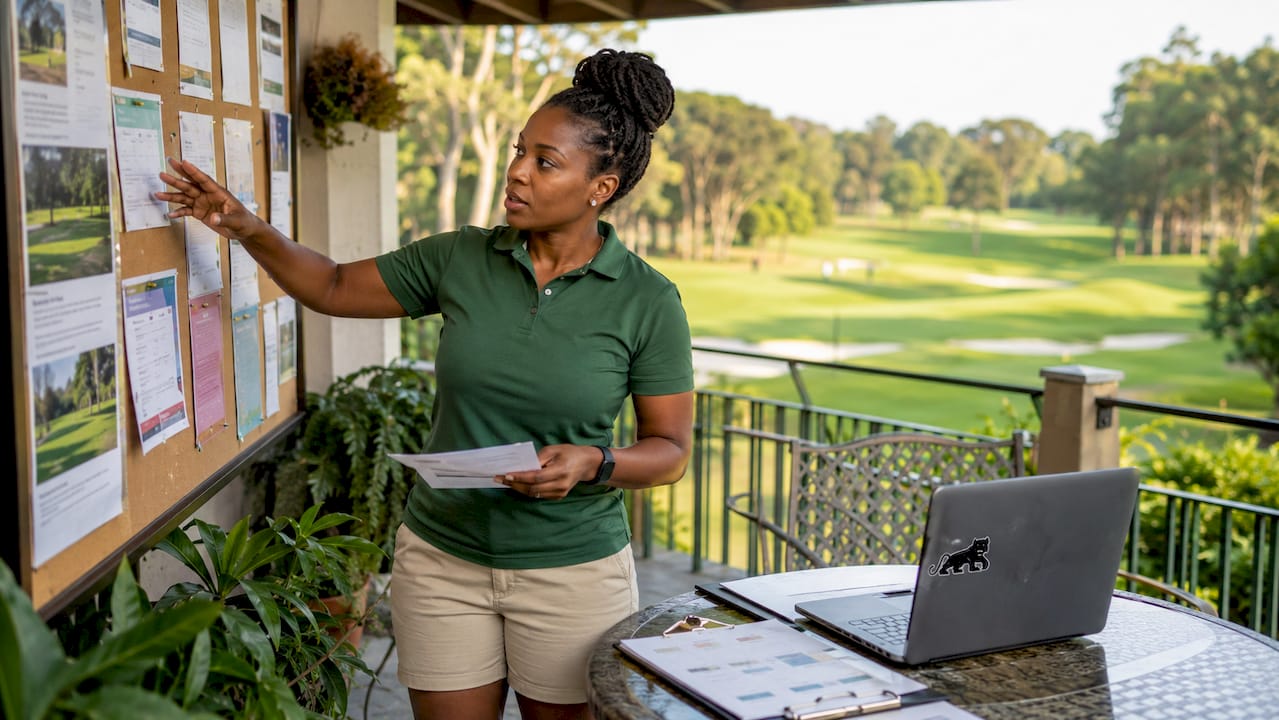
Golf course manager reviewing strategy documents


TL;DR:

  • A golf course strategy workflow combines staff roles, technology tools, and operational decisions to improve pace, service, and revenue. Implementing interconnected components like real-time data, mobile service, and frictionless payments leads to measurable guest satisfaction and efficiency gains. Regular data review and standardized enforcement are essential to maintaining effective, scalable operations across the season.

A golf course strategy workflow is defined as the coordinated system of operational decisions, staff roles, and technology tools that govern pace of play, guest satisfaction, and revenue performance across every round. Without this structure, even well-maintained courses lose revenue to slow play, inconsistent service, and missed pricing opportunities. The most effective workflows integrate five core operational areas: mobile service delivery, self-service options, real-time data access, frictionless payments, and on-the-spot program registrations. Managers who build around these pillars report measurable gains in guest satisfaction and first-tee efficiency. This guide gives you the exact framework to build, execute, and refine that system in 2026.

What are the core components of a golf course strategy workflow?

The foundation of any effective operational plan rests on five workflow categories that reduce friction at every guest touchpoint. Each one addresses a specific failure point that costs courses time, money, or goodwill.

  • Mobile service everywhere. Staff equipped with mobile devices can take orders, process payments, and communicate pace alerts from anywhere on the property. This eliminates the bottleneck at the first tee where guests traditionally wait for service before teeing off.
  • Self-service options. Golfers using a course’s mobile app or kiosk can check in, view their tee time, and browse the pro shop without staff assistance. Self-service reduces front-desk congestion during peak morning windows.
  • Real-time data access. Starters and rangers need live tee sheet visibility, not a printed sheet from 7:00 AM. When staff can see current group positions and spacing gaps, they respond to pace problems before those problems compound.
  • Frictionless payments. Stored payment profiles and tap-to-pay options at the turn reduce the time golfers spend off the course. Every minute saved at the halfway house protects the pace of the groups behind.
  • On-the-spot registrations. Rangers and starters who can sign guests up for tournaments, lessons, or loyalty programs during the round capture revenue that would otherwise be lost. This turns a service interaction into a sales moment without feeling transactional.

Pro Tip: Equip your starters with a tablet loaded with the live tee sheet, payment processing, and event registration. One device replaces three separate workflows and cuts first-tee wait times significantly.

These five components work as a system, not a checklist. Implementing mobile payments without real-time data access, for example, solves one problem while leaving pace management blind. Managers who treat workflow components as interconnected see compounding gains across the season.

Infographic illustrating golf course workflow steps

How can data-driven pace-of-play management be implemented effectively?

Pace of play is a system problem, not a behavior problem. Treating it as the latter produces conflict. Treating it as the former produces results.

A science-based pace strategy requires five components working in sequence:

  1. Tee sheet demand alignment. Space tee times to match the course’s actual throughput capacity. Overselling peak windows creates pace collapses that no ranger can fix after the fact.
  2. Bottleneck hole identification. Most pace problems originate at specific holes, often par-3s, where groups stack behind slower players. Identifying these holes by GPS data lets you target interventions precisely rather than applying blanket rules across the round.
  3. Objective timing checkpoints. Set expected arrival times at holes 6, 9, and 12. When a group misses a checkpoint, the data triggers a ranger response. This removes subjectivity from the enforcement conversation entirely.
  4. GPS-guided ranger workflows. Rangers equipped with GPS dashboards can see exactly which groups are lagging and by how much. Evidence-based ranger interventions outperform subjective enforcement because the ranger arrives with facts, not opinions.
  5. Consistent enforcement standards. Inconsistent enforcement breeds resentment. When every ranger uses the same checkpoint data and the same language, guests accept the process as fair rather than personal.

Proactive pace management that identifies and protects bottlenecks early reduces conflicts and preserves revenue. Flow is a system issue, not a behavior issue. Ranger interventions using objective data early in the round prevent the conflict-heavy late-round management that damages guest relations and rarely recovers lost time.

The measurable benefit of this approach is that it shifts ranger conversations from accusation to observation. A ranger who says “You’re four minutes behind the checkpoint at hole 9” is stating a fact. A ranger who says “You’re playing too slowly” is starting an argument. Objective data protects both the guest relationship and the pace of the field.

Which tools and technology enable a modern golf course strategy workflow?

Classic tee sheet software is a scheduling tool, not an operating system. Treating it as the latter is the single most common technology mistake in golf course management.

Hands holding tablet in golf tech office

Capability Static tee sheet software Integrated dashboard platform
Pricing adjustments Manual, daily updates Automated, demand-triggered
Pace monitoring None Real-time GPS group tracking
Inventory management Manual entry Live adjustments based on bookings
Revenue reporting End-of-day summaries Live KPI dashboards
Decision loop Human-only, reactive Closed-loop with AI-flagged alerts

High-performing golf operations use dashboards that consolidate key performance indicators, enabling dynamic pricing and resource allocation decisions in real time. The result is less discounting and better demand distribution across the day. A course that manually adjusts pricing once per morning leaves revenue on the table every time weather, cancellations, or local events shift demand mid-round.

The most advanced operations use closed-loop workflow models that continuously observe operational signals, flag risks for human review, and record outcomes to improve future automated recommendations. This is not science fiction. Entry-level platforms now offer rule-based automation, while enterprise platforms add AI-backed predictive alerts. The right choice depends on your volume and staff capacity, not on chasing the most sophisticated option available.

Pro Tip: Before purchasing any platform, map your three most expensive operational failures from last season. Choose the tool that directly addresses those failures. A platform that solves problems you don’t have is overhead, not investment.

The practical outcome of integrated technology is reduced micromanagement. When the system flags a pricing opportunity or a pace risk, your managers respond to specific alerts rather than monitoring every variable manually. That shift frees management time for guest relations, staff development, and course improvement decisions that technology cannot make.

What are the best practices to execute and maintain a golf course strategy workflow?

Building the workflow is one task. Sustaining it through a full season is another. The managers who maintain consistent operations follow a structured execution cycle.

  1. Define workflow goals before selecting tools. Identify your top three operational priorities: pace, revenue per round, or guest satisfaction scores. Every tool and process you add should map directly to one of those priorities.
  2. Train staff on mobile service and pace roles simultaneously. A starter who understands pace checkpoints and can process a payment on a tablet is twice as valuable as one trained on only one function. Cross-functional training reduces the number of staff needed during peak windows.
  3. Schedule weekly KPI reviews. Regular metric reviews shift management from reactive firefighting to proactive planning. Review pace data, revenue per tee time, and guest feedback scores every Monday morning before the week’s tee sheet is finalized.
  4. Establish communication protocols for starters and rangers. Define exactly when a starter radios a ranger, what information they share, and what the ranger does with it. Ambiguous communication protocols produce inconsistent enforcement.
  5. Conduct quarterly workflow audits. Pull GPS data, payment processing logs, and guest satisfaction scores together once per quarter. Identify which workflow components are performing and which are creating friction. Adjust before problems become patterns.

Alongside these steps, build feedback loops into daily operations:

  • Debrief starters and rangers after every busy weekend to capture real-time observations.
  • Survey guests at the 90-day mark of the season, not just at year-end.
  • Track which self-service features guests use and which they ignore, then remove friction from the ignored ones.
  • Review golf performance indicators monthly to catch revenue trends before they become revenue losses.

The discipline of regular review separates courses that improve year over year from those that repeat the same seasonal mistakes.

What common challenges arise in golf course workflows and how can they be troubleshooted?

Every course encounters workflow failures. The difference between a well-run operation and a struggling one is how quickly those failures are identified and corrected.

  • Misreading bottleneck holes. Managers often assume the slowest group causes pace problems. GPS data frequently reveals that a specific par-3 or a blind approach shot creates stacking regardless of which group plays it. Fix the hole design or the tee time spacing before blaming the golfer.
  • Subjective enforcement without data. Rangers who rely on personal judgment rather than checkpoint data produce inconsistent results and guest complaints. Standardize enforcement language and tie every intervention to a specific data point.
  • Over-reliance on outdated tee sheet software. A course running pace management and revenue decisions through a basic booking calendar is operating blind. The tee sheet records who is playing. It does not tell you how the round is going or what it should cost.
  • Poor inter-staff communication. When starters and rangers operate without a shared protocol, pace problems fall through the gaps. A group that leaves the first tee late but is never flagged to a ranger will finish 40 minutes behind schedule.
  • Skipping data validation. GPS data and payment logs are only useful if someone reviews them. Courses that collect data but never analyze it gain no operational advantage over courses with no technology at all.

The real value of technology in golf operations comes from combining data outputs with human judgment. Data without review is just storage. The best operators use data to anticipate issues before those issues impact profitability, not to document problems after they occur.

Continuous data validation and iterative adjustments are the practical habits that separate high-performing courses from average ones. Build the review into the weekly schedule, not the annual retreat.

Key Takeaways

A golf course strategy workflow succeeds when it connects real-time data, trained staff, and consistent enforcement standards into a single, repeatable operational system.

Point Details
Five core workflow areas Mobile service, self-service, real-time data, frictionless payments, and on-the-spot registrations reduce friction at every touchpoint.
Pace as a system problem Bottleneck holes and tee sheet spacing cause most pace failures; GPS data and objective checkpoints fix them.
Technology requires human judgment Dashboards and closed-loop platforms improve decisions only when managers review data regularly and act on it.
Execution demands structure Weekly KPI reviews, cross-functional staff training, and quarterly audits sustain workflow performance across a full season.
Troubleshoot with data, not instinct Misidentified bottlenecks and subjective enforcement are the two most common workflow failures, and both are solved by standardized data review.

What I’ve learned about workflow evolution in golf course management

Golf course management spent decades running on institutional memory. The head pro knew which holes backed up on Saturday mornings. The ranger knew which groups needed a nudge. That knowledge lived in people’s heads, and when those people left, the knowledge left with them.

The shift toward data-driven operations is not about replacing that human expertise. It is about making it transferable. When your GPS dashboard shows the same bottleneck pattern that your veteran ranger recognized by instinct, you can train every new ranger to see it too. The knowledge becomes institutional rather than personal.

What I find most compelling about modern workflow design is the closed-loop model. The idea that a system can observe an operational signal, flag it for human review, act on a decision, and then record the outcome to improve the next recommendation is genuinely new in golf management. It mirrors how the best managers already think, but it scales that thinking across every hour of every operating day.

The risk I see is that managers adopt the technology without changing the culture. A dashboard no one reviews is furniture. The courses that will pull ahead in the next five years are the ones that treat data review as a non-negotiable weekly discipline, not an optional reporting exercise. Staff empowerment matters equally. Rangers who understand why they are using GPS data, not just how, make better decisions in the field. Technology sets the table. People serve the meal.

— Michael Marini

How Golf Blab supports your course’s brand and player experience

A well-executed operational workflow creates the conditions for memorable golf. The final layer is the experience players carry home with them. Golf Blab’s custom golf club labels give courses a tangible way to extend their brand identity directly onto the equipment players use every round. Branded labels reinforce course identity, make excellent tournament gifts, and create a personal connection between the player and the venue. For managers building a complete guest experience strategy, Golf Blab also offers a full range of personalized golf merchandise that supports loyalty programs, member events, and pro shop retail. These products turn a great round into a lasting brand impression.

FAQ

What is a golf course strategy workflow?

A golf course strategy workflow is the coordinated system of staff roles, technology tools, and operational protocols that govern pace of play, guest service, and revenue decisions across every round. It connects tee sheet management, ranger enforcement, and payment processing into a single repeatable process.

How does pace-of-play management fit into the workflow?

Pace management is the operational core of any course workflow. Science-based pace strategies use tee sheet alignment, GPS checkpoint data, and ranger protocols to prevent pace collapses before they occur rather than reacting after the field falls behind.

What technology does a golf course workflow require?

An effective workflow requires at minimum a live tee sheet with GPS integration, mobile payment processing for staff, and a KPI dashboard for weekly review. Enterprise operations add closed-loop automation that flags pricing and spacing adjustments in real time.

How often should managers review workflow performance data?

Managers should review pace data, revenue per tee time, and guest satisfaction scores weekly, with a deeper quarterly audit of GPS logs and payment data. Regular review is what converts data collection into operational improvement.

What is the most common golf course workflow failure?

Misidentifying bottleneck holes and applying subjective enforcement are the two most frequent failures. Both are corrected by standardizing ranger protocols around objective GPS checkpoint data rather than personal judgment.