
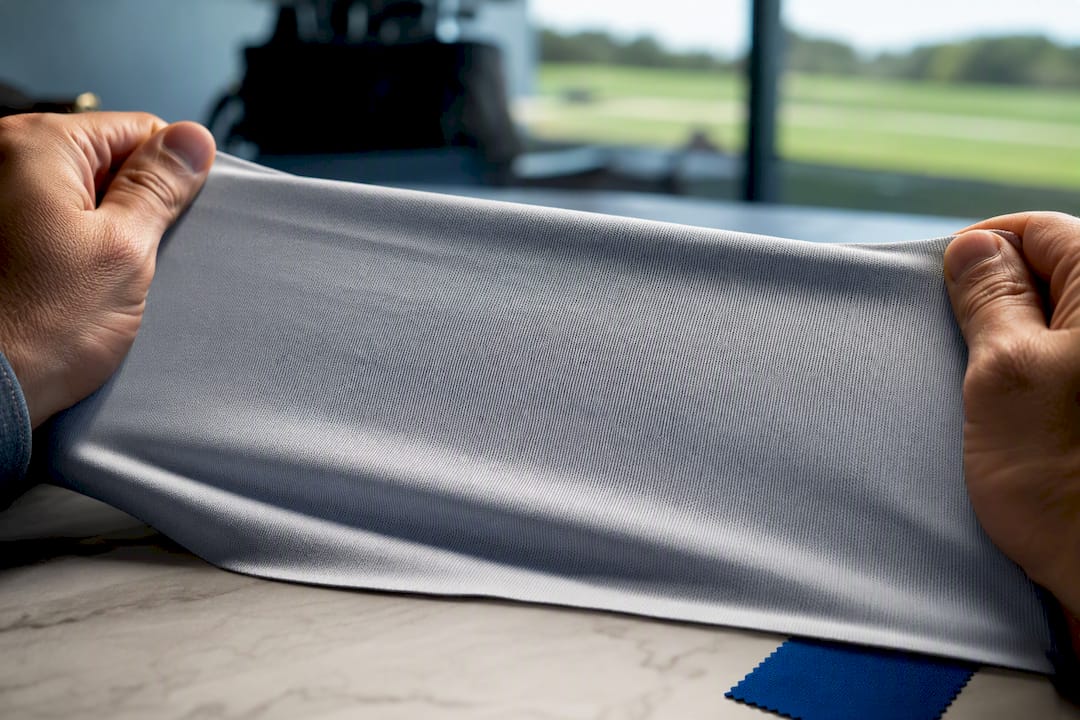
For most golfers and merch buyers, an 88/12 polyester-spandex blend is the clear all-around winner. It wicks moisture, moves through the swing, and holds its color through washes without straining budgets. Cotton-pique still earns its place for a classic look, and nylon-spandex blends deliver a softer, more premium hand if cost isn’t the deciding factor.
TL;DR:
- Polyester-spandex blends, especially 88/12 ratios, offer the best balance of performance, durability, and cost for most golf shirts.
- Knitting construction, such as warp-knit fabrics, significantly impacts stretch, shape retention, and breathability, beyond fiber content alone.
- Fabric choice should match the shirt’s purpose, with higher GSM and spandex for performance golf and lighter, textured fabrics for casual or traditional looks.
- Proper laundering, including cold water washes and air drying, extends the longevity of performance finishes and maintains fabric properties.
- Suppliers should provide detailed specifications and wash-test data, as performance can vary across dye lots and manufacturing batches.
Table of Contents
- What Makes Golf Shirt Fabric Different From a Regular Polo
- How Knit Construction Changes the Way Fabric Performs
- Moisture-Wicking, Stretch, UPF, and Durability Compared
- Choosing the Right Fabric for Your Golf Shirt Project
- Caring for Performance Fabric So It Lasts
- Why Golf Blab Builds Around These Fabric Standards
- Feel or Performance? When to Choose Each
- Find Your Fit in Golf Blab’s Performance Polo Lineup
- Sources
What Makes Golf Shirt Fabric Different From a Regular Polo
A golf swing puts more torque through the shoulders and back than almost any other athletic motion a dress shirt or casual polo will ever see. That single fact drives most of the technical choices behind golf shirt fabric, and it separates it from anything you’d wear to the office. The fiber, the knit, and the finish all have to work together to survive four hours of humidity, sun, and rotational stress without bagging out by the back nine.
Polyester: the workhorse fiber
Performance polyester dominates the category for good reason. It wicks moisture efficiently, dries fast, and holds color through repeated washing far better than natural fibers. It’s also the most cost-effective option for bulk apparel orders, which matters enormously for corporate and event merch runs.
- Polyester-spandex blends are the industry standard for performance polos, and 88/12 is the most commonly cited optimal ratio, balancing four-way stretch against cost and long-term UV durability.
- Nylon-spandex blends feel noticeably softer against the skin and resist abrasion better, though they typically cost 15% to 25% more than polyester-spandex and can be a touch more UV-sensitive without added finishes.
- Cotton pique and poly-cotton blends deliver the breathable, textured look golfers associate with tradition, but cotton’s wicking performance lags badly once you’re sweating in humid heat.
- Recycled polyester (RPET) performs on par with virgin polyester for wicking and quick-dry, and it supports sublimation printing just as well, making it an easy sustainability upgrade with no real performance penalty.
Field comparisons of brand samples back this up: nylon-spandex often wins on hand feel and abrasion resistance, while polyester-spandex wins on value and colorfastness. Neither fiber is universally “better.” The right call depends on whether your buyer prioritizes texture or turnaround cost.
How Knit Construction Changes the Way Fabric Performs
The same fiber can behave completely differently depending on how it’s knitted. Construction is where a lot of buyers get tripped up, assuming fiber content alone tells the whole story.
- Warp-knit fabrics provide more even, controlled stretch and superior shape recovery compared to basic circular knits, which is why they’re increasingly preferred for golf apparel that has to survive a full swing without permanently stretching out.
- Pique knits create the classic textured surface golfers expect, with small air pockets that improve breathability over a flat jersey.
- Interlock knits produce a smooth, double-knit surface favored for a more tailored, corporate-polo aesthetic.
- Open-loop mesh and bird-eye constructions maximize airflow for hot-climate play, often used as underarm or side panels on premium polos.
Construction modifies fiber performance more than most buyers realize. A cheap polyester in a poorly engineered circular knit will feel clingy and lose shape fast, while that same fiber in a well-built warp-knit can outperform a “premium” fabric with sloppy construction.
Moisture-Wicking, Stretch, UPF, and Durability Compared
Fabric performance isn’t a single score. It’s a set of trade-offs, and matching fiber, knit, and finish to your climate and budget matters more than chasing one “best” material.
Moisture management works in two stages: wicking pulls sweat off the skin, and quick-dry evaporates it from the fabric surface. Performance polyester does both well; cotton does neither well once you’re sweating heavily in humid conditions.
Stretch and recovery come down largely to spandex content. Higher spandex percentages increase mobility but raise cost and can shorten UV durability over time, which is why spandex content in the 10 to 15% range is standard for athletic cuts while casual polos use closer to 2% to 5%.
UPF protection depends heavily on fabric weight and finish. Tightly knit, higher-GSM fabrics naturally block more UV than loose, sheer knits, and permanent (fiber-integrated) UV treatments hold up far better over the shirt’s life than sprayed-on coatings.
Statistic Callout: Spandex content commonly ranges from lower spandex content, typically around a few percent, is common for casual polos up to 10% to 15% for performance cuts, and industry test protocols like AATCC 61 for colorfastness and ASTM D3512 for pilling resistance are the benchmarks worth requesting from any supplier.
- Durability is measured through pilling and abrasion resistance, typically tested against AATCC or ASTM standards.
- Anti-odor treatments built into the fiber itself last far longer than topical sprays applied after knitting.
- Colorfastness failures usually show up as fading along collar seams and underarms first, a sign of a cheap dye process rather than a fiber problem.
Choosing the Right Fabric for Your Golf Shirt Project
Matching fabric to purpose is where most buying mistakes happen. A shirt built for a weekend member-guest doesn’t need the same spec sheet as one built for a 500-unit corporate order shipping to a hot climate.
- Define the use case first. Tournament play in high heat wants lighter GSM and higher spandex; corporate gifting in mixed climates can lean toward a heavier, more structured feel.
- Request specific specs, not marketing language. Ask for the blend ratio (88/12 is the benchmark), GSM band, and spandex percentage rather than accepting “performance fabric” as an answer.
- Use GSM as your opacity and weight guide. 120 to 140 GSM suits ultralight tournament wear (watch for see-through risk), 150 to 170 GSM balances performance and coverage, and 180 to 200 GSM suits premium, structured polos.
- Ask for wash-test data before committing to a bulk order. Colorfastness, pilling, and shrinkage reports catch problems a hand sample never will.
Pro Tip: Never approve a bulk order off a single sample shirt. Ask your supplier for wash-test results across at least three production batches, since fabric performance can drift between dye lots even when the spec sheet stays identical.
If a supplier can’t produce shrinkage or colorfastness data on request, treat that as a red flag rather than an oversight. Golf Blab’s performance apparel guide breaks down these specs further for readers building out a full order.

Caring for Performance Fabric So It Lasts
Finishes fade faster than most golfers expect. Topical anti-odor and UV treatments often wear down within 15 to 40 washes, while fiber-integrated treatments hold their properties much longer.
- Wash in cold water and skip the fabric softener, which coats fibers and blocks wicking channels.
- Air dry when possible; high heat degrades spandex elasticity over time.
- Expect shrinkage within an industry-standard a small shrinkage tolerance, generally considered acceptable after washing after the first several washes, not zero.
- Watch for dulled color, stiffened fabric, or loss of stretch recovery. Those are signs the finish has worn out even if the shirt looks intact.
For a deeper laundering breakdown, Golf Blab’s polo care guide walks through wash settings and drying methods that protect elasticity and UPF longer.
Why Golf Blab Builds Around These Fabric Standards
Golf Blab’s founder, Michael Marini, has spent years studying how fabric science translates into real performance on the course, from spandex ratios to knit architecture. That firsthand attention to fiber and construction shapes every product decision Golf Blab makes, rather than treating fabric as an afterthought behind logo placement.
The brand’s polo lineup applies the exact specs covered here: balanced polyester-spandex blends, GSM chosen for opacity without added bulk, and finishes selected for wash durability rather than one-season performance. Readers building a swing-tested fit will find the technical detail carries through to how each shirt actually moves. Full specs sit on each product page for anyone comparing blend and construction side by side.
Feel or Performance? When to Choose Each
Raw performance numbers don’t always win the room. A club pro shop selling to members who golf twice a month should lean toward the softer hand of a nylon-spandex or cotton-pique blend, even if it wicks less efficiently than pure polyester, because comfort drives repeat purchases more than a lab spec sheet does.
Cotton-pique remains the right call when the brand story is tradition, not athletic performance. It’s a legitimate design decision, not a compromise.
Recycled polyester is worth the trade-off almost every time it’s engineered well, since it performs on par with virgin fiber. For buyers weighing warmer-weather alternatives outside the synthetic world entirely, merino wool offers a natural-fiber comparison worth knowing, even if it sits outside most golf apparel budgets.
— Michael Marini
Find Your Fit in Golf Blab’s Performance Polo Lineup
If the specs above sound like exactly what you’d want in a shirt rather than a spreadsheet, Golf Blab built its polo lineup around them. The Golf Blab Adidas Sport Polo runs on a balanced polyester-spandex blend with the stretch and wicking properties covered throughout this guide, while the Golf Blab Adidas Space Dyed Polo delivers the same performance backbone with a textured, tonal finish for buyers who want fabric personality along with function. Each product page lists blend ratio, GSM, fit notes, and care instructions upfront, no digging required.

Outfitting a team or shipping client gifts this season? Custom Golf Club Labels make an easy add-on that pairs personalization with the same attention to detail Golf Blab puts into its fabric choices. Browse the polo specs, pick your blend, and check sizing before your next order ships.
Sources
- Golf Polo Shirt Fabric Guide: Polyester, Piqué & Performance Blends — Expert USA Guide (2026)
- Best golf shirt fabric (2026) — NovaKnitting
- Custom Golf Shirts Fabric Guide: Best Materials, Tech and Quality