
TL;DR:
- Golf pressure training involves adding meaningful consequences to practice to help the nervous system perform under real competitive stress. It trains the mind and body to manage emotional load, reducing on-course anxiety and improving scoring consistency over 4 to 8 weeks. Simple drills like restart penalties and score thresholds, combined with breathing and relaxation techniques, build mental resilience without requiring expensive equipment.
Golf pressure training is defined as the deliberate practice of adding competition-like consequences and stressors to your training sessions so your nervous system learns to perform under emotional load, not just ideal conditions. Most golfers practice mechanics on the range and then wonder why their swing deserts them on the 18th hole with a two-shot lead. The answer is not technique. Mental conditioning failures cause the gap between range performance and course scoring under pressure. Systems like Barla Golf Academy’s FLOWCODE, controlled breathing protocols, and pressure plate training aids exist precisely to close that gap by training the mind and body as one integrated performance system.
What is golf pressure training and how does it work?
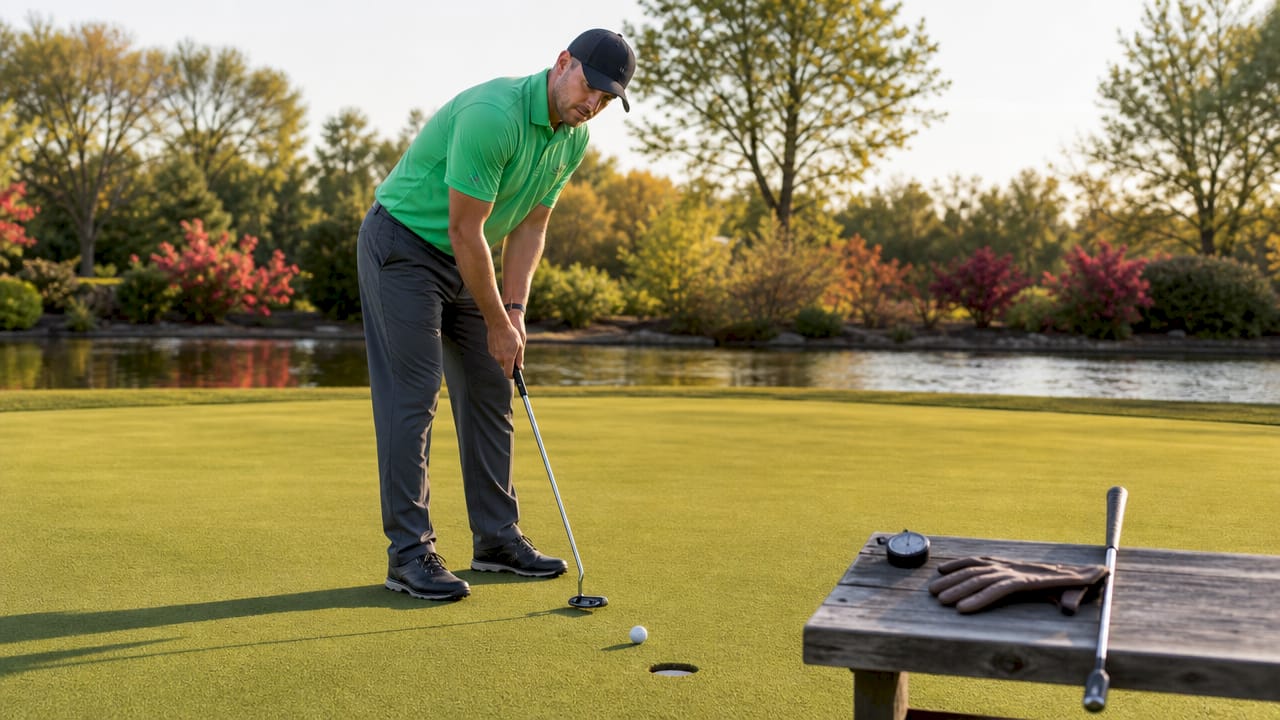
Golf pressure training works by attaching meaningful consequences to practice repetitions, forcing your nervous system to confront real stakes rather than comfortable repetition. When you practice a putt with nothing on the line, your brain treats it as a low-priority task. Add a restart penalty or a scoring threshold, and the emotional load shifts immediately. That shift is the point.

The physiological response to pressure is real and measurable. Elevated heart rate, tightened muscles, and narrowed attention are all stress responses that degrade fine motor control, which is exactly what a golf swing demands. Pressure training adds consequences like restart penalties or scoring thresholds to practice, simulating the competitive emotional load that triggers these responses. Training under those conditions teaches your nervous system to operate through them rather than collapse because of them.

The psychological goal is equally specific. You are not trying to eliminate nerves. Pressure is a signal that a moment matters, and reframing nerves as motivation prevents the decision-making collapse that causes poor shots under pressure. Anxiety and excitement share the same physiological signature. Pressure training teaches you to read that signature as fuel.
Two physiological tools anchor the mental conditioning process:
- Controlled breathing at 6 breaths per minute synchronizes respiratory and heart rates, reducing stress markers during high-pressure moments. Inspiratory muscle training over 4 weeks has been shown to increase endurance and decrease performance time in athletes. Applied to golf, this translates to a calmer, more consistent tempo under stress.
- Progressive muscle relaxation reduces cognitive anxiety significantly after approximately 12 sessions. Tensing muscles for 3 to 5 seconds and then releasing them consistently lowers anxiety and heart rate response, making it a practical pre-shot tool for competitive rounds.
Pro Tip: Practice your breathing protocol during low-stakes range sessions first. You want the rhythm to feel automatic before you need it in competition.
Which pressure training techniques are most effective for golfers?
Effective pressure training techniques share one defining quality: they make failure feel real. Without genuine stakes, practice is just rehearsal. With stakes, it becomes conditioning. The following methods are proven to build golf performance under pressure across all skill levels.
- Restart penalty drills. Set a target, such as sinking 10 consecutive putts from 6 feet. Miss one and restart from zero. Simple failure consequences are more effective than expensive technology because they force genuine nervous system adaptation. Golfers who use restart drills report reductions in three-putts per round within 2 to 3 weeks.
- Score threshold challenges. Assign yourself a minimum score to “pass” a practice session. For example, you must hit 7 of 10 approach shots within a designated landing zone or the session does not count. This mirrors the scoring pressure of a competitive round without requiring a partner.
- Streak requirements. Require a streak of successful shots before moving to the next drill. Three clean chip-and-runs in a row before you advance. This builds tolerance for sustained focus, which is what separates good rounds from great ones.
- Simulated match-play and wagered drills. Practice with a partner and assign small, meaningful consequences to each hole or drill. The social dimension of competition adds a layer of pressure that solo drills cannot fully replicate.
- Visualization of recovery, not perfection. Visualizing recovery from bad shots primes the brain to handle adversity smoothly rather than reacting with shock or panic. Build this into your pre-shot routine by mentally rehearsing your response to a missed shot before you take the swing.
- Pressure plate and weight transfer aids. Physical training aids that measure weight distribution and balance during the swing add a biofeedback layer to pressure training. When you know your data is being recorded, the stakes feel higher and your focus sharpens accordingly.
Pro Tip: Combine restart penalties with your breathing protocol. The moment you feel the restart looming, that is exactly when you practice your 6-breath reset. You are training the skill and the recovery simultaneously.
Integrating these techniques into structured practice routines accelerates the adaptation process. Consistency matters more than intensity. Three focused pressure sessions per week outperform one marathon session every weekend.
How does pressure training improve mental resilience and on-course performance?
The brain is trainable. Repeated exposure to pressure in practice rewires the stress response so that competition feels familiar rather than threatening. This is not motivational language. It is how neural adaptation works: the nervous system habituates to stimuli it encounters repeatedly, reducing the magnitude of the stress response over time.
Barla Golf Academy’s FLOWCODE system treats mental game training as a skill to develop, targeting focus, confidence, and consistency under pressure as measurable outcomes. The system prepares players to enter flow states on the course by building mental resilience through structured repetition. Flow state entry is not accidental. It is the product of deliberate mental conditioning.
One of the most practical benefits is the separation of mindsets. Separating training mindset from trusting mindset helps golfers execute reliably under pressure. On the range, you analyze and correct. On the course, you commit and trust. Pressure training accelerates this separation by giving you repeated experience of trusting your swing when the stakes are real.
| Benefit | Mechanism | Timeline |
|---|---|---|
| Fewer three-putts | Restart drills build focus and routine adherence under stress | 2 to 3 weeks |
| Reduced choke moments | Nervous system habituates to competitive emotional load | 4 to 6 weeks |
| Improved shot decisions | Trusting mindset replaces over-analysis under pressure | 4 to 8 weeks |
| Consistent swing tempo | Breathing protocols regulate heart rate and muscle tension | 2 to 4 weeks |
| Faster recovery from mistakes | Physical resets interrupt negative thought loops | Immediate with practice |
Mental performance coaching that targets first-tee nerves and confidence loss after bad shots produces measurable scoring improvement typically over 4 to 8 weeks of consistent work. That timeline is realistic and worth committing to.
How to implement pressure training into your practice routine
Building a pressure training routine does not require a coach, a simulator, or expensive equipment. It requires honest assessment and deliberate design. Here is how to build yours from the ground up.
Assess your current practice habits. Most golfers practice without any consequences attached to their shots. Identify the specific situations where your game deteriorates under pressure. First-tee nerves? Putting with a score on the line? Approach shots when you need a par to win? Your pressure training should target those exact scenarios.
Design drills with meaningful consequences. The consequence does not need to be financial. Restarting a drill, losing a point, or recording a failed session are all psychologically meaningful. What matters is that missing costs you something you care about. Practicing with consequences such as restarting drills after misses can reduce three-putts per round within 2 to 3 weeks, which is a concrete return on a simple behavioral change.
Set incremental goals for pressure tolerance. Do not begin with the hardest possible drill. Start with a 5-putt streak requirement, then move to 7, then 10. Incremental progression builds confidence alongside pressure tolerance, so you are not just surviving the training but growing through it.
Incorporate breathing and physical reset cues. Physical resets like posture straightening or tapping the thigh serve as biological circuit breakers that halt negative thought loops during rounds. Practice these resets during your pressure drills so they become automatic responses to stress, not afterthoughts.
Track your mental game metrics. Confidence, focus, pre-shot routine adherence, and recovery speed after mistakes are all measurable. Keep a simple log after each session. You will see patterns that reveal where your mental game is strongest and where it needs more pressure exposure.
Balance pressure training with mechanical practice. Pressure training is not a replacement for swing work. It is a complement. A useful ratio for competitive golfers is roughly 60% mechanical and skill practice to 40% pressure-conditioned practice. You can also explore home practice drills that incorporate meaningful consequences without requiring a full course or range session.
| Practice Type | Focus | Frequency |
|---|---|---|
| Mechanical practice | Swing mechanics, ball striking, technique refinement | 3 to 4 sessions per week |
| Pressure training | Consequence drills, mental routines, recovery practice | 2 to 3 sessions per week |
| Simulated competition | Match-play formats, score thresholds, partner drills | 1 session per week |
The mental aspects of golf performance are as trainable as the physical ones. Building resilience requires the same consistency and intentionality you bring to your swing.
Key takeaways
Golf pressure training works because it forces your nervous system to adapt to competitive emotional load through repeated, consequence-driven practice rather than comfortable repetition.
| Point | Details |
|---|---|
| Pressure training definition | Deliberate practice with meaningful consequences that simulate competitive emotional load. |
| Core techniques | Restart penalties, streak requirements, score thresholds, and recovery visualization build genuine pressure tolerance. |
| Physiological tools | Controlled breathing at 6 breaths per minute and progressive muscle relaxation reduce stress response during high-pressure shots. |
| Mindset separation | Training mindset and trusting mindset must be kept distinct to prevent overthinking during competitive play. |
| Realistic timeline | Measurable improvements in focus, confidence, and scoring consistency develop over 4 to 8 weeks of consistent pressure training. |
Why most golfers are training the wrong way
I have watched golfers spend hundreds of hours on the range hitting bucket after bucket with zero consequence attached to any shot. They groove a beautiful swing in isolation and then step onto the first tee of a club championship and produce something unrecognizable. The problem is not their swing. The problem is that their nervous system has never been asked to perform that swing when something real is on the line.
The most common mistake I see is treating the range as a sanctuary rather than a training ground. Golfers go there to feel good, not to feel pressure. That comfort is the enemy of competitive development. The range should occasionally feel uncomfortable. It should occasionally feel like the back nine on Sunday.
What I find genuinely counterintuitive is how little equipment or technology this requires. A restart penalty costs nothing. A score threshold drill costs nothing. Yet these simple tools produce more durable competitive improvement than most swing aids on the market. The mental game skills that separate scratch golfers from 10-handicappers are not technical. They are psychological, and they are trainable with nothing more than a target, a consequence, and the willingness to feel uncomfortable.
My strongest recommendation is this: before your next practice session, decide what failure costs you. Then practice as if it does.
— Michael Marini
Gear and resources to support your pressure training journey
Golf Blab understands that confidence on the course begins long before the first tee shot. When your equipment reflects your identity and your preparation is deliberate, you carry a different kind of composure into every round.

The Innovate Tour Performance Golf Balls are engineered for consistency and feel, giving you one less variable to doubt when the pressure is real. Pair them with custom golf club labels that personalize your setup and reinforce the sense of ownership over your game. For golfers ready to take their mental and physical preparation to the next level, the Play Golf with a Tour Pro experience offers an unmatched opportunity to perform under genuine competitive pressure alongside a professional. Browse the full Golf Blab shop and build the setup that matches your ambition.
FAQ
What is golf pressure training in simple terms?
Golf pressure training is the practice of adding meaningful consequences to your drills and practice sessions so your nervous system learns to perform under competitive stress. It bridges the gap between range performance and on-course execution.
How long does it take to see results from pressure training?
Measurable improvements in focus, confidence, and scoring consistency typically develop over 4 to 8 weeks of consistent, deliberate pressure training. Specific skills like putting under pressure can improve in as little as 2 to 3 weeks.
Do I need special equipment for golf pressure training?
No special equipment is required. Simple failure consequences like restarting a drill after a miss are more effective than expensive technology because they force genuine nervous system adaptation. Pressure plates and biofeedback tools add value but are not prerequisites.
What is the difference between training mindset and trusting mindset?
Training mindset involves deliberate mechanical focus used during practice to analyze and refine your swing. Trusting mindset means committing to your instincts during competition without over-analysis. Separating these two modes is a core skill that pressure training develops over time.
Can breathing techniques actually help golf performance under pressure?
Controlled breathing at 6 breaths per minute synchronizes heart rate and respiratory rate, measurably reducing stress markers during high-pressure moments. Practiced consistently, this technique becomes an automatic tool for maintaining composure and tempo when the stakes are highest.