
TL;DR:
- Golf flexibility exercises target key areas like hips and thoracic spine to improve swing movement and reduce injuries. Regular dynamic warm-ups and static stretches held 45-90 seconds promote lasting mobility gains, while neglecting proper timing and duration can hinder progress. Strengthening mobility through consistent off-course training prevents compensatory patterns and chronic injury development.
Golf flexibility exercises are targeted stretches and mobility routines that increase range of motion in the hips, thoracic spine, shoulders, and hamstrings to improve swing mechanics and reduce injury risk. The industry term for this practice is golf mobility training, which distinguishes controlled movement under load from passive stretching alone. Golfers who commit to a structured flexibility and strength routine see measurable gains in swing rotation, club speed, and postural stability. Whether you play once a week or compete regularly, the joints you move through during a swing demand consistent preparation. The exercises below give you a complete, evidence-based system to build that foundation.
1. What are the essential golf flexibility exercises?
Golf mobility training targets six primary areas: hips, thoracic spine, shoulders, hamstrings, calves, and wrists. Each area contributes a specific mechanical function to the swing. Neglecting any one of them creates compensatory patterns that restrict hip and thoracic mobility and raise your injury risk over time.

The exercises below form a complete golf flexibility exercises list, organized from lower body to upper body. Each entry includes recommended volume and a brief explanation of its swing benefit.
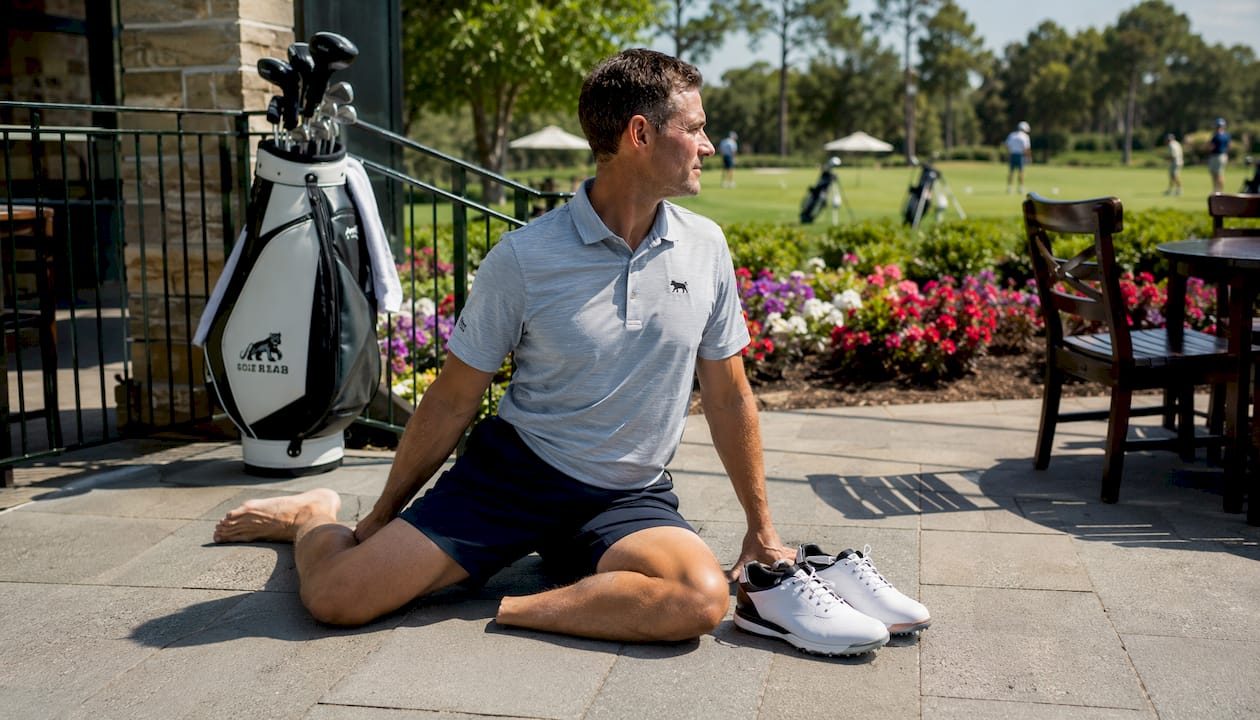
90/90 hip switch
Sit on the floor with both knees bent at 90 degrees, one leg in front and one behind. Rotate your hips to switch sides, keeping your spine tall. 8–10 repetitions per side improve both internal and external hip rotation, which directly drives hip clearance through impact.
World’s Greatest Stretch
Step into a deep lunge, place the same-side hand on the ground, and rotate your upper arm toward the ceiling. This single movement trains hip flexors, thoracic rotation, and shoulder mobility simultaneously. It is the most efficient single exercise in any golf stretching routine list.
Open Book thoracic rotation
Lie on your side with knees stacked and arms extended. Sweep the top arm open toward the floor behind you, following with your eyes. This exercise isolates thoracic rotation without loading the lumbar spine, making it safe for golfers with lower back sensitivity.
Doorway chest stretch
Stand in a doorway, place both forearms on the frame, and lean forward gently. Hold for 45–90 seconds per side. Tight pectoral muscles pull the shoulders forward and restrict the backswing, so this stretch directly restores address posture.
Seated hamstring stretch
Sit on the edge of a chair, extend one leg, and hinge forward from the hips with a flat back. Tight hamstrings tilt the pelvis posteriorly, which flattens the lumbar curve and limits hip rotation. Releasing them restores the athletic posture the swing requires.
Standing hip flexor stretch
Step one foot forward into a lunge and drop the back knee to the ground. Shift your hips forward until you feel a pull at the front of the rear hip. Restricted hip flexors prevent full hip extension through the downswing, costing you both power and balance.
Thoracic spine rotation with club
Hold a club across your shoulders and rotate your torso left and right from a golf posture. This movement grooves the rotational pattern specific to your swing plane. It also serves as an excellent bridge between static stretching and active warm-up.
Ankle circles and calf raises
Stand on one foot and draw slow circles with the ankle, then perform 10–15 calf raises. Ankle mobility anchors the kinetic chain at its base. Poor ankle dorsiflexion forces the heel to lift early in the backswing, disrupting weight transfer.
Wrist flexion and extension stretch
Extend one arm, palm up, and gently pull the fingers back with the other hand. Repeat with palm down. Wrist flexibility affects grip pressure and clubface control through impact, particularly on wedge shots and putting.
Lateral thoracic stretch
Stand tall, reach one arm overhead, and side-bend away from it. This stretch opens the lateral rib cage and intercostal muscles, which limit full shoulder turn when tight. Golfers who sit at desks for long hours benefit most from this one.
Glute bridge
Lie on your back, feet flat, and drive your hips toward the ceiling. Hold for two seconds at the top, then lower slowly. Strong, mobile glutes stabilize the pelvis during the downswing and prevent the lower back from absorbing rotational forces it was not designed to handle.
Pro Tip: Pair the 90/90 Hip Switch with the Open Book on the same day. Together, they address the two joints most responsible for swing rotation: the hips and the thoracic spine.
2. How to perform a dynamic warm-up for golf before your round
Dynamic priming before a round activates neuromuscular pathways and raises tissue temperature, preparing your body for high-speed movement in a way that static stretching cannot. Static stretching held over 30 seconds before play temporarily reduces muscle force production, which costs you swing speed at the worst possible time. The goal of a pre-round routine is activation, not elongation.
An effective dynamic warm-up for golf runs 8–15 minutes and follows this sequence:
- Ankle rolls and toe raises (30 seconds each foot). Start at the base of the kinetic chain to establish ground contact and balance.
- Hip circles (10 per direction). Loosen the hip capsule before any rotational demand.
- Leg swings, front to back (10 per leg). Activate the hip flexors and hamstrings through their full range.
- Leg swings, side to side (10 per leg). Target hip abductors and adductors that stabilize the stance.
- Thoracic rotations with club across shoulders (10 per side). Prime the thoracic spine for the rotational demands of the swing.
- Arm circles, small to large (10 forward, 10 backward). Warm the shoulder capsule and rotator cuff.
- Wrist rotations (10 per direction). Prepare the grip and forearm muscles for club control.
- Club-hitting progression: Start with half-speed chip shots, move to three-quarter swings, then build to full swings over 10–15 balls.
Dynamic movements warm joints and muscles for immediate performance needs, while static stretching addresses long-term tissue change. Treat them as two separate tools with two separate purposes.
Pro Tip: If you arrive at the course with only five minutes to spare, prioritize hip circles, thoracic rotations, and the club-hitting progression. Those three steps deliver the highest return per minute before your first tee shot.
3. Integrating static stretching and off-course training for lasting gains
Long-term mobility gains come from off-course static stretching practiced consistently, not from occasional pre-round routines. Holding static stretches for 45–90 seconds per side is required for meaningful tissue remodeling. Holds shorter than 30 seconds produce minimal lasting change.
The most effective off-course golf flexibility stretches include:
- 90/90 hip stretch: 45–60 seconds per side, three times per week minimum
- Doorway chest stretch: 60 seconds per side, daily if possible
- Supine thoracic rotation (Open Book): 10 slow repetitions per side, held at end range for two seconds
- Seated hamstring stretch: 60 seconds per leg, focusing on a flat-back hinge rather than rounding the spine
- Standing hip flexor stretch: 45–60 seconds per side, especially after long periods of sitting
- Lateral thoracic stretch: 30–45 seconds per side, performed standing or seated
Aim to practice this routine at least three times per week, with daily sessions producing the fastest results. Combine static stretching with glute and core stability work to translate mobility gains into actual swing power. Flexibility without supporting strength creates instability, not performance.
Golfers over 50 face a specific challenge: hip and thoracic mobility decline faster with age, and joint sensitivity requires a more gradual approach. Start with 30-second holds and add five seconds per session as comfort allows. Modify positions using a chair or wall for support when needed. The principle remains the same; only the progression changes.
4. Common mistakes golfers make with flexibility training
Most golfers undermine their own mobility work through a handful of repeatable errors. Recognizing them is the fastest way to stop losing ground.
- Static stretching before a round: Holding a stretch over 30 seconds before play reduces muscle force production. Save static work for after the round or on off days.
- Confusing flexibility with mobility: True mobility requires controlled range of motion at the speeds relevant to the golf swing, not just passive muscle length. A golfer can touch their toes and still lack the hip mobility to clear properly through impact.
- Neglecting hips and thoracic spine: These two areas drive the majority of swing rotation. Skipping them forces the lower back to compensate, which is a leading cause of chronic golf injuries.
- Under-holding stretches: Holds under 30 seconds produce minimal tissue change. Most golfers rush through stretches and wonder why nothing improves.
- Skipping the warm-up progression: Walking straight to the first tee and swinging cold is the single fastest path to a pulled muscle or a wasted front nine.
Mobility beyond the range your swing actually requires offers limited performance benefit compared to strength and power training. Once you achieve the range of motion your mechanics demand, the next investment is building strength through that range, not stretching further.
Key takeaways
Consistent golf mobility training, combining dynamic pre-round priming with off-course static stretching held 45–90 seconds, produces the most reliable gains in swing rotation, power, and injury prevention.
| Point | Details |
|---|---|
| Dynamic priming before rounds | Use 8–15 minutes of movement-based warm-up to activate joints without reducing muscle force. |
| Static stretching off the course | Hold each stretch 45–90 seconds, three or more times per week, for lasting tissue change. |
| Prioritize hips and thoracic spine | These two areas drive swing rotation; neglecting them causes compensations and chronic injuries. |
| Mobility differs from flexibility | Controlled range of motion under load matters more than passive muscle length for golf performance. |
| Consistency outperforms intensity | Daily short sessions build more mobility than occasional long ones. |
What I’ve learned after years of watching golfers stretch wrong
The most common pattern I see is golfers who stretch religiously before a round, hold each position for about 10 seconds, and then wonder why their swing still feels stiff on the back nine. They are doing the right thing at the wrong time, for the wrong duration, and expecting the wrong result.
The distinction between dynamic priming and static stretching is not a minor technical detail. It is the difference between preparing your body to perform and inadvertently dulling its ability to generate force. I have seen golfers improve swing power sources dramatically simply by moving their static stretching routine to the evening and replacing their pre-round ritual with five minutes of hip circles, thoracic rotations, and graduated swings.
The other thing worth saying plainly: mobility beyond your swing’s requirements stops paying dividends. Once your hips clear freely and your thoracic spine rotates through a full shoulder turn, the next gains come from strength and stability, not more stretching. Golfers who chase endless flexibility without building the strength to control it often end up with hypermobile joints and inconsistent ball-striking. The goal is a body that moves well and holds its position under load, not one that simply bends far.
For golfers dealing with persistent tightness that stretching alone does not resolve, therapies like the Graston Technique address soft tissue restrictions at a deeper level and can accelerate the mobility gains that exercise alone takes months to produce.
— Michael Marini
Golf Blab gear and instruction to complement your training
Physical conditioning and quality equipment belong together. Golf Blab’s custom golf club labels let you personalize your clubs with the same attention to detail you bring to your mobility work, turning your bag into a genuine expression of your game. For golfers who want to translate improved flexibility into better scores, Golf Blab’s Play Golf with a Tour Pro experience pairs you with a professional who can show you exactly how your new range of motion translates into swing mechanics. Better movement is only half the equation. Knowing how to use it is the other half.
FAQ
What are the best golf flexibility exercises for beginners?
The World’s Greatest Stretch, the 90/90 Hip Switch, and the Open Book thoracic rotation cover the three most critical areas for beginners: hip rotation, thoracic mobility, and shoulder flexibility. Perform 8–10 repetitions per side for each exercise three times per week.
How long should I hold a golf flexibility stretch?
Hold static stretches for 45–90 seconds per side to produce meaningful tissue change. Holds shorter than 30 seconds yield minimal lasting improvement, according to established mobility training guidelines.
Should I stretch before or after a golf round?
Use dynamic movements before a round to activate joints and raise tissue temperature. Save static stretching for after the round or on off days, since holding stretches over 30 seconds before play temporarily reduces muscle force production.
How often should golfers do flexibility training?
Practice static stretching routines at least three times per week, with daily sessions producing the fastest results. Dynamic warm-ups should precede every round and every practice session without exception.
Can flexibility exercises prevent golf injuries?
Targeted hip and thoracic spine mobility work prevents the compensatory swing patterns that cause chronic lower back injuries in golfers. Consistent flexibility training, combined with core stability work, addresses the root mechanical causes of most common golf injuries.