
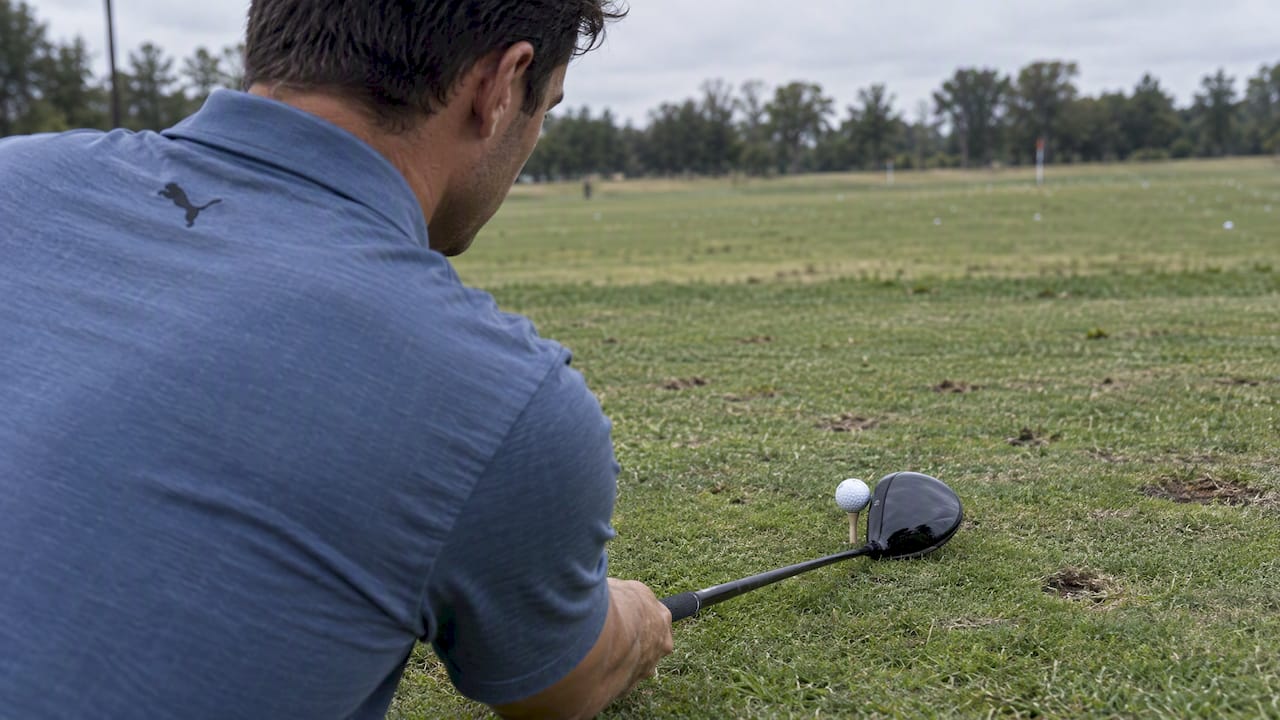
Start with the ball’s equator aligned to the top edge of your driver’s crown, about half the ball showing above the clubhead, then fine-tune from there based on your own ball flight, following this step-by-step tutorial enhancing your golf game with Puma golf shoes to improve your setup stability and posture. This starting point promotes an upward strike and center-face contact, the two conditions USGA testing and our own coaching at Golf Blab consistently link to longer, straighter drives.
TL;DR:
- Optimal tee height is roughly with the ball’s equator level with the top edge of the driver crown, usually 1.0 to 1.5 inches above ground for most drivers.
- Raising impact higher on the face promotes a positive attack angle and longer carry distances, but hitting above the optimal impact zone reduces ball speed.
- Lowering the tee can decrease launch angle and distance, with distance losses ranging from 2 to 13 yards depending on driver and ball pairing.
- Golfers with an upward approach benefit from higher tee heights, while steep swingers tend to perform better teeing lower.
- Testing multiple tee heights with a launch monitor or range drill provides the most personalized and effective setup for consistent contact and maximum distance.
Table of Contents
- Why tee height changes your launch, spin, and impact location
- The rule of thumb: how much ball should show above the driver
- Matching tee height to your swing and your common misses
- Two tests to find your ideal tee height
- Reading your ball flight: quick fixes between shots
- How your driver and ball shift the ideal height
- A coach’s checklist for locking in your tee height for good
- Our take: stop chasing one perfect number
- Practice and personalize your setup with Golf Blab
- FAQ
- Sources
Why tee height changes your launch, spin, and impact location
A driver rewards height in ways an iron never will, and the physics behind that reward come down to one variable: where the ball meets the face. Raise the tee and you raise the collision point. That shift lets you strike the ball on a more upward path, a change that tends to lift launch angle and settle spin into a more efficient range. Lower the tee and the opposite happens: contact drifts down the face, the attack angle flattens or turns negative, and spin tends to climb while launch sags.
USGA equipment research found that moving impact location up the face allows a more positive angle of attack, and that carry distance on many drivers peaks just above the center of the face, not dead center and not near the top. That plateau matters because it means more height is not endlessly better. Push the ball too high and you flirt with the upper edge of the face, where ball speed drops off and mis-hits balloon.
A separate USGA investigation into tee height and distance found no single relationship that applies to every golfer. Lowering tee height typically reduced launch and increased spin, with distance losses ranging from about 2 to 13 yards depending on the specific driver and ball combination tested.
Lowering your tee height can cost you measurable distance. USGA robot testing recorded reductions of 2 to 13 yards when tee height dropped, a swing in outcome driven almost entirely by which club and ball were paired together.
A few things worth holding onto as you think through your own setup:
- Higher tee height generally moves impact up the face, raising launch and often lowering spin.
- Carry distance tends to peak just above center face, not at the very top of the driver.
- The size of the effect depends heavily on your specific driver and ball, so results vary golfer to golfer.
- Extreme height in either direction, too high or too low, tends to produce weaker, less consistent contact.
The rule of thumb: how much ball should show above the driver
Golfers have asked “how high should I tee my driver” for as long as drivers have had crowns, and the honest answer starts with a visual cue you can use on literally any tee box. Set the ball so its equator sits roughly level with the top edge of the driver’s crown. From behind, you should see about half the ball peeking above the clubhead at address. This recommendation lines up with Golf, which treats the equator-to-crown alignment as a dependable starting point before any fine-tuning with a launch monitor.
In practical inches, that usually works out to the ball sitting about 1.0 to 1.5 inches above the ground for most standard driver heads. Drivers with deeper faces, a common trait in modern 460cc heads, often need a touch more height than that range to put the equator back in line with the crown, simply because the crown itself sits higher off the turf.
A few adjustments worth knowing before you lock in a number:
- If your driver has an unusually deep face, add a little extra height to keep the equator-to-crown relationship intact.
- If you consistently feel like you are swinging up and under the ball, come down slightly from the half-ball guideline.
- If your misses are low on the face or thin, raise the tee a notch before changing anything else in your swing.
Treat this as a starting position, not a finish line. The real answer lives in how the ball actually flies off your face, which is where the next two sections come in.
Matching tee height to your swing and your common misses
Tee height works best when it is matched to the shape of your swing rather than applied as a universal rule. Golfers with a shallow, more rounded swing and an upward angle of attack at impact tend to benefit from teeing the ball higher, since their swing path is already set up to catch the ball on the way up. Steeper swingers, the ones who come down sharply into the ball, often do better teeing lower, which keeps them from skying the ball off the top of the face.
Tee height also interacts with swing path in ways that matter for shot shape. Teeing the ball higher can encourage a swing that works more from the inside, which tends to help golfers fighting a slice by softening that outside-in cut. Teeing lower tends to support a flatter, more on-plane move, useful for golfers who are already battling a hook or feel stuck behind the ball coming into impact. Instruction coverage from Australian Golf Digest backs this pattern, noting that a higher tee tends to shallow the downswing and can promote a draw for many players, while a lower tee supports a more on-plane, lower-launch ball flight.
Skill level plays a role too. In a Golf Magazine experiment with 27 golfers, teeing the ball high produced an average of 12 yards more carry than teeing it low across the full group, but high-handicap players gained roughly 18 yards, a far larger jump than their lower-handicap counterparts saw.
- Shallow, upward swingers tend to gain the most from a higher tee.
- Steep swingers often find more consistency teeing lower.
- Slicers may find relief from a slightly higher tee that encourages an inside path.
- Higher-handicap golfers showed the largest distance gains from teeing up in controlled testing.
Pro Tip: Practice hitting drives from three different heights in the same session so you learn to call on the right one for a tight fairway, a wide-open hole, or a crosswind.
Two tests to find your ideal tee height
Guesswork gets you close. Testing gets you exact. Two methods, one that uses technology and one that needs nothing but a few balls and a flat lie, will tell you more about your ideal tee height than any generic rule ever could.
The launch monitor protocol gives you numbers you can trust:
- Pick three tee heights: low (ball mostly below the crown), mid (the half-ball equator rule), and high (ball mostly above the crown).
- Hit 8 to 12 solid reps at each height, discarding any obvious mis-hits.
- Compare launch angle, spin rate, smash factor, impact location on the face, and left-right dispersion across the three sets.
- Choose the height that delivers the most center-face contact paired with your best carry distance and tightest dispersion, not necessarily the single longest shot in the batch.
This structure mirrors testing guidance from GOLF.com, which recommends exactly this kind of multi-height comparison while tracking impact location rather than chasing one standout swing.
The low-tech range drill works when a launch monitor is not available. Set up three tees at the same low, mid, and high heights, keep your tempo identical across all three, and hit 10 to 15 swings total, splitting them evenly. Watch ball flight and pay attention to feel at impact. Keep your six best swings from the full set, the ones that felt most center-struck and produced the flattest, most boring trajectory rather than a weak balloon or a low dart. Whichever height produced the most of those six swings is your answer.

Reductions in distance from lowering tee height ranged from 2 to 13 yards in controlled USGA robot testing, a gap wide enough that getting this test right is worth the ten minutes it takes.
Keep your ball model and your tee’s fore-and-aft position constant across every test. Changing more than one variable at a time muddies the results and leaves you guessing all over again.
Reading your ball flight: quick fixes between shots
Your ball flight tells you almost everything you need to know about tee height, often before you even look up. Learning to read it turns every round into free diagnostic data.
- Ballooning, weak, high shots usually mean the tee is too high. Lower it a quarter inch to half an inch, or move the ball slightly back in your stance.
- Low, spinny shots that never get out of their own way usually mean the tee is too low. Raise it a quarter inch to half an inch, or move the ball slightly forward.
- Contact high on the face, or an outright top, often improves by lowering the tee or shifting the ball back a touch.
- Thin or low-on-the-face contact usually responds to raising the tee rather than changing anything else first.
Golf Digest instruction treats these flight cues as reliable, repeatable diagnostics, which is exactly how we suggest you use them: as a quick read between shots, not a mystery to solve from scratch every time you step on the tee box. Small half-inch adjustments, made one at a time, usually solve the problem before you need to touch your swing at all. For a deeper look at how these ball-flight patterns form, our guide to golf ball trajectory walks through the launch and spin relationship in more detail.
How your driver and ball shift the ideal height
The half-ball rule is a strong starting point, but it was never meant to be the final word, because the driver and ball in your hands change the math.
Deeper-faced drivers, common across most modern 460cc heads, often need a bit more ball showing above the crown to land the equator back in line with the top of the face. A shallower, more compact head reaches that same alignment with less exposed ball. Skipping this adjustment is one of the most common reasons golfers follow the visual rule perfectly and still strike the ball low on the face.
Ball model matters too. USGA testing found that the distance impact of changing tee height depends on the specific driver and ball pairing, with some combinations losing far more distance from a lower tee than others. A low-spin ball paired with a low tee can exaggerate the spin and launch losses that come from off-center, lower-face contact.
- Deeper-faced 460cc drivers often need a bit more visible ball to hit the ideal equator alignment.
- Low-spin and high-spin ball models can respond differently to the same tee height.
- Persistent inconsistency after testing multiple heights is often an equipment fit issue, not a setup issue.
If you have tried several heights and still cannot find center contact, a club fitting is worth exploring before you keep chasing adjustments on your own.
A coach’s checklist for locking in your tee height for good
Consistency beats a perfect number you only use once. Build a short routine around four checkpoints: a pre-shot visual check that confirms the equator-to-crown alignment before every drive, a first-shot verification where you actually watch where the ball starts on the face, a mid-round recheck since fatigue and stance width drift as a round goes on, and a habit anchor, something as simple as always teeing from the same side of the tee marker, that keeps your routine identical shot after shot.
- Check equator-to-crown alignment visually before every single drive, not just on the range.
- Verify your first tee shot’s flight and feel before assuming your height is locked in for the day.
- Recheck your height and stance midway through the round, since small drifts add up.
- Anchor the routine with one consistent physical habit so the setup becomes automatic.
For more on how impact location ties into all of this, our guide to impact position in golf and our breakdown of launch angle both go deeper into the mechanics behind these checkpoints.
Our take: stop chasing one perfect number
The most common mistake golfers make with tee height is treating it like a single magic number to find and then forget. The data does not support that. USGA testing shows the ideal height shifts with your driver, your ball, and your own swing geometry, which means the golfer who tests three heights once and locks in forever is leaving distance on the table.
What gets overlooked most is how much tee height can function as a tool, not just a setup habit. A golfer fighting a slice under pressure can reach for a slightly higher tee the same way they might reach for a different club. That flexibility matters more than nailing a single inch measurement.
Our honest view: spend less time debating whether it is 1 inch or 1.5 inches, and more time learning how your ball flight changes across a small range of heights. The half-ball rule gets you in the right neighborhood fast. Testing, and a willingness to adjust by feel and flight, is what actually keeps you there.
— Michael Marini
Practice and personalize your setup with Golf Blab
Dialing in your tee height is a process, and we built a few ways to make that process easier and a little more personal. If you want direct, personalized coaching on launch conditions and tee setup, our Play Golf with a Tour Pro service pairs you with professional guidance built around your own swing, not a generic chart.
For the testing phase itself, consistency in equipment helps you trust your results, which is where our Innovate Tour Performance Golf Balls come in: a steady, reliable ball to keep that variable controlled across every height you try.
Once you have found your number, our Custom Golf Club Labels let you mark your driver with a personal reminder of your ideal setup, right on the shaft where you will see it every time you tee off. We also carry apparel and Golf Blab E-Gift Cards for golfers who want to share the game, or the gear, with someone else.
FAQ
What tee height does Rory McIlroy use?
Tour pros adjust tee height shot to shot based on the hole, wind, and shot shape they need rather than using one fixed number every time. Specific tee-height figures for individual tour players are not publicly documented in detail, so the best approach for most golfers is testing your own ideal height rather than copying a pro’s setup.
What is Tiger Woods’ tee height?
Like most tour professionals, individual tee height preferences are not something publicly tracked or confirmed in detail. The more useful takeaway is the approach tour players use broadly: aligning the ball’s equator near the top edge of the crown and adjusting from there based on the shot at hand, a method covered in GOLF.com’s instruction.
How far should a 60-year-old man hit his driver?
Driver distance depends far more on swing speed, strike quality, and equipment fit than on age alone, so there is no single reliable figure for any age group. Testing your own tee height and impact location, using the methods in this guide, will do more for your distance than targeting a number tied to age.
What is the recommended tee height for a 460cc driver?
Deeper-faced 460cc drivers generally need a bit more ball showing above the crown than shallower heads to keep the ball’s equator aligned with the top edge of the face. Starting around 1.0 to 1.5 inches of visible ball and adjusting from there based on your impact location is a reliable way to dial in a 460cc head specifically.
How do I know if my tee height is wrong?
Ballooning, weak, high shots usually signal a tee that is too high, while low, spinning shots with little roll usually mean it is too low, a pattern confirmed in Golf Digest’s instructional coverage. Small quarter-inch to half-inch adjustments based on these flight cues usually fix the problem without any swing changes needed.
Sources
- This experiment reveals how high you should tee up your driver | GOLF Magazine archive (Golf Digest)
- Effects of teeing height and impact position — USGA Equipment Specifications Research
- Golf