
TL;DR:
- Effective home golf practice focuses on drills that improve swing mechanics, short game, and putting.
- Consistency, proper feedback, and goal-setting are essential for translating practice into real game improvement.
- Real skill transfer requires combining home drills with on-course experience, as home practice alone doesn’t guarantee lower scores.
You want to get better at golf. But between work, family, and life in general, getting to the course three or four times a week just isn’t realistic. So your game stagnates, and every round feels like you’re starting from scratch. Here’s the thing: practicing at home, done right, can genuinely sharpen your swing mechanics, your putting stroke, and your feel for the short game. This guide breaks down exactly how to set up your space, which drills actually work, how to track your progress, and how to stay motivated so your at-home sessions translate into real results when it counts.
Table of Contents
- Set up your home golf practice space
- Essential drills for swing, short game, and putting
- Using feedback and tracking progress
- Avoiding common mistakes and staying motivated
- What most home golf practice guides miss
- Enhance your home practice with Golf Blab
- Frequently asked questions
Key Takeaways
| Point | Details |
|---|---|
| Dedicated practice space | Set up a safe and functional area at home to make your golf practice consistent and effective. |
| Simple, repeatable drills | Focus on basic swing, short game, and putting routines that build reliable skills without fancy tools. |
| Use technology wisely | Leverage mirrors, smartphones, and simple apps to get feedback, but realize tech is no substitute for real on-course experience. |
| Track and celebrate progress | Measuring and enjoying your small wins helps you stay motivated and see steady improvement. |
Set up your home golf practice space
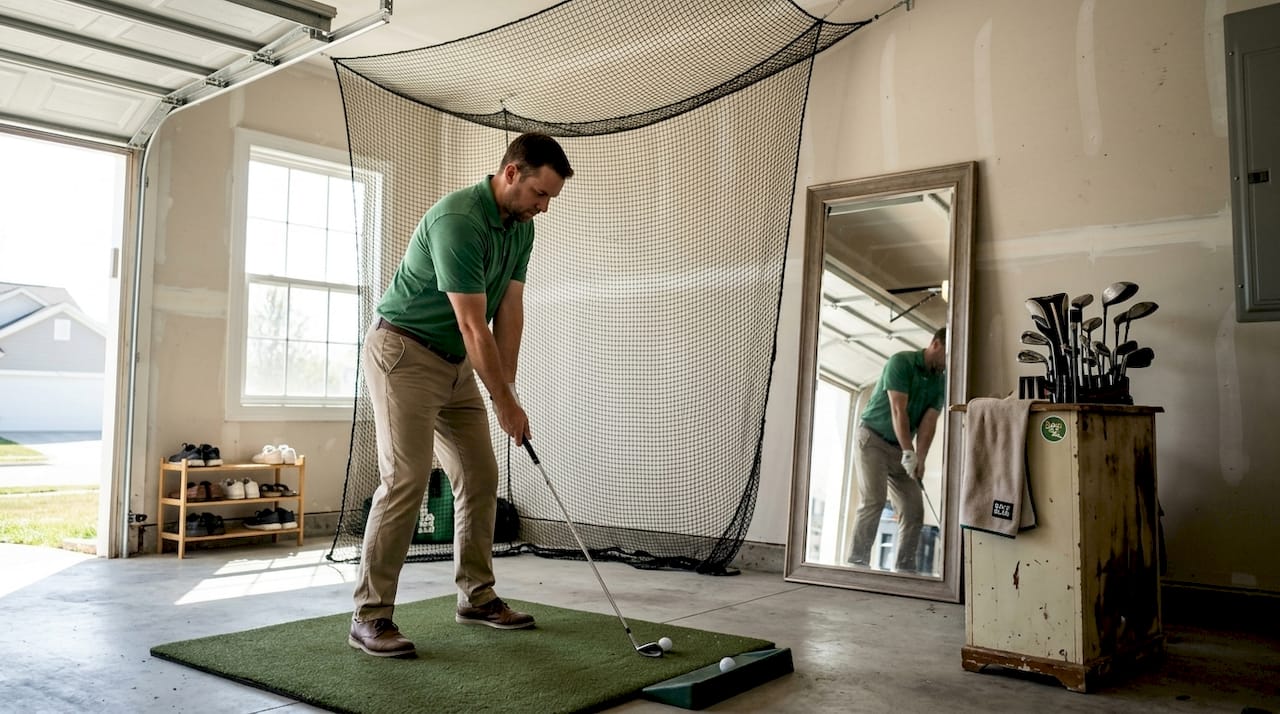
With a clear goal in mind, the first step is to establish a dedicated space for productive at-home practice. You don’t need a mansion or a fancy studio. A garage, basement, or even a backyard corner can become a surprisingly effective training ground if you set it up with intention.
The key is consistency. When your practice space is always ready, you’re far more likely to actually use it. Tripping over boxes to find your mat, or having to move furniture every time you want to swing a club, is a fast road to skipping sessions.

Home drills build swing mechanics and consistency effectively when the environment supports focused repetition. That means removing distractions, ensuring safe clearance around you, and having your tools within reach.
Here’s a quick checklist of what your practice area should include:
| Item | Purpose |
|---|---|
| Hitting mat | Protects floors, simulates turf feel |
| Practice net | Safely catches full and half swings |
| Full-length mirror | Real-time posture and alignment feedback |
| Foam or wiffle balls | Safe for indoor chipping and short swings |
| Putting cup/target | Grooves putting stroke indoors |
| Alignment sticks | Reinforces correct setup and ball position |
| Smartphone mount | Enables easy video recording of swings |
Beyond gear, keep these space and safety considerations in mind:
- Ceiling height matters. You need at least 9 feet of clearance for full swings with a driver indoors.
- Clear a zone of at least 6 feet around you on all sides to avoid clipping furniture or walls.
- Use a non-slip mat or rubber flooring if you’re working on a smooth surface.
- Keep pets and kids out of the space during active practice sessions.
- Backyard setups need to account for neighbors and sightlines before you start hitting.
You might also want to explore some golf club personalization tips to make your practice setup feel more like your own.
Pro Tip: Place a full-length mirror to your left (for right-handed golfers) at address. Glance at it during slow-motion swings to check your spine angle, knee flex, and shoulder turn without needing anyone else in the room.
Essential drills for swing, short game, and putting
Once your space is ready, it’s time to focus on which practice routines actually drive skill development. Not all drills are created equal. Some build raw mechanics, others sharpen feel. You need both.
Home drills improve swing mechanics and help build consistency when done with intention and repetition. Here are three core drills that cover the major areas of your game:
-
Slow-motion swing drill (full swing mechanics): Take any iron and swing at 25% speed, pausing at key positions like takeaway, top of backswing, and impact. This trains your muscles to follow the correct path without relying on momentum to cover mistakes. Do 20 slow reps before any full-speed work.
-
Towel chip drill (short game feel): Roll a small towel and place it just behind the ball position on your mat. Practice chipping without clipping the towel. This drill builds a clean, descending strike on chip shots and eliminates the scooping habit that kills most amateurs around the green.
-
Gate putting drill (putting accuracy): Set two alignment sticks or pencils just wider than your putter head, about 6 inches in front of the ball. Stroke putts through the gate without touching either side. This immediately reveals any face rotation or path issues in your stroke.
Here’s a breakdown of how these drills compare in purpose:
| Drill | Focus | Benefit |
|---|---|---|
| Slow-motion swing | Mechanics | Builds muscle memory and correct positions |
| Towel chip | Touch and feel | Eliminates scooping, improves contact |
| Gate putting | Stroke accuracy | Corrects face angle and putter path |
Want to push further? The swing like a pro drills at Golf Blab give you a structured framework for self-coaching your full swing at home.
Pro Tip: Start recording your swing at home with your smartphone at face-on and down-the-line angles. Watch in slow motion. You’ll catch flaws in 30 seconds that you’d never feel during the swing itself.

On VR simulators: they’re a fun addition, but research shows they don’t reliably predict improvement in your actual handicap. Use them as a supplement, not a replacement for mechanical drills.
Using feedback and tracking progress
Effective drills are only part of improvement; verifying progress with feedback tools ensures your at-home practice yields real-world results. Here’s the honest truth: practice without feedback is mostly just repetition. And repeating a flawed movement hundreds of times doesn’t fix it. It cements it.
Fortunately, you don’t need expensive equipment to get solid feedback. A smartphone, a mirror, and a free swing app will get you most of the way there. The swing recording tips at Golf Blab walk you through exactly how to film and review your swing to spot real issues.
Here are the metrics you can actually track at home without a launch monitor:
- Swing path: Use your mirror or video to check your club’s direction through the impact zone.
- Tempo: Count a rhythm like “one, two” for backswing and downswing. Consistent tempo is trackable without tech.
- Putting accuracy: Track how many putts out of 10 you make from 3, 5, and 8 feet. Chart it weekly.
- Setup consistency: Check your grip, stance width, and ball position each session. Take photos to compare over weeks.
- Contact quality: Notice where foam balls fly and how the mat feels at impact. Clean strikes feel and sound different.
“The difference between a golfer who improves and one who plateaus almost always comes down to whether they have a clear feedback loop. Without it, you’re flying blind.”
When it comes to apps and VR swing analysis, the current evidence shows they can be useful for general motion training but do not yet predict real-world golf handicap improvement. That’s not a reason to ignore them. It’s a reason to use them intelligently as one tool among many.
For deeper educational resources to pair with your feedback work, the Golf Blab Learning Center resources offer structured lessons that complement what you’re doing at home.
Avoiding common mistakes and staying motivated
To make progress sustainable, it’s vital to address obstacles and prevent burnout during home golf training. Most golfers start with great intentions but fall into predictable traps that stall progress or kill motivation entirely.
Consistency, routine, and smart feedback are essential for progress in home practice. Without them, even the best drills produce mediocre results. Here are the most common at-home practice errors to watch for:
- No structure: Randomly swinging without a drill or goal teaches your body nothing useful. Every session needs a plan.
- Overtraining the full swing: Most golfers spend 80% of practice on driving and barely touch putting and chipping. Flip that ratio. The short game is where scores are actually made.
- Ignoring setup: Gripping the club wrong or standing too far from the ball makes every drill you do counterproductive. Check your fundamentals first.
- Skipping review: If you never watch your videos or check your logged metrics, you lose the entire feedback benefit.
- Practicing too long: Forty focused minutes beats two sloppy hours every time. Mental fatigue leads to bad reps.
Staying motivated over weeks and months requires more than willpower. Here’s what actually works:
Set small, specific goals. “Make 7 out of 10 putts from 4 feet” is a real goal. “Get better at putting” is not. Mix up your drills every two weeks so sessions don’t feel stale. Connect with an online golf community or accountability partner who checks in on your progress. The golf strategy tips on Golf Blab give you fresh concepts to keep learning between drill sessions.
Pro Tip: Keep a simple practice journal. Write down what you worked on, what felt off, and one thing that improved. Reviewing it monthly shows you real progress that’s easy to miss day to day. Small wins add up faster than most golfers realize.
What most home golf practice guides miss
Taking a step back, it’s important to consider what most advice misses about practicing golf at home and what really matters for improvement. Most guides will hand you a drill list and send you on your way. They oversell home practice as a near-complete substitute for course time. It isn’t.
The real issue is skill transfer. You can groove a beautiful slow-motion swing in your garage and still struggle on the course because real golf involves uneven lies, wind, pressure, and visual targets at actual distance. Those variables don’t exist in your basement.
That’s not a reason to skip home practice. It’s a reason to use it correctly. Build your mechanics at home. Then take them to a range and eventually to the course to test them under pressure.
Research confirms that VR and home-based training do not always correlate with improved golf handicaps. Deliberate feedback beats volume every single time. One focused session where you catch a flaw on video and correct it is worth more than ten sessions of mindless swinging.
At Golf Blab, we’d rather you take the swing challenge experience seriously, treat home practice as a foundation, and approach every session with curiosity rather than frustration. That mindset is what separates golfers who genuinely improve from those who just stay busy.
Enhance your home practice with Golf Blab
For golfers serious about efficient improvement at home, dedicated support and quality tools can make a dramatic difference.

At Golf Blab, we’ve built a space specifically for players like you who want to get better without wasting time on vague advice. Browse our training aids and gear to outfit your home practice space with equipment that actually supports your development. Dig into the Learning Center for structured lessons that build on exactly the drills covered in this guide. And if you want a broader framework for developing a complete game, the master every shot guide is a great next step. You don’t have to figure this out alone.
Frequently asked questions
What are the best drills for practicing golf indoors?
The best drills are simple swing repetitions, mirror feedback, and putting to targets, all easily done indoors without special equipment. Home drills improve swing mechanics and help build the consistency needed for real on-course improvement.
Does practicing golf at home really improve my actual game?
Practicing at home develops important mechanics and consistency, especially when you track progress, but real handicap gains require on-course play too. Home practice is valid for mechanics but does not predict handicap improvement directly.
What equipment do I need to practice golf effectively at home?
A hitting mat, net, foam balls, mirror, and basic putting cup are sufficient for most core home practice routines. Home setups with minimal equipment can build core golf skills without expensive gear.
Are VR golf simulators useful for at-home golfers?
VR simulators are useful for general training but don’t correlate with handicap improvement, so stick to mechanical drills for best results. VR swing analysis does not predict real-world handicap gains reliably.