Posted on

7 Clear Signs You Need Golf Lessons Now

Frustrated golfer at driving range with unused balls


TL;DR:

  • Golfers often remain stuck at the same skill level despite regular practice, indicating a need for professional diagnosis.
  • Feeling confused after lessons, poor transfer of range skills to on-course performance, and repeated mistakes highlight coaching mismatches.

Most golfers know something is off. The scores aren’t dropping. The swing feels wrong. But knowing when the signs you need golf lessons are staring you in the face? That’s the part most players miss. It’s easy to blame a bad round on the weather or a tough course. It’s harder to be honest about the fact that you’ve been stuck at the same level for months, maybe years. This article lays out exactly what to look for, so you can stop guessing and start making real progress.

Table of Contents

Key takeaways

Point Details
Plateau is a red flag If your handicap hasn’t moved despite regular play, ingrained faults likely need professional diagnosis.
Confusion after lessons is a sign Feeling tense or overwhelmed after coaching signals a mismatch, not a personal failure.
Goal alignment matters A good coach asks about your goals before changing a single thing about your swing.
Lesson blocks beat one-offs Spaced lessons with practice in between are what actually break long-standing habits.
Coaching fit is not optional If lessons aren’t transferring to the course, the approach needs to change.

Signs you need golf lessons: how to set the criteria first

Before you book a lesson, you need an honest look at where you actually are. Not where you think you are. Where you actually are. That means tracking your scores over at least ten rounds and asking whether anything has genuinely changed in the last six months.

Here is the truth most golfers skip: improvement plateaus are not about effort. You can practice without progress for years if the underlying fault is never identified. That is exactly where professional instruction earns its keep. A good coach does not just watch you swing. They diagnose your specific miss patterns and build a plan around them.

Goal-setting is the other piece most golfers ignore completely. Are you playing for fun and social enjoyment? Are you trying to break 90 for the first time? Are you a competitive amateur trying to shave strokes off your handicap? The answer changes everything about what kind of coaching you need and what adult golfers get from lessons.

A few honest questions worth asking yourself before taking lessons:

  • Have your scores stayed flat for more than three months?
  • Do you have a specific, measurable goal you want to reach?
  • Do you have realistic time to practice between sessions?
  • Have you ever received coaching that felt tailored to you specifically?

Pro Tip: Before booking your first session, write down your single biggest frustration on the course. Not a list of ten things. One thing. That is what your first conversation with a coach should center on.

1. Your handicap hasn’t moved in months

This one is blunt and unmistakable. You play regularly, you practice, and your handicap just sits there like it is bolted to the floor. That is not bad luck. That is almost certainly an ingrained mechanical fault that you cannot see yourself. Lack of progress signals that you need diagnostic coaching with video and launch monitor data, not more range time doing the same thing.

Worn golf scorecard with unchanged scores

2. You leave lessons feeling confused or less confident

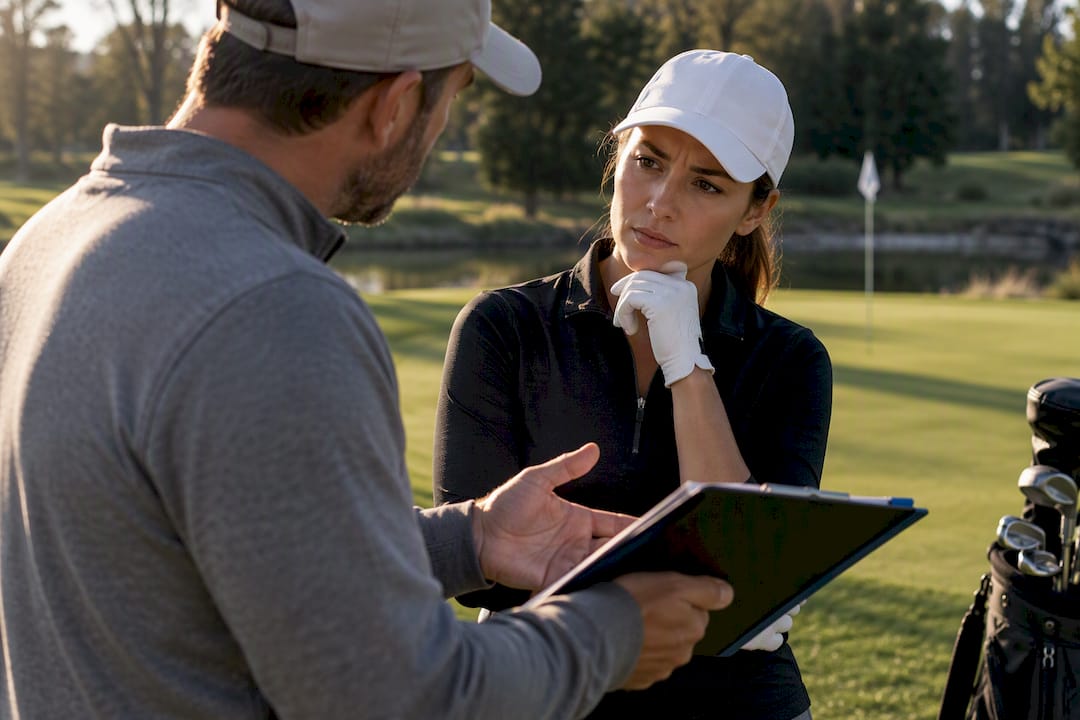
This one trips people up because they assume the confusion is their fault. It is not. If you walk off the lesson tee feeling overwhelmed, tense, or unsure what you are even working on, that is a coaching red flag, not a personal shortcoming. Good lessons should leave you with one clear feeling to work with and a specific drill you can repeat on your own.

3. You play better on the range than on the course

You stripe it beautifully at the driving range. Then you get to the first tee and it all falls apart. This gap between range performance and on-course performance is a classic sign that your learning is not transferring. Coaching should include on-course scenarios and pressure-based practice strategies. If your coach never addresses how you actually play under real conditions, you are missing the most important part.

4. Your coach never asked about your goals

Think back to your last lesson. Did your coach ask what you wanted to achieve before diving into technical changes? Did they ask about your schedule, your physical limitations, or what part of your game bothers you most? Effective coaching starts with a full picture of the golfer, not just the swing. If that conversation never happened, you are getting generic instruction dressed up as personal coaching.

5. Every lesson introduces something new

One session it is your grip. Next session it is your backswing plane. The session after that it is your weight transfer. If your lessons feel like a rotating menu of technical fixes with no thread connecting them, that is a problem. Quality instruction focuses on one or two prioritized corrections with measurable drills. More is not better. More is just more confusing.

Pro Tip: After each lesson, you should be able to answer three questions: What is the one thing I am working on? What drill will I practice this week? Why will this change fix my miss? If you cannot answer all three, ask your coach directly.

6. You are repeating the same mistakes without correction

You know that pull-hook that shows up on the fifth hole every single round. You have had it for two years. You have mentioned it. Nothing has changed. Repeating common golfing mistakes without any real correction is one of the clearest signs that either you have never had proper instruction, or the instruction you have received is not targeting the right root cause.

7. You feel less confident after coaching than before

Confidence in golf is fragile. You should feel better after a lesson, not worse. If you have started second-guessing your natural tendencies, over-thinking your setup, or dreading your own swing, that is the direct result of instruction that is not suited to how you learn. A poor communication fit between coach and golfer kills confidence faster than any technical flaw. Do not stay loyal to a coach out of habit when your belief in your own game is eroding.

What each sign actually tells you about your coaching needs

Not all signs point to the same solution. Here is a quick breakdown of what each situation actually calls for.

Sign What it likely means Type of coaching to seek
Stalled handicap Ingrained faults need diagnosis Video and launch monitor coaching
Range-to-course gap Learning not transferring On-course and scenario-based lessons
Lesson overload No prioritized focus Coach who works from one correction at a time
Post-lesson confusion Communication mismatch Coach who matches your learning style
Repeated same mistakes Root cause never identified Diagnostic-first, fault-pattern coaching
Declining confidence Instruction misaligned to you New coach or group format to rebuild feel

A few additional things worth considering when you match your sign to a solution:

  • Visual learners often respond far better to coaches who use video and graphics to explain movement rather than verbal description alone.
  • Group lessons can actually rebuild confidence faster than private sessions when the issue is mental pressure, because they normalize the struggle.
  • If the mismatch is communication style rather than technical depth, switching coaches is not quitting. It is smart self-management.
  • What a golf coach really does goes well beyond swing mechanics, and recognizing that changes how you shop for instruction.

Practical steps for deciding to start or change your lessons

Once you have identified your signs, the next question is what to actually do about it. Here is what works in practice.

Start with a block of lessons, not a single session. Breaking a plateau requires continuity. A block of four to six lessons spaced two to three weeks apart gives you time to practice the changes, bring what is happening on the course back to the lesson, and let new patterns settle in your body. One lesson tells you what is wrong. A coaching program actually fixes it.

Be honest about your available practice time before you commit. A coach who gives you a twenty-minute daily drill routine when you have fifteen minutes twice a week is setting you up to fail. Good coaching adapts to your real schedule and physical constraints, not an ideal version of them.

A few practical checkpoints to carry into your coach search:

  • Ask the coach how they assess a new student before the first lesson begins.
  • Ask what a typical lesson plan looks like over a four-session block.
  • Ask how they handle it when a student is not seeing improvement.
  • Know in advance what your exit criteria are. If you are not seeing measurable progress after four lessons, that is the signal to reassess.

Knowing the right questions to ask before you walk into your first session puts you in control from day one.

My honest take after watching hundreds of golfers get stuck

I have seen this pattern play out more times than I can count. A golfer grinds away for a season, maybe two, convinced they are one more range session away from a breakthrough. They are not ignoring the signs you need golf lessons. They genuinely do not recognize them as signs at all. The repeated slice gets treated as a fluke. The post-lesson confusion gets chalked up to golf being hard. The plateau gets blamed on age or equipment.

What I have learned is that the biggest obstacle is not skill. It is the assumption that “more of the same” will eventually produce a different result. That thinking keeps golfers stuck longer than any mechanical fault ever could.

The coaches who actually move the needle are the ones who start by watching and asking, not by immediately telling. I have seen complete beginners make faster progress in six weeks with a diagnostically focused coach than a ten-year player made in two years of weekly lessons with someone who just kept piling on tips.

My honest opinion? If lessons have not improved your scoring after a reasonable block of coaching, the lesson is probably fine. The coaching relationship is not. Changing coaches is not disloyalty. It is the exact kind of self-awareness that separates golfers who keep improving from those who plateau for good.

— Michael

Take your game further with Golf-blab

Recognizing the signs is the first step. Acting on them is where the real change happens. At Golf-blab, we have built a library of content specifically designed to help golfers at every level understand what professional instruction should actually look like and how to get the most from it. Whether you are shopping for the right golf lesson packages or gearing up for a fresh start with a new coach, we have resources to guide you there.

https://golf-blab.com

While you are working on your game, your gear should be working for you too. Check out Golf-blab’s golf club personalization options to make your equipment feel as intentional as your improvement plan. Because when your confidence on the course starts growing, there is no better time to make your set look the part.

FAQ

What are the main signs you need golf lessons?

The clearest signs include a stalled handicap despite regular play, feeling confused or less confident after coaching, and repeating the same mistakes without correction. If your range game does not translate to the course, that is also a strong indicator that professional instruction is overdue.

When is the best time to take golf lessons?

The best time to take golf lessons is when you notice a specific, repeating problem you cannot fix on your own, or when your scores have plateaued over multiple months. Starting a lesson block early in the season gives you time to practice and ingrain changes before your most competitive rounds.

How do I know if my golf coach is right for me?

A good coach asks about your goals before making any changes, gives you one clear focus per session, and explains why each change will fix your specific miss. If you consistently leave lessons feeling overwhelmed or less confident, that is a sign the communication fit is off.

How many lessons does it take to see real improvement?

A block of four to six lessons spaced two to three weeks apart is the standard recommendation for breaking through a plateau. Single one-off lessons rarely create lasting change because there is not enough time between sessions to practice, assess, and adjust.

Can beginner golfers spot signs they need lessons too?

Absolutely. Signs you are a beginner golfer who needs instruction include having no consistent ball flight, not knowing where your miss tends to go, and feeling overwhelmed by conflicting tips from playing partners. Starting with structured lessons early prevents bad habits from becoming permanent.

Posted on

El rol de la vestimenta en el golf: guía 2026

Un golfista actual se prepara en el campo atándose los cordones de sus zapatos antes de comenzar su juego.

La mayoría de los golfistas piensa que la ropa es solo protocolo. Están equivocados. El rol de la vestimenta en el golf va mucho más allá de cumplir reglas del club: afecta tu concentración, tu seguridad y cómo te perciben otros jugadores en los primeros segundos. Según estudios de psicología, el 90% de la imagen que proyectamos depende de cómo nos vestimos, y el cerebro forma esos juicios en apenas 13 milisegundos. En esta guía vas a entender la ciencia, los códigos y las tendencias de 2026 para que uses la ropa como ventaja real.

Tabla de contenidos

Puntos clave

Punto Detalles
Impacto psicológico real La vestimenta activa circuitos cerebrales de confianza que mejoran concentración y desempeño en el campo.
Código de vestimenta obligatorio La mayoría de los clubes exige camisa con cuello, pantalón o short ajustado y calzado especializado.
Tecnología textil en 2026 Los tejidos con protección UPF 50+ y poliéster reciclado reducen huella ambiental sin sacrificar rendimiento.
Adaptación clima y ocasión Elegir la ropa correcta según temperatura y tipo de club mejora comodidad y evita sanciones sociales.
Ventaja competitiva y social Vestir con propiedad genera credibilidad, abre puertas en redes de golf y refuerza la mentalidad ganadora.

El rol de la vestimenta en el golf y tu mente

Antes de hablar de telas y colores, necesitas entender algo que pocas personas en el golf te van a decir: lo que llevas puesto cambia cómo piensas.

En 2012, investigadores de la Universidad de Northwestern demostraron que la cognición vestida mejora el rendimiento cuando usas una prenda asociada a un rol específico. Los participantes que vistieron batas de médico cometieron significativamente menos errores de atención que quienes llevaban ropa casual. El mecanismo es simple: el símbolo que represents con tu ropa activa una mentalidad coherente con ese rol.

Para ti, como golfista, esto es directo. Cuando te pones un polo técnico, pantalón de golf y calzado especializado, tu cerebro recibe una señal clara: “Estamos aquí para jugar en serio.” Esa señal no es trivial. Genera concentración antes de que siquiera toques el palo.

“La ropa es una herramienta de comunicación y bienestar emocional. Vestir prendas que generan seguridad activa circuitos cerebrales de recompensa, mejorando actitud y concentración.”

Este fenómeno tiene un nombre más moderno: dopamine dressing. Elegir ropa que te hace sentir bien no es vanidad. Es una herramienta psicológica. Los golfistas que lo aplican conscientemente notan menos ansiedad antes de un hoyo difícil y mayor claridad en la toma de decisiones.

Consejo profesional: Elige tu atuendo de golf la noche anterior. Este ritual pequeño prepara mentalmente tu identidad de jugador y reduce la carga cognitiva el día del partido.

Códigos de vestimenta en golf: historia y reglas

El golf tiene uno de los códigos de vestimenta más reconocibles del deporte. No apareció por capricho. Surgió de una cultura de clubes privados en Escocia e Inglaterra donde la ropa era señal de membresía, compromiso y respeto al campo.

Hoy, la importancia de la ropa en el golf sigue siendo igual de concreta. Los clubes la aplican como política oficial, no como sugerencia.

Lo que se espera en la mayoría de los clubes

Según normas explícitas de vestimenta, los requerimientos habituales incluyen:

  • Camisa con cuello polo: Las camisetas sin cuello están prohibidas en la gran mayoría de los campos. La camisa debe estar metida en el pantalón en muchos clubes tradicionales.
  • Pantalones o shorts apropiados: Los shorts deben llegar por encima de la rodilla. Los jeans están explícitamente prohibidos en casi todos los campos.
  • Gorras con visera hacia adelante: Usar la gorra al revés es motivo de corrección en clubes con código estricto.
  • Sin ropa deportiva genérica: Las camisetas de gym, sudaderas con capucha o pantalones de chándal no son aceptables.

El calzado: un detalle que muchos ignoran

Los zapatos de golf especializados con clavos suaves o suelas de goma específica cumplen dos funciones: optimizan tu tracción durante el swing y protegen el césped del campo. Las zapatillas de tenis o running, aunque cómodas, suelen estar prohibidas porque dañan el green.

Prenda Aceptada No aceptada
Camisa Polo con cuello Camiseta sin cuello, franela
Pantalón Chino, golf trouser Jeans, leggins, chándal
Calzado Zapato golf con clavos suaves Zapatillas de tenis, sandalias
Gorra Visera hacia adelante Gorra al revés, gorro de lana informal
Colores Neutros y clásicos Estampados llamativos o logos grandes

El código de vestimenta no es arbitrario. Cumple una función social concreta: genera uniformidad, credibilidad y respeto dentro de la comunidad. Cuando llegas a un campo con la ropa correcta, ya estás comunicando algo positivo sobre ti antes de hacer tu primer swing.

Tecnología textil y moda en golf en 2026

La vestimenta recomendada para golf en 2026 no tiene nada que ver con la ropa rígida y aburrida de hace 20 años. Los materiales han evolucionado radicalmente, y eso tiene consecuencias reales para tu comodidad y rendimiento.

Aficionado al golf se prueba una chaqueta técnica en una tienda deportiva

Los tejidos técnicos actuales combinan varias propiedades que antes no podías encontrar juntas en una misma prenda. La tecnología Dri-FIT de Nike, por ejemplo, utiliza poliéster reciclado con UPF 50+ que reduce las emisiones de producción hasta un 30% frente a materiales convencionales. Al mismo tiempo, ofrece elasticidad multidireccional y absorción de humedad para mantener frescura y libertad de movimiento durante las 18 hoyos.

Lo que debes buscar en los tejidos

La elasticidad cuatro direcciones es el factor más ignorado y más importante. Un swing de golf requiere rotación completa del torso, extensión total de los brazos y transferencia de peso. Una camisa o pantalón que restrinja cualquiera de esos movimientos no solo es incómodo: te roba distancia y consistencia.

La protección solar UPF 50+ no es un extra lujoso. Si juegas regularmente, pasas entre 3 y 5 horas bajo el sol. La ropa técnica con esta protección equivale a tener bloqueador solar integrado en la tela.

Infografía sobre los tejidos más innovadores para practicar golf

Consejo profesional: Al comprar ropa de golf, prueba simular el movimiento de swing completo en la tienda. Si sientes resistencia en hombros o caderas, esa prenda no es para ti sin importar lo bien que se vea.

Las tendencias de vestimenta en golf para 2026 apuntan también hacia colores neutros y clásicos como el blanco, azul marino, negro y verde. Los colores sobrios transmiten profesionalismo y son aceptados en prácticamente cualquier club o resort. Las marcas como Adidas Golf, FootJoy y Callaway han lanzado líneas que combinan estos colores con tejidos reciclados, cerrando el círculo entre moda, función y sostenibilidad.

Cómo elegir tu ropa de golf según clima y ocasión

Saber qué ponerse es una habilidad que se desarrolla. Estos son los criterios más prácticos para elegir bien, según los escenarios más comunes.

  1. Clima cálido o tropical: Opta por polos de tejido ligero con absorción de humedad y protección UPF. Los pantalones de golf en tela stretch fina o los shorts de largo apropiado son tu mejor opción. Incluye siempre una gorra con visera para proteger la cara sin sudar de más bajo el casco.

  2. Clima frío o con viento: Las capas son la solución. Una camiseta térmica de manga larga debajo del polo, combinada con un chaleco cortavientos sin capucha, te permite manejar cambios de temperatura sin quitarte prendas inapropiadas. Muchos clubes no aceptan sudaderas con capucha ni abrigos de estilo casual en el campo.

  3. Torneos o eventos formales: Aquí el criterio es conservador. Camisa polo clásica metida en pantalón, zapato de golf con suelas técnicas y colores neutros. Nada de logotipos gigantes ni colores llamativos. Consulta el código de vestimenta del club antes de llegar.

  4. Partidas casuales o prácticas: Tienes más flexibilidad, pero el estándar mínimo sigue siendo camisa con cuello y calzado apropiado. Usa ese margen para probar ropa nueva o explorar la moda en el golf sin riesgo.

  5. Resorts o clubes de alto nivel: Algunos resorts tienen guías específicas de colores y materiales. Los colores neutros y clásicos son siempre seguros. Lleva siempre una opción de respaldo en la bolsa de golf.

El calzado merece repetición aquí. No improvises con zapatillas. Los zapatos de golf técnicos mejoran tu postura y tracción durante el swing, lo que se traduce directamente en resultados. Revisa el checklist de equipamiento completo si estás armando tu kit desde cero.

Ventajas concretas de vestir bien en el campo

Cumplir con el equipamiento adecuado en golf no es solo cuestión de no quedar mal. Tiene beneficios específicos que muchos subestiman.

  • Mejor percepción en el grupo: Llegas vestido correctamente y los demás jugadores te toman en serio desde el primer momento. Eso abre conversaciones, conexiones y hasta oportunidades de juego con jugadores de mayor nivel.
  • Mentalidad más enfocada: Como explicamos antes, la ropa correcta activa una identidad de jugador. Esa identidad te ayuda a mantener la concentración durante rondas largas.
  • Evitas sanciones y vergüenzas: Llegar a un club con jeans o zapatillas de tenis puede resultarte en una negativa de acceso al campo o la obligación de alquilar ropa del pro shop. Es incómodo y caro.
  • Mayor comodidad física: La ropa técnica diseñada para golf reduce la fatiga, regula la temperatura y permite movimiento libre. Eso se siente en los últimos hoyos, cuando el cuerpo ya acumula horas de juego.
  • Refuerzo de tu marca personal: En el golf, cómo te ves es parte de cómo juegas. Una presencia cuidada comunica seriedad y compromiso con el deporte.

Mi opinión sobre la vestimenta y el juego real

Voy a ser honesto contigo. Durante años, yo también pensé que la ropa era lo de menos en el golf. Si sabes tirar la bola, ¿qué importa lo que llevas puesto?

Me equivocaba, y lo entendí el día que llegué a una ronda importante con ropa que no me sentaba bien. No era cómoda, me hacía dudar en cada giro de cadera, y para el hoyo 7 ya estaba de mal humor. No fue un problema técnico. Fue un problema de cabeza que comenzó en el closet.

Lo que he aprendido es que el efecto positivo de la cognición vestida solo funciona si usas la prenda con consciencia de lo que representa. No se trata de gastar más dinero. Se trata de elegir ropa que tú asocies con jugar bien, con estar concentrado, con ser el jugador que quieres ser.

La tradición del golf tiene partes que yo cuestionaría, pero el código de vestimenta no es una de ellas. Fuerza un nivel de intención antes de que empieces a jugar. Te obliga a pensar: “Hoy salgo a jugar golf de verdad.” Eso vale mucho.

Mi consejo práctico: invierte en dos o tres conjuntos de calidad, elige colores que te gusten y que sean aceptados en cualquier club, y úsalos solo para golf. Ese ritual de ponerse la ropa de golf tiene un poder real. Úsalo a tu favor.

— Michael

Mejora tu juego con Golf-blab

Si ya entiendes el poder de la ropa en el golf, el siguiente paso es alinearlo con el resto de tu equipamiento. En Golf-blab encontrarás desde personalización de palos de golf hasta lecciones para mejorar tu swing. Todo pensado para golfistas que quieren verse bien y jugar mejor.

https://golf-blab.com

Visita la tienda de Golf-blab y descubre productos que complementan tu estilo en el campo. También puedes explorar el curso Swing Like a Pro para trabajar técnica y confianza al mismo tiempo. Porque en el golf, la imagen y el rendimiento van de la mano.

Preguntas frecuentes

¿Por qué es importante la vestimenta en el golf?

La vestimenta en el golf impacta la percepción externa y la mentalidad interna del jugador. Estudios muestran que el 90% de la imagen que proyectamos depende de cómo vestimos, y usar ropa apropiada activa una mentalidad enfocada y competitiva.

¿Qué ropa no está permitida en los campos de golf?

La mayoría de los clubes prohíbe jeans, camisetas sin cuello, ropa deportiva genérica y zapatillas de tenis. Las gorras deben llevarse con la visera hacia adelante y los shorts deben ser de largo apropiado.

¿Qué materiales son mejores para la ropa de golf en 2026?

Los tejidos técnicos con poliéster reciclado, protección UPF 50+ y elasticidad multidireccional son los más recomendados. Ofrecen libertad de movimiento, protección solar y menor impacto ambiental frente a materiales convencionales.

¿Cómo afecta la ropa al swing de golf?

Una prenda con poca elasticidad restringe la rotación del torso y la extensión de los brazos, lo que reduce distancia y consistencia. La ropa técnica de golf está diseñada específicamente para permitir el rango de movimiento completo del swing.

¿Qué colores son recomendados para vestir en el golf?

Los colores neutros y clásicos como el blanco, azul marino, negro y verde son preferidos en la mayoría de los campos y resorts. Transmiten elegancia y profesionalismo, y son aceptados en prácticamente cualquier entorno golfístico.

Recomendación

Posted on

Why Set Golf Improvement Goals for Real Gains

Golfer reviews notes at driving range between swings


TL;DR:

  • Most golfers practice without a clear plan, which prevents real progress and score improvement. Setting specific, timed, and personal goals enhances focus, effort, and persistence, leading to better results. Regularly tracking, revising, and connecting goals to genuine motivation turns effort into meaningful, lasting golf skill development.

Most golfers practice without a real plan. They hit a bucket of balls, maybe work on their driver for a while, and call it a day. Then they wonder why their handicap never moves. Understanding why set golf improvement goals matters is the missing piece for a huge number of players, from absolute beginners to single-digit handicappers. Goals aren’t just motivational posters on the wall. They’re the mechanism that turns vague effort into actual progress. This article breaks down the science, the mindset, and the practical steps to make goal setting work for your game.

Table of Contents

Key takeaways

Point Details
Goals change behavior Specific, difficult goals drive more focus, effort, and persistence than vague intentions.
Your “why” matters Connecting goals to personal motivation sustains commitment when practice gets hard.
Balance all three goal types Combining outcome, performance, and process goals produces better results than using one type alone.
Feedback is non-negotiable Tracking progress regularly keeps goals realistic and stops them from becoming meaningless targets.
Goals are living tools Revising goals as your skills evolve is a feature, not a failure.

Why goal setting scientifically improves your golf game

Here’s the naked truth about natural talent: it gets you started, but it doesn’t get you far. The golfers who actually improve, year after year, are almost always the ones who know exactly what they’re working toward. That’s not coincidence. That’s psychology.

Research backs this up hard. SMART goals in sport show a statistically significant positive effect on performance compared to players who practice without structured goals. The mechanism isn’t mysterious. When you give your brain a specific target, it organizes your behavior around hitting that target. Without a target, effort scatters.

The psychological engine behind goal setting

There are four core mechanisms at work when goals improve performance:

  • Focus: Goals direct your attention to what matters and filter out irrelevant distractions during practice.
  • Effort: Specific, difficult goals trigger more effort than easy or vague ones. There’s a near-linear relationship between goal difficulty and performance, up to the edge of your ability.
  • Persistence: When you have a clear target, you’re more likely to grind through the rough patches instead of giving up.
  • Strategy development: Goals push you to figure out how to improve, not just whether you want to.

Beyond individual psychology, social support amplifies these effects. Working with a coach or a practice partner who knows your goals can push outcomes significantly higher than going it alone.

Why SMART goals specifically work for golf

SMART stands for Specific, Measurable, Achievable, Relevant, and Time-bound. Every one of those adjectives solves a real problem golfers face.

“I want to improve my putting” is not a goal. It’s a wish. “I will reduce my three-putts per round from six to three over the next eight weeks by practicing lag putting for 20 minutes after every range session” is a goal. You know exactly what you’re doing, how you’ll measure it, and when to check if it’s working. The difference in outcomes between those two approaches is not small.

Pro Tip: Write your SMART goal on paper and keep it in your bag. Reading it before a practice session takes 10 seconds and immediately sharpens your focus.

The “why” behind your golf goals

You can build a technically perfect SMART goal and still abandon it after three weeks. Why? Because you never connected it to a reason that actually means something to you.

Think about what drives you on the course. Is it competing in your club’s member-guest? Breaking 80 for the first time? Playing a round with your kid without embarrassing yourself? Those reasons are not fluff. They are fuel. Connecting your goals to personal motivation is what makes them endure beyond the initial burst of enthusiasm.

“Goals without reasons are tasks. Goals with reasons are commitments.”

This is why two golfers can have identical improvement targets and get completely different results. The one who knows why they want to improve will outwork, outfocus, and outlast the one who set a goal because they read an article about it. One is going through the motions. The other is on a mission.

There’s also a critical distinction between measuring yourself against others versus measuring yourself against your own previous performance. Focusing on individual progress rather than comparing your scorecard to your playing partners produces better long-term motivation. Golf is hard enough without making it a constant referendum on how you stack up. Keep the comparison internal.

Pro Tip: Before writing any goal, spend two minutes writing down why achieving it matters to you personally. That “why” statement belongs right next to the goal itself.

Treat your goals as living, evolving guides rather than fixed checklists. Life changes. Your game changes. A goal that made perfect sense in March might need recalibrating in July, and that’s not failure. That’s smart goal adaptation in action.

Structuring your golf goals: outcome, performance, and process

Most golfers, when they think about goals, only think about outcome goals. “Win the club championship.” “Shoot under 90.” Those are fine, but they’re incomplete. The real power comes from layering all three goal types together.

Infographic pyramid showing golf goal types hierarchy

Goal type Definition Golf example
Outcome goal The result you want Reach a 15 handicap by end of season
Performance goal A personal standard to hit Average fewer than 36 putts per round
Process goal The specific behaviors during play Keep your head still through every putting stroke

Using multiple goal types together yields better skill learning and retention than fixating on just one. Here’s the practical reason: outcome goals give you direction, performance goals give you benchmarks, and process goals give you something concrete to execute right now, on this shot.

Common pitfalls to avoid

Even golfers who understand goal setting fall into a few predictable traps:

  • Too many goals at once. Pick one to three priorities per season. Chasing ten things at once means you’re really chasing nothing.
  • Only outcome goals. If you only track whether you won or shot a certain score, you give yourself no actionable path to get there.
  • No timeline. An open-ended goal has no urgency. Without a deadline, “someday” never comes.
  • Ignoring process goals during a round. Outcome anxiety is the number one round-wrecker for club golfers. Shifting focus to a process goal (“stay loose through impact”) quiets the noise.

A consistent practice routine built around your specific goals is what turns this framework from theory into real strokes dropped.

Practical steps to set, track, and adapt your golf goals

Knowing why goal setting works is one thing. Actually doing it well is another. Here’s a practical sequence you can use starting today.

  1. Assess where you are right now. Track your last five rounds and identify your biggest scoring leaks. Is it off the tee? Approach shots? Short game? You cannot set a meaningful goal without an honest baseline.
  2. Set one primary SMART goal per skill area. Be specific. “Improve my bunker play” becomes “Get up and down from greenside bunkers 40% of the time within 10 weeks.”
  3. Create a practice schedule that feeds the goal. A goal with no corresponding practice time is just a wish in disguise. Block dedicated time in your week and assign it to the goal. You can find structured approaches at home practice methods if you cannot always get to the course.
  4. Track progress weekly, not monthly. Regular feedback is a critical moderator of goal effectiveness. Without it, goals go abstract fast. Keep a simple note on your phone or a small notebook in your bag.
  5. Review and revise every four to six weeks. If you hit your target ahead of schedule, stretch it. If you’re falling short despite genuine effort, adjust the target or the method. Neither is defeat.

Realistic timelines and what to expect

Golf improvement is notoriously nonlinear. You will plateau. You will have stretches where your scores get worse before they get better. This is not a sign that goals aren’t working. It’s a sign that real skill acquisition is happening beneath the surface.

Amateur golfer reviews scorecard at kitchen table

Think of your golf timeline to improvement as a staircase, not a ramp. Progress happens in layers. Setting short-term golf improvement milestones, like “make solid contact on 8 out of 10 iron shots in practice this week,” gives you wins along the way and keeps motivation alive between the big breakthroughs.

Pro Tip: For each major goal, set three mini milestones along the way. Hitting those smaller targets gives your brain a reward signal that keeps the whole system running.

For golfers who want to complement their structured goals with tactical know-how, working through score-lowering strategies alongside your practice plan accelerates progress significantly.

My honest take on goal setting in golf

I’ve watched golfers grind for years without measurably improving, and in almost every case, the problem wasn’t talent or time. It was direction. They were working hard but working scattered.

When I started treating goals as real tools rather than vague wishes, something shifted. It wasn’t just that my scores improved. It was that I actually enjoyed practice more. Knowing what I was working on and why gave every session a point. That sounds simple, but it is genuinely transformational.

The thing most people miss is that goal setting isn’t about putting pressure on yourself. It’s about giving yourself permission to focus on one thing at a time. Golfers are already hard on themselves. The last thing you need is a goal that makes you feel like a failure every time you step on the course. I’ve learned that flexible goals, ones I’m willing to revise without ego, outperform rigid ones every single time.

The psychological barrier I see most often? Golfers who are afraid to write the goal down because then they’re accountable to it. That fear is exactly the reason to write it down. Accountability is not a threat. It is the mechanism that makes the whole thing work. Give yourself a direction, connect it to a reason that matters, and then get after it with patience.

— Michael

Take your game further with Golf-blab

https://golf-blab.com

At Golf-blab, we believe every golfer has more game to unlock. The difference between spinning your wheels and making real progress often comes down to having the right tools and guidance alongside your goals. Whether you want to play golf with a Tour pro for a session that rewires how you see the game, or you want to sharpen your swing fundamentals with the Swing Like a Pro program, we’ve got resources designed for golfers who are serious about improving. Personalize your setup with custom golf club labels to keep your gear organized and your focus sharp. Explore the full Golf-blab Learning Center to find the content that matches where you are right now.

FAQ

Why do golfers need goals to improve?

Without goals, practice lacks direction and effort scatters. Research shows that SMART goals improve sport performance by increasing focus, effort, and strategy development in ways that unstructured practice simply cannot replicate.

What are the three types of golf improvement goals?

The three types are outcome goals (the result you want), performance goals (measurable personal standards), and process goals (specific behaviors during play). Combining all three produces better skill retention and motivation than relying on any single type alone.

How often should I review my golf goals?

Every four to six weeks is a solid rhythm. Regular feedback is critical because without it, goals lose their grip on your behavior. Adjust targets up or down based on honest, tracked progress rather than gut feeling.

Does goal setting work for beginner golfers too?

Absolutely. Beginners benefit enormously from process and performance goals because golf improvement is nonlinear and layered. Setting small, specific milestones keeps motivation alive through the early stages when progress can feel slow.

How do I connect my golf goals to real motivation?

Write down why each goal matters to you before you write the goal itself. Tying a target to a personal reason, like competing in a club event or enjoying a round with family, turns a task into a commitment and dramatically increases follow-through.