
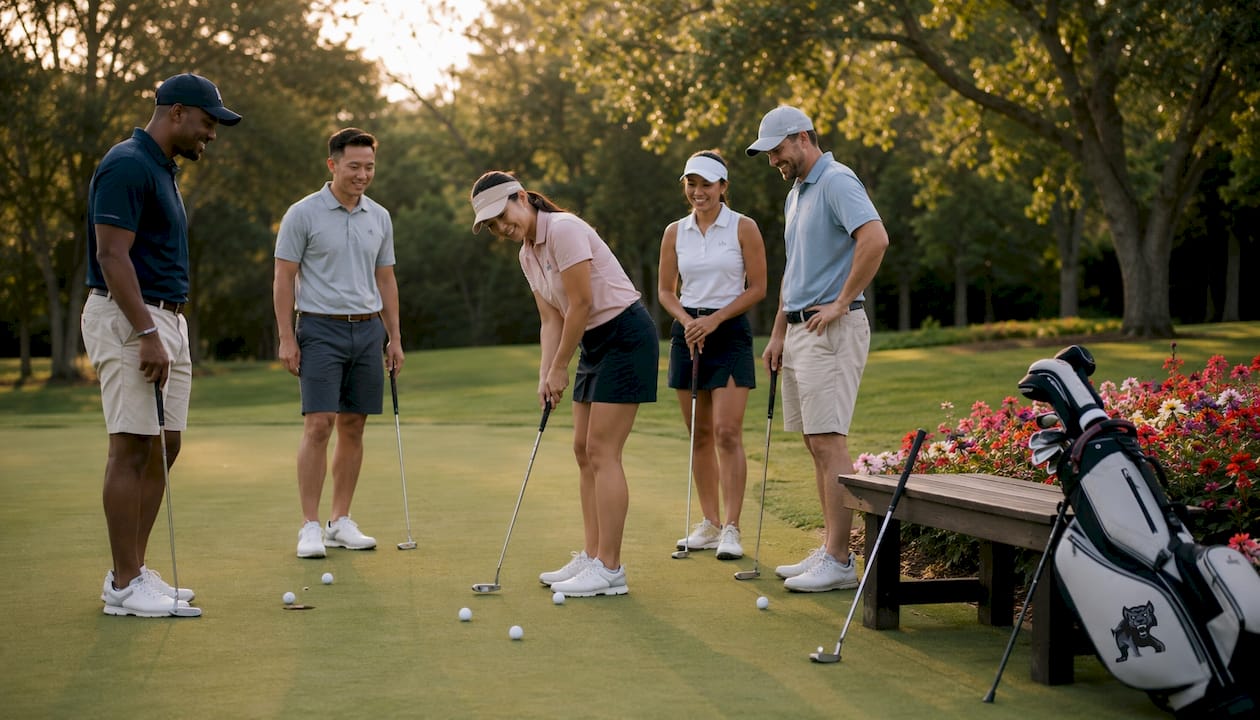
Group golf learning ideas work best when they blend structured coaching, friendly competition, and genuine social connection — giving every golfer in the session a reason to return. Whether you are stepping onto the fairway for the first time or refining a mid-handicap game, the collective energy of a well-run group session accelerates progress in ways that solo range time rarely matches.
The most effective group learning formats include:
- Themed practice sessions built around a single skill (short game, course management, bunker play)
- Game-based drills such as Battleship chipping, Lunar Landing pitching, and Jeopardy-style rules quizzes
- Contextual practice that mimics real course conditions, including pressure and decision-making
- Peer feedback rounds where golfers observe and coach one another under instructor guidance
- Technology-assisted sessions using launch monitors and swing analysis apps for shared data literacy
- Social formats like “Coffee and Chipping” or “Pitching and a Pint” that lower barriers and build community
Group lessons also deliver measurable skill gains. A PLOS One randomized controlled trial found that tactical awareness training in group settings produced significant improvements across all measured subscales of strategic decision-making, while skill-based group training produced notable gains in putting accuracy and swing consistency. The social and motivational benefits are equally real: when golfers practice alongside peers who share their goals, accountability deepens and the sport becomes something to look forward to, not just work through.
Table of Contents
- Why group golf lessons accelerate skill development
- How to choose the right instructor for group sessions
- Setting individual and group goals that actually drive progress
- Structured practice sessions: drills and exercises that keep groups engaged
- How technology can sharpen group learning without overwhelming participants
- Research-backed methods and community building for lasting group progress
- Golf Blab brings your group learning to life
- Key Takeaways
Why group golf lessons accelerate skill development
The case for group learning goes well beyond convenience or cost. Watching a fellow golfer work through the same swing challenge you face is itself a form of learning, activating the same mental rehearsal processes as physical practice. Peer observation sharpens your eye for movement patterns and gives you a vocabulary for self-correction that solo practice rarely builds.
Social interaction also sustains motivation across weeks and months. Group sessions serve both physical skill development and mental health through social bonding, and ongoing communication channels — a shared messaging group, a weekly WhatsApp thread with drill reminders — are key to keeping golfers engaged between sessions. That ongoing connection transforms a six-week course into a lasting community.
Friendly competition within the group adds another layer of engagement. When a drill has a score attached, golfers naturally invest more attention in each shot, which mirrors the focus required on the course. The result is practice that feels like play, and play that quietly builds technique.
Key advantages of group golf lessons at a glance:
- Shared feedback accelerates error recognition and self-correction
- Peer observation reinforces motor learning without additional instructor time
- Friendly competition raises focus and emotional investment in each shot
- Social bonds improve attendance, accountability, and long-term retention
- Lower cost per session compared to private instruction, broadening access
- Welcoming atmosphere reduces intimidation for beginners and returning golfers
How to choose the right instructor for group sessions
The qualities that make an excellent one-on-one instructor do not automatically translate to group settings. Managing four to eight golfers simultaneously demands a different set of skills: clear, concise communication that lands for every experience level in the room, the ability to read group energy and adjust pacing, and a genuine talent for delivering individual feedback without stalling the session for everyone else.
Look for an instructor who structures each session around a single, clear objective. As one PGA coach puts it, every golfer should leave with one clear win for their own game. That discipline prevents the common trap of trying to fix everything at once, which leaves participants confused rather than confident. A good group coach also keeps the session moving through mirror drills, no-ball exercises, and paired activities so that no one is standing idle.
Credentials matter, but teaching style compatibility matters more. An instructor who holds a PGA certification and can be found through the PGA coach directory brings a verified foundation in motor learning and coaching methodology. Beyond credentials, ask prospective instructors how they handle mixed-ability groups, how they deliver individual feedback within a group format, and what a typical session structure looks like.
Instructor selection criteria worth prioritizing:
- PGA or equivalent coaching certification
- Demonstrated experience with mixed-ability adult groups
- Clear session objectives communicated before each lesson
- Ability to deliver concise, individual feedback without halting group flow
- Use of paired and mirror drills to maintain participant engagement
- Willingness to cap group size at around eight for quality interaction
Setting individual and group goals that actually drive progress
Vague goals are the quiet enemy of group learning. When a golfer says they want to be “more consistent,” that phrase can mean a dozen different things, and an instructor who does not dig deeper will spend weeks coaching in the wrong direction. The most productive group sessions begin with a brief goal-setting conversation that translates broad ambitions into specific, measurable targets: reducing three-putts per round, landing approach shots within a defined zone, or completing a chip-and-run sequence with a particular club.
Balancing individual objectives with shared group goals requires deliberate structure. A group might collectively aim to complete a five-week short-game program, while each member tracks a personal metric within that framework. This layered approach respects the diversity of skill levels and motivations that naturally exist in any group, from the beginner who wants to break 100 to the mid-handicapper chasing a single-digit index.
Peer accountability is one of the most underused tools in group learning. When golfers share their weekly targets with the group, even informally, they create a social contract that sustains effort between sessions. Pairing golfers of similar ability for specific drills also allows for more targeted feedback and a natural check-in rhythm.
Practical goal-setting techniques for group sessions:
- Start with one measurable personal goal per golfer before the first session
- Connect individual goals to a shared group milestone for collective motivation
- Use simple tracking tools — a scorecard, a notes app, a shared spreadsheet — to record progress
- Revisit goals at the midpoint of a program and adjust based on actual performance
- Encourage golfers to share one specific improvement each session, however small
- Build in a brief reflection at the end of each session using the Plan-act-Review framework
Structured practice sessions: drills and exercises that keep groups engaged
The most common mistake in group practice is defaulting to blocked repetition — hitting the same shot from the same spot until the bucket is empty. Motor learning research is clear that contextual interference, mixing clubs, targets, and conditions within a session, produces better long-term retention than repetitive blocked practice, even though it feels harder in the moment. That productive difficulty is precisely the point.

Game-based drills solve the engagement problem while delivering the variability that learning requires. Battleship asks golfers to chip to target cones arranged in a grid, scoring points for direct hits. Lunar Landing sends pitches to distance zones marked on the fairway, rewarding precision over power. Jeopardy-style rules quizzes run as team trivia, building course knowledge while giving golfers a mental break between physical reps. These game-based activities boost engagement through friendly competition and break the monotony that kills motivation in longer sessions.
Pro Tip: Pair golfers of different ability levels for game-based drills rather than grouping by skill. The stronger player develops communication and observation skills; the newer golfer benefits from watching a more experienced swing up close. Both leave with more than they came in with.
A well-structured 60-minute group session might look like this: ten minutes of warm-up and goal review, twenty minutes of a paired mirror drill targeting the day’s technical focus, twenty minutes of a competitive game-based activity, and ten minutes of group reflection using the PaR framework. Keeping the group moving and the format varied prevents the mental fatigue that sets in when sessions feel like assembly lines.
Sample drills and exercises for group sessions:
- Battleship chipping: target cone grid, scored by accuracy
- Lunar Landing pitching: distance zones, rewarding controlled trajectory
- 21 Chipping: team-based point accumulation with zone scoring
- Jeopardy rules quiz: team trivia on golf rules and etiquette
- Mirror drill pairs: one golfer swings, one observes and gives one-word feedback
- Pressure putting ladder: sequential putts with a consequence for missing, simulating course nerves
- Explore more golf challenge ideas for additional competitive formats
How technology can sharpen group learning without overwhelming participants
Launch monitors, 3D motion capture systems, and swing analysis apps have moved from tour vans to public teaching bays, and their presence in group sessions can transform abstract coaching cues into concrete, shared data. Seeing ball speed on a screen after a drive gives every golfer in the group an immediate reference point, one that is far more memorable than a verbal description of tempo or contact quality.
The risk is data overload. Introducing too many metrics at once fragments attention and can make newer golfers feel that the technology is judging them rather than helping them. The most effective approach is to introduce metrics gradually, starting with ball speed before adding launch angle, and only introducing spin rate once the group has developed a shared vocabulary for the earlier metrics. That sequencing builds data literacy organically, turning numbers into tools rather than obstacles.
Shared terminology is the bridge between raw data and genuine learning. When every golfer in the group understands what “carry distance” means and can relate it to their own swing, the data becomes a conversation rather than a lecture. Group members start coaching each other with precision, referencing specific numbers rather than vague impressions.
Key technology tools and usage principles for group sessions:
- Launch monitors (e.g., Trackman, FlightScope): start with ball speed and carry distance only
- Swing analysis apps (e.g., V1 Golf, Hudl Technique): use side-by-side video for peer comparison
- 3D motion capture systems: best reserved for advanced groups with established data literacy
- Introduce one new metric per session, not one per shot
- Build a shared glossary of terms before the first technology-assisted session
- Use data as a conversation starter, not a verdict on performance
Research-backed methods and community building for lasting group progress
The most durable group learning programs are built on motor learning science, not habit or tradition. The PaR framework, drawn from peer-reviewed motor learning research, reframes practice as a problem-solving activity rather than a repetition exercise. Golfers who plan each shot deliberately, execute it, and then review the outcome with genuine curiosity develop error-detection skills that transfer directly to the course. The research argues that overemphasizing the act of swinging, at the expense of planning and review, is the single most common error in golf practice.
The Practice Thinkers’ DTP framework (Develop, Train, Perform) extends this thinking into a phased structure that group coaches can adopt across a multi-week program. The Develop phase encourages exploration of movement solutions in a low-pressure environment. The Train phase introduces task difficulty and competitive pressure to push golfers beyond their current ceiling. The Perform phase consolidates what has been learned, allowing golfers to execute with confidence rather than experiment. Integrating situational and emotional challenges into the Train phase, such as simulating a one-shot lead with five holes to play, produces practice environments that genuinely mirror course pressure.
Community building is the often-overlooked multiplier in all of this. Creative session branding, “Coffee and Chipping” on a Tuesday morning, “Pitching and a Pint” on a Friday evening, reduces learner intimidation and signals that the group is a welcoming space rather than a performance arena. Social media, particularly Instagram and Facebook groups, extends that community beyond the lesson tee, keeping golfers connected, motivated, and visible to one another between sessions.
Pro Tip: End every group session by asking each golfer to name one thing they will practice before the next meeting. That single commitment, spoken aloud in front of peers, dramatically increases the likelihood of follow-through.
Evidence-based strategies for group golf learning:
- Apply the PaR framework: plan deliberately, execute, review with curiosity
- Use the DTP structure across a multi-week program for phased skill development
- Introduce situational and emotional challenges in the Train phase to simulate course pressure
- Build a shared communication channel (messaging app, social group) for between-session engagement
- Use creative session names and social media to grow community visibility and reduce intimidation
- Pair peer feedback with instructor guidance to reinforce learning without overloading the coach
Golf Blab brings your group learning to life
Group practice reaches a different level when the experience carries a personal dimension. Golf Blab offers golfers two ways to make that happen. The Play Golf with a Tour Pro experience places you and your group directly alongside a professional golfer, turning a standard session into a masterclass in decision-making, course management, and competitive mindset. It is the kind of access that no amount of range time can replicate, and it fits naturally into the social, skill-building spirit that makes group learning so rewarding.
For golfers who want to carry that sense of identity onto the course, Golf Blab’s custom golf club labels let every member of the group personalize their equipment with designs that reflect who they are as a player. Beyond aesthetics, that personal mark builds a sense of ownership and pride that quietly reinforces commitment to improvement. Golf Blab’s educational resources, developed with insights from LPGA professional Mariel Galdiano, extend the learning well beyond any single session. Visit Golf Blab to explore both offerings and find the next step that fits your group.
Key Takeaways
Group golf learning works best when structured practice, social engagement, and research-backed coaching methods are combined into a single, cohesive program.
| Point | Details |
|---|---|
| Game-based drills drive retention | Activities like Battleship chipping and Lunar Landing pitching build skills through competition, not repetition. |
| Contextual interference beats blocked practice | Mixing clubs, targets, and conditions within a session produces better long-term skill retention. |
| Session length and group size matter | Sixty-minute sessions capped at around eight golfers allow for meaningful individual feedback and sustained engagement. |
| Technology works best introduced gradually | Starting with ball speed before adding launch angle prevents data fatigue and builds shared data literacy. |
| Golf Blab deepens the group experience | The Play Golf with a Tour Pro experience and custom club labels add professional insight and personal identity to group learning. |