Posted on

Take the “Swing Like a Pro” golf lesson challenge at Golf Blab

If you are interested in improving your golf game quickly through a free, four-minute online lesson, the Swing Like a Pro Golf Lesson Challenge by Golf Blab is for you. Swing Like a Pro is the only golf lesson that comes with a 100% money back guarantee. Our four-minute, online golf lesson, will quickly upgrade your drive, chip, and putt to tour quality and deliver low golf scores NOW. GUARANTEED, or your money back!

The first five people to respond to this post via email will receive a free online golf lesson from Golf Blab, and a set of Golf Blab custom golf club labels.

To be eligible for the free lesson and golf balls you should have a golf handicap of 12 or above. If you do not have a handicap, your average scores should be 90 or above. Please send an email to Michael@golf-blab.com and express your interest in participating in the challenge. Include your name, address and phone number.

Once we accept you into the challenge, you will be asked to provide pre-lesson video of your golf swing, either on a driving range or on course. You will need three swings taken face-on and three swings taken down the line showing your ball flight. We will also need video of you chipping and putting. And you will need to state your name and city/state on camera.

After your pre-swing videos are received, you will be given an e-gift certificate so you can purchase your online golf lesson on the Golf Blab website. Upon viewing the lesson, you will be asked to take the same swing videos post lesson, showing your improvement in driving, chipping and putting and giving your personal lesson testimonial. After your post swing videos and testimonial are received, your custom golf club labels will be mailed to you.

By participating, you agree to allow your likeness, videos and testimony to be used by Golf Blab in online promotions. We look forward to hearing from you! You have nothing to lose but your handicap.

Posted on

Golf stance explained: master your setup for better shots

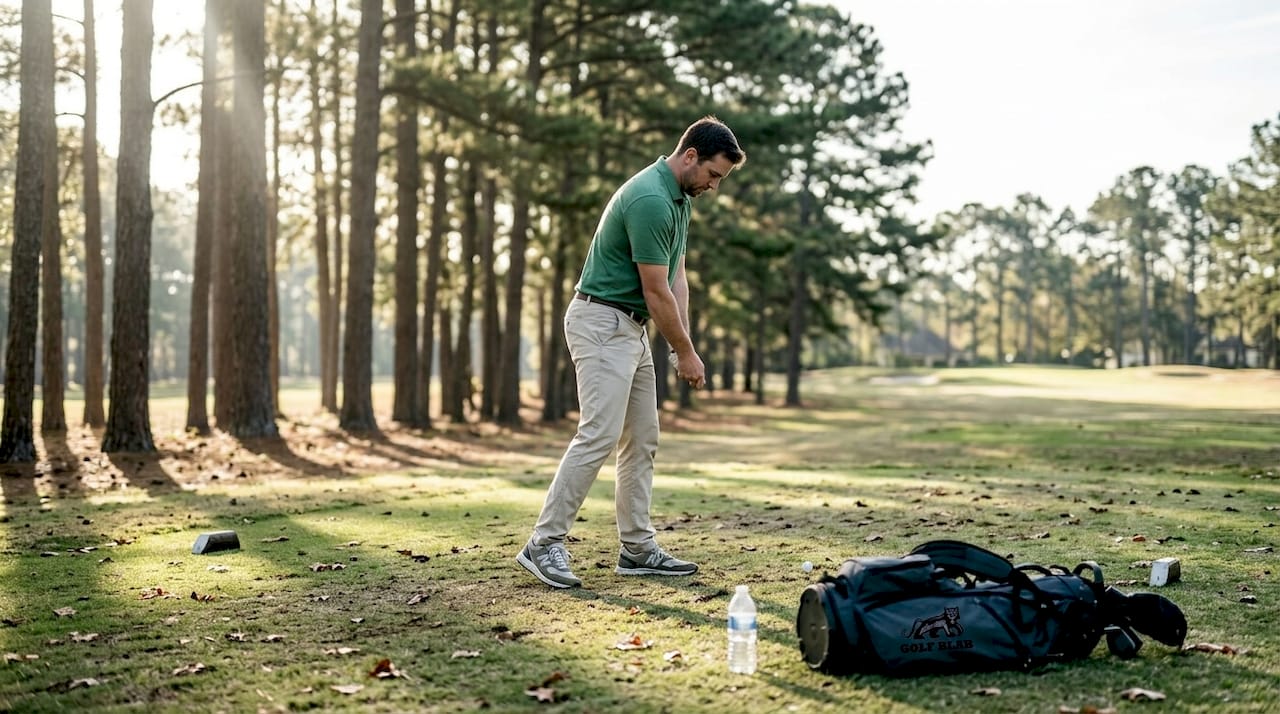
Golfer preparing stance on course tee


TL;DR:

  • A proper golf stance involves feet placement, knee flex, hip tilt, spine angle, and balance.
  • Even weight distribution at address and correct weight transfer during the swing are crucial for power and accuracy.
  • Focus on dynamic balance and weight timing rather than overcomplicating foot angle or ball position for better results.

Most golfers think a good stance is about where you put your feet. That’s it. Feet together, feet apart, point them left or right. But that’s only a fraction of the picture. Even minor stance changes can dramatically affect ball contact and swing speed, and most players have no idea they’re leaving distance and accuracy on the table before the club even moves. This guide cuts through the noise and gives you the real fundamentals: what a proper stance actually involves, why weight distribution matters more than most instructors admit, and how to fix the mistakes that are quietly wrecking your game.

Table of Contents

Key Takeaways

Point Details
Stance fundamentals matter A proper golf stance forms the base for consistent, accurate shots.
Weight distribution is key Distribute weight evenly at address and shift smoothly for maximum power.
Mistakes have quick fixes Common stance errors can be corrected with simple adjustments and awareness.
Research backs timing Low-handicap players use faster, earlier weight transfer for better results.
Practice builds confidence Regular stance checks and drills help you translate knowledge into better performance.

What is a golf stance and why does it matter?

Your golf stance is the total package of how you position your body before you swing. It’s not just your feet. It covers your feet placement, knee flex, hip position, spine angle, and overall balance. Every one of those elements works together to create the platform your swing launches from. Get one wrong, and the whole thing can fall apart.

Think of it this way. If you tried to throw a baseball while standing on one foot with your shoulders twisted sideways, you’d lose power and control instantly. The same logic applies here. Your stance is the foundation that supports every dynamic movement in the swing. Without a solid foundation, you’re just hoping for the best.

Here’s what most golfers get wrong: they treat stance like it’s about aesthetics. Like it’s something you do to look like a pro in photos. The truth is, stance is functional. It’s mechanical. Subtle variations in how you set up directly impact how well you strike the ball, how far it goes, and how consistently you repeat the shot.

Easy golf lessons will always start with stance because everything else builds on it. If your setup is off, no amount of swing tips will save you.

Core elements of a proper stance:

  • Feet: Roughly shoulder-width apart, toes slightly flared outward
  • Knees: Softly flexed, not locked or deeply bent
  • Hips: Tilted forward from the hip joint, not the waist
  • Spine: Neutral angle, not hunched or overly upright
  • Balance: Weight centered and evenly distributed

Pro Tip: Before every shot, run a quick mental checklist of these five elements. It takes five seconds and can save you from a bad swing before it ever starts.

“Even distribution at address enables better energy transfer throughout the swing.” Research consistently shows that 50/50 weight distribution at address for iron shots creates the best starting point for a powerful, controlled swing.

Key elements of an effective golf stance

Now that you know what stance means, let’s get specific. Because knowing the components is one thing. Understanding how each one affects your shot is where real improvement happens.

Foot width is the starting point. A shoulder-width stance gives you the balance and rotational freedom you need for most iron shots. Go too wide and you restrict your hip turn. Go too narrow and you lose stability. It’s a simple guideline, but it works.

Golf stance with proper foot width

Alignment is where many golfers quietly bleed shots. Your feet, hips, and shoulders should all run parallel to your target line, with the clubface square to the target. Even a few degrees off and you’re fighting your own setup on every swing. Low-handicap golfers show superior timing and weight transfer, which starts with correct alignment at address.

Infographic showing stance alignment basics

Posture is the one most people get completely wrong. You tilt from the hips, not the waist. When you bend from the waist, you round your back and restrict your shoulder turn. Tilt from the hips and your spine stays neutral, your chest faces the ball properly, and your arms hang naturally.

Check out these swing like a pro drills to see how posture connects directly to swing mechanics.

Setup element Proper form Common fault
Foot width Shoulder-width apart Too wide or too narrow
Alignment Parallel to target line Open or closed to target
Posture Hip hinge, neutral spine Bent at waist, rounded back
Knee flex Slight, athletic bend Locked straight or over-bent
Weight distribution Even, centered Heels or toes, or one-sided

Posture and balance self-assessment checklist:

  • Can you feel equal pressure in both feet?
  • Are your knees over your shoelaces, not your toes?
  • Is your back flat, not rounded?
  • Do your arms hang freely without reaching or crowding?
  • Are your shoulders relaxed, not raised toward your ears?

If you answer no to any of these, you’ve found your first fix.

The science of weight distribution and transfer

Here’s where things get genuinely interesting. Most golfers know they should “shift their weight” during the swing. But few understand how that shift should happen or when it matters most.

At address, the best practice for iron shots is a 50/50 weight split between both feet. That’s your neutral starting point. From there, the backswing loads roughly 60% of your weight onto your trail foot. Then the downswing drives that weight aggressively forward to your lead foot.

The key word is timing. Research on ground reaction force (GRF), which is the force your feet exert against the ground during the swing, shows that skilled golfers generate this transfer earlier and more powerfully than amateur players. That earlier transfer is what creates the speed and compression that separates a good ball striker from an average one.

Efficient weight timing directly links to higher ball speeds. Skilled players don’t just transfer more weight. They transfer it faster and at the right moment in the swing.

Metric Low-handicap golfer High-handicap golfer
GRF peak timing Earlier in downswing Later, near impact
Lead foot transfer Strong and early Weak and delayed
Ball speed result Higher Lower
Contact consistency More reliable More variable

Low-handicap players generate greater and earlier ground reaction force transfer to their lead foot compared to high-handicap players. That’s not a minor detail. That’s the difference between a flush iron and a thin, weak contact.

Pro Tip: Film your swing from the face-on angle, or use a mirror at the range. Watch where your weight sits at the top of your backswing and whether it genuinely moves forward through impact. Most golfers are shocked by what they see. Check out golf swing speed tips to train this transfer more effectively.

Common stance mistakes and quick fixes

Let’s get practical. You know what a good stance looks like. Now let’s talk about what most golfers actually do, and how to fix it fast.

Amateurs plateau by failing to transfer weight efficiently, which undermines power and consistency. Most of the time, that failure traces back to a flawed setup. Here are the top mistakes and their quick fixes:

  1. Stance too wide or too narrow: If your feet are wider than your shoulders, you’re restricting hip rotation. If they’re too narrow, you lose stability. Fix: Stand with feet directly under your shoulders and adjust from there based on the club you’re hitting.

  2. Hunched posture: Rounding your back at address kills your shoulder turn and puts stress on your lower back. Fix: Practice the hip hinge. Stand tall, push your hips back, and let your chest tilt toward the ball naturally.

  3. Weight too far on toes or heels: This throws off your balance through the entire swing. Fix: Feel the pressure in the balls of your feet, just behind your toes. That’s your athletic position.

  4. Alignment errors: Most golfers aim right of their target without knowing it. Fix: Lay two clubs on the ground at the range, one along your toe line and one pointing at your target. Compare them. You’ll likely be surprised.

  5. Stiff, rigid setup: Tension in your arms, shoulders, or legs kills swing speed. Fix: Take a deep breath before addressing the ball. Let your arms hang loose. Think “ready to move,” not “locked in position.”

Pro Tip: Set up to the ball without a club in your hands. Just get into your stance naturally and check your balance. If you feel awkward or unstable, that’s your body telling you something is off. Use golf lesson tips to build these corrections into repeatable habits.

Why most golfers overcomplicate their stance and what actually matters

Here’s something we’ve seen over and over again. Golfers spend hours obsessing over foot angle, ball position, and the exact distance from the ball, then step up and make the same swing they always have. All that prep work, and nothing changes.

The naked truth? Most golfers are focusing on the wrong things. The details matter, sure. But the real difference between a golfer who improves and one who stays stuck is whether they’ve trained dynamic balance and weight timing. Those are the two things that actually show up in ball flight.

The research is clear: the difference is in how and when you transfer energy, not just how you stand. A textbook-perfect static stance means nothing if your weight never moves correctly through the swing.

At Golf Blab, we’ve seen this firsthand. The golfers who make the fastest progress aren’t the ones who memorize every position. They’re the ones who find a simple, repeatable setup and then train their weight shift until it becomes automatic. Stop chasing perfection and start chasing consistency. Visit Golf Blab for a complete golf lesson approach that builds real, lasting habits instead of temporary fixes.

Experiment. Find your personal stance sweet spot. Then repeat it until it’s second nature.

Unlock your best swing with Golf Blab tools and lessons

You’ve got the knowledge. Now it’s time to put it to work with the right support behind you.

https://golf-blab.com

At Golf Blab, we’ve built resources specifically for golfers who are serious about improving their setup and swing mechanics. The swing like a pro program takes everything you’ve read here and walks you through it with structured, actionable lessons designed to build real muscle memory. Want to take it further? You can even play with a tour pro and get direct feedback on your stance and weight transfer from someone who does this at the highest level. Browse our full lineup of golf improvement tools to find the gear and guidance that fits your game right now.

Frequently asked questions

What is the ideal golf stance width?

A shoulder-width stance provides the optimal balance and base for most shots, giving you the rotational freedom and stability your swing needs. Foot width sets the platform for balance throughout the swing.

How should weight be distributed at address?

At address, distribute your weight evenly (50/50) between both feet for iron shots to create the best starting point for energy transfer. Even weight at address is the foundation for a consistent swing.

Why is weight transfer important in the golf swing?

Proper weight transfer generates speed and ensures solid ball contact by loading and releasing energy at the right moment. Efficient weight transfer leads directly to higher ball speeds and better contact.

How do I know if my stance needs adjustment?

If you lose balance during or after your swing, hit inconsistent shots, or feel physically awkward at address, your stance is worth revisiting. Posture and balance are fundamental to effective ball striking at every skill level.

Posted on

9 golf strategy tips to lower your scores fast

Golfer practicing swing at driving range


TL;DR:

  • Long game accounts for approximately two-thirds of golf score variability.
  • Focusing on driving accuracy and approach shots yields faster scoring improvements.
  • Modern equipment enhancements boost consistency but require proper skill to maximize benefits.

You’ve heard it a thousand times: “Drive for show, putt for dough.” It sounds wise, but modern data tells a very different story. Research shows the long game explains ~2/3rds of your score variability, not your putting. That means the hours most golfers spend on the practice green may be the least efficient use of their time. If you want to lower your scores fast, you need a smarter strategy, one built on what the numbers actually say. This article gives you nine concrete tips grounded in modern analysis and real-world play, so you can stop guessing and start improving.

Table of Contents

Key Takeaways

Point Details
Long game first Driving and approach shots impact your score more than putting.
Approach is key Most amateurs lose strokes on approach shots, not putts.
Smart equipment matters Modern gear lets you apply strategy more effectively.
Short game focus Refine your putting after building a consistent long game.

Prioritize your long game for impact

Having reframed what drives scoring, let’s dive into the specific areas where effort yields the biggest returns.

The naked truth is that most amateur golfers spend the majority of their practice time chipping and putting. It feels productive. You see the ball go in the hole. But if SG:OTT explains 28% of scoring variance, meaning Strokes Gained: Off the Tee, the metric that measures how your driving compares to the field, then ignoring your tee shots is like fixing the paint on a car with a broken engine.

Strokes Gained: Off the Tee (SG:OTT) is a stat that captures both distance and accuracy off the tee. It tells you how many strokes you gain or lose compared to the average golfer. A positive number means you’re helping your score before you even reach the fairway. A negative number means you’re already fighting an uphill battle on every hole.

Area Scoring variance explained
Long game (SG:OTT + approach) ~67%
Putting (SG:P) ~19%
Short game (chipping/pitching) ~14%

So where should average golfers focus? Three areas stand out: driving accuracy, distance control, and approach shot consistency. These are the levers that move the needle most.

Three drills to improve your long game:

  • Alignment stick drill: Place a stick on the ground pointing at your target. Practice swinging along that line to build directional consistency off the tee.
  • Half-swing tempo drill: Hit balls at 50% power focusing on clean contact. This builds the muscle memory that translates to better full swings under pressure.
  • Fairway tracking: After every round, note how many fairways you hit. Tracking this number forces you to think about placement, not just power.

Pro Tip: Record your fairway percentages for four rounds in a row. Most golfers are shocked by how low the number is. Awareness alone can improve your decision-making off the tee. If you want structured guidance, easy golf lessons can help you build a repeatable swing that holds up on the course. You can also explore how to swing like a pro with focused, step-by-step instruction built for real golfers. For more context on club selection and course management, golf club resources offer useful supplementary reading.

Use approach shots to capitalize on distance

With a stronger long game, your next scoring opportunity is approach precision.

Approach shots are often the biggest leak for amateur golfers. You can stripe a drive down the middle and still make bogey or worse if your approach misses the green by 30 feet. That gap between a good drive and a makeable putt is where most amateur scores fall apart.

Golfer preparing approach shot on fairway

The top three approach mistakes amateurs make are: choosing the wrong club, aiming at the pin instead of the center of the green, and ignoring wind and lie. Each one costs strokes in a very preventable way.

Steps to pick the right target line on approach:

  1. Identify where trouble is located (bunkers, water, thick rough).
  2. Find the fat part of the green, the area that gives you the most room for error.
  3. Factor in wind direction and strength before selecting your club.
  4. Commit to the shot. Indecision creates tension, and tension kills contact.
  5. Aim for the center of the green unless the pin is in a low-risk position.
Strategy Amateur approach Pro approach
Target selection Aim at the flag Aim at center of green
Club selection Based on best-case distance Based on average carry distance
Wind adjustment Often ignored Always factored in
Risk management High-risk lines common Conservative lines preferred

Pro Tip: Always account for wind and lie when planning your shot. A downhill lie in the rough plays very differently than a flat lie in the fairway, even with the same club. Treat every approach as its own problem to solve. If you want to sharpen your approach game with real feedback, the lesson guarantee at Golf Blab means you have nothing to lose by trying.

Adopt equipment advances for strategic advantage

Mastering your approach shot choices is vital, but equipment can make the difference between consistency and chaos.

Modern equipment shifts strategic priorities in meaningful ways. Today’s drivers are more forgiving on off-center hits. Modern irons have larger sweet spots. High-performance golf balls offer better spin control and distance. These are not just marketing claims. They genuinely change what shots you can attempt and how often you can execute them.

That said, new equipment is not a substitute for skill. The golfer who can’t make solid contact will not suddenly become consistent just because they bought a new driver. Equipment works best when it amplifies a skill that already exists, even a basic one.

Essential equipment upgrades for the modern game:

  • Forgiving irons: Game-improvement irons with wider soles and cavity backs reduce the penalty for slight mishits.
  • High-launch drivers: A driver fitted to your swing speed and attack angle can add real distance without extra effort.
  • Quality golf balls: Switching to tour golf balls designed for your swing speed improves both feel and performance.
  • Custom club labels: Staying organized on the course matters more than people think. Custom club labels keep your bag tidy and your mind focused.
Equipment upgrade Potential performance impact
Game-improvement irons More greens in regulation, fewer big misses
Fitted driver 10 to 20 yards added distance on average
Tour-level golf ball Better spin control and distance consistency
Proper shaft flex Improved accuracy and trajectory control

The key is to get fitted, not just buy. A club that doesn’t match your swing speed or tempo can actually hurt your game. Spend an hour at a fitting session before making any major purchase.

Don’t overlook the short game: When and how to focus

Having explored distance, approaches, and equipment, what about the short game’s famous reputation?

Here’s the honest answer: putting matters, just not as much as you’ve been told. SG:P explains only 19% of scoring variance. That’s real, but it’s not the dominant factor. The short game becomes most valuable once your long game and approach play are reasonably solid. If you’re still losing three shots off the tee every round, spending two hours on putting drills is not the best use of your time.

That said, there are specific situations where short game focus absolutely pays off. If you’re already hitting greens in regulation at a decent rate and your scores aren’t dropping, your short game is likely the leak. Golfers who regularly reach the green in regulation but three-putt often will see immediate score improvement from putting work.

Critical short game drills to practice:

  • Gate drill: Place two tees just wider than your putter face and practice rolling the ball through them. This fixes the path and face angle in one move.
  • Distance ladder: Set balls at 10, 20, and 30 feet and try to stop each putt within 18 inches of the hole. This builds lag putting skill fast.
  • Chip and run practice: From just off the green, practice using a 7-iron to bump and run the ball to the hole. It’s more reliable than a lob wedge for most amateurs.

“The best players in the world don’t practice putting more than anything else. They practice what loses them the most shots. For most golfers, that’s not on the green.”

Balance is the word here. A focused 20 minutes on putting after a long game session is smart. Spending your entire practice time on the putting green while your swing falls apart is not.

Why modern strategy beats old-school thinking

Putting it all together, here’s how we view strategy for the 2026 golf environment.

The old advice, “putt for dough,” came from an era before we had the data to actually measure what drives scoring. It was a reasonable guess. But it was still a guess. Now we know better, and smart golfers are using that knowledge to practice smarter, not just harder.

At Golf Blab, we’ve seen too many golfers grind on their putting stroke for years while their swing quietly falls apart. The game-changing lesson strategy we believe in starts with the swing, moves to approach play, and treats the short game as a finishing touch, not the foundation. Analytics and modern equipment give you an edge that previous generations simply didn’t have. Use them. The golfers who adapt to what the data actually says are the ones who drop three, four, even five strokes in a single season. The ones who keep doing what they’ve always done keep getting the same results.

Ready to transform your golf game?

Take your next step toward better scores with hands-on guidance and proven tools.

If you’re serious about lowering your scores, you don’t have to figure this out alone. At Golf Blab, we offer money-back golf lessons that are built around what actually moves the needle, starting with your swing and working through every part of your game. We’re the only company that backs our lessons with a full money-back guarantee. No risk, just results.

https://golf-blab.com

Check out our lesson demo to see what a focused, four-minute lesson looks like in practice. Or browse our golf gear shop for equipment and products designed to complement your improvement. The next lower score is closer than you think.

Frequently asked questions

What is the most effective strategy to lower golf scores quickly?

Focus on improving your long game, especially driving and approach shots, since driving and long game account for about two-thirds of scoring variance. That’s where the fastest gains live for most amateur golfers.

Is putting still important if the long game matters more?

Yes, but prioritize long game improvement first. Putting becomes crucial once you have a solid swing and approach consistency, since SG:P explains only 19% of scoring variance.

How does equipment choice affect golf strategy?

Modern clubs and balls can greatly increase distance and forgiveness, and modern equipment shifts the balance of strategic priorities, letting you focus your practice on key areas that matter most.

Do online golf lessons really help improve scores?

Yes, structured online lessons target your weakest areas with focused feedback, and when they come with a money-back guarantee, there’s genuinely no reason not to try them.

Posted on

Golf rules explained: master the basics for better play

Golfer studies ball as it lies off fairway


TL;DR:

  • Golfers often misunderstand the rules, leading to unnecessary penalties and errors.
  • Understanding core principles like playing the ball as it lies and area-specific rules offers a strategic advantage.
  • Knowing when and how to take relief, along with pace-of-play rules, enhances fairness and improves scores.

Most golfers walk onto the course with a vague idea of the rules and hope for the best. That’s a costly strategy. Governed by the USGA and The R&A, the Rules of Golf are more detailed than most beginners expect, and misunderstanding them leads to avoidable penalties, awkward moments with playing partners, and strokes you didn’t need to lose. Here’s the thing though: once you understand even the core principles, you stop fearing the rules and start using them. This guide breaks down the essentials in plain language so you can walk onto any course with real confidence.

Table of Contents

Key Takeaways

Point Details
Know the basics Understanding core principles like playing the ball as it lies prevents costly mistakes.
Course areas matter Rules change depending on tee, fairway, penalty area, bunker, or green.
Relief can help Knowing how and when to take relief can give you genuine advantages.
Pace prevents penalties Stick to timing rules to avoid strokes added for slow play or delays.
Rules are resources Using rule knowledge turns penalties into play opportunities.

Core principles: Play the ball as it lies

Golf is one of the few sports where you call penalties on yourself. There’s no referee watching every shot. That means the entire game runs on honesty and self-policing, and that’s actually something to be proud of. It’s a culture of integrity that separates golf from almost every other sport out there.

The foundational principle is simple. As the USGA puts it, you play the ball as it lies, play the course as you find it, and only take relief when the rules specifically allow it for fairness. That’s the whole philosophy in one sentence.

“The Rules of Golf are designed to be fair to all players. The core idea is simple: play the ball as it lies and the course as you find it.”

What does that mean in practice? It means if your ball rolls into a divot, you play it from the divot. If it lands behind a tree, you play it from behind the tree. You don’t get to move it just because you don’t like where it ended up. That’s the game.

Here’s where most beginners go wrong. They assume that certain situations automatically grant relief. They move the ball, improve their lie, or ground their club in a hazard without realizing those actions carry penalties. Common misconceptions include:

  • Thinking you can always move loose impediments near your ball (you can in most areas, but not always in bunkers)
  • Assuming a ball near a fence or cart path always gives you free relief (it depends on whether the obstruction is immovable)
  • Believing you can re-tee a ball that falls off the tee peg after a swing (no penalty, but only if you hadn’t yet made a stroke)
  • Thinking a provisional ball is the same as a lost ball ruling (it’s not, and the difference matters)

Golf rewards sportsmanship and fair play above all else. Once you internalize that the rules exist to protect everyone’s experience, including yours, they stop feeling like obstacles and start feeling like a framework you can work with.

Course areas and their unique rules

Here’s something that surprises a lot of new golfers: the rules don’t apply the same way everywhere on the course. Where your ball lands changes what you’re allowed to do with it. The five defined course areas each carry their own set of rules for play and relief.

Infographic of course areas and key golf rules

Course area Key rule highlights
Teeing area You may tee up the ball anywhere between the markers; re-tee if ball falls before stroke
General area Covers most of the course; standard rules apply for play and relief
Penalty areas Red or yellow stakes; stroke-and-distance or lateral relief options apply
Bunkers Can’t ground club before stroke; limited removal of loose impediments
Putting green May mark, lift, and clean ball; can repair spike marks and damage

Each area has a personality, so to speak. The putting green gives you the most flexibility. Bunkers give you the least. Understanding this breakdown alone will save you from making costly errors.

When your ball lands in a penalty area (marked by red or yellow stakes), here’s how to proceed:

  1. Identify the color of the stakes. Red allows lateral relief; yellow requires stroke-and-distance or back-on-the-line relief.
  2. Decide whether to play the ball as it lies (allowed even in penalty areas, if possible).
  3. If taking relief, add one penalty stroke to your score.
  4. For red stakes, drop within two club-lengths of where the ball crossed the boundary, no nearer the hole.
  5. For yellow stakes, go back as far as you like on the line between the hole and where the ball crossed, then drop.

Pro Tip: Learn the color of the stakes before your round starts. Red and yellow mean very different things, and knowing the difference in the moment will save you time and strokes.

Browsing the right golf gear for every area of the course can also make a real difference in how comfortable and prepared you feel during play.

Relief and penalty mechanics: When and how to take relief

This is where a lot of golfers leave strokes on the table. They either take relief they’re not entitled to (adding penalties they don’t know about) or they fail to take relief they’re fully allowed (suffering unnecessarily). Let’s fix both.

Free relief means no penalty stroke. You get it when your ball is affected by abnormal course conditions. These include:

  • Ground under repair (GUR), usually marked with white lines
  • Immovable obstructions like cart paths, sprinkler heads, or permanent structures
  • Temporary water (casual water) that you can see before or after you take your stance
  • Animal holes

When you qualify for free relief from abnormal conditions, here’s the process: find the nearest point of complete relief, then drop the ball from knee height within one club-length of that point, making sure it’s no nearer the hole. That’s it.

Situation Relief type Penalty stroke?
Ball on cart path Free relief (immovable obstruction) No
Ball in GUR Free relief No
Ball in penalty area Stroke-and-distance or lateral Yes (1 stroke)
Unplayable lie Player’s choice of three options Yes (1 stroke)
Lost ball Stroke-and-distance Yes (1 stroke)

Pro Tip: Relief can actually improve your position. If a cart path runs along the rough and your nearest relief point puts you on the fairway, that’s perfectly legal. Knowing this is the difference between a bogey and a par.

Golfer marks relief spot beside cart path

For penalty relief situations, like an unplayable lie, you have three options: go back to where you played the last shot, drop within two club-lengths of the ball’s spot, or go back on the line keeping the ball between you and the hole. All cost one stroke. Choosing the right option takes practice, but easy golf lessons can help you build that decision-making instinct faster than trial and error on the course.

Essential timing and search rules: Avoiding penalties on the course

Let’s talk about something that affects every single round: time. Specifically, how long you’re allowed to search for a lost ball and how quickly you’re expected to play. These rules trip up beginners constantly, and they affect not just your score but the enjoyment of everyone in your group.

The search rule is clear. You have three minutes maximum to search for a lost ball. After that, it’s officially lost. No exceptions. If the ball isn’t found within three minutes, you must return to where you played the last shot, add a penalty stroke, and play again. That’s stroke-and-distance relief.

Here’s what to do if you accidentally move your ball while searching:

  1. Stop searching and note where the ball came to rest.
  2. Replace the ball as close as possible to its original spot.
  3. No penalty stroke is added for accidentally moving it during a search.
  4. Continue play normally from the replaced position.

That’s a relief rule most golfers don’t know, and it matters.

On pace of play, ready golf is actively encouraged in recreational rounds. That means you play when you’re ready, not strictly in the traditional order of who’s furthest from the hole. It keeps things moving and keeps your group from getting that uncomfortable tap on the shoulder from the group behind you.

Undue delay is an actual penalty. In stroke play, the first offense results in a one-stroke penalty. Repeated delays can lead to two-stroke penalties. Most recreational rounds won’t enforce this formally, but the spirit of the rule matters. Slow play is the number one complaint among golfers, and nobody wants to be that person.

If you’re curious about what it feels like to play at a higher level of pace and precision, playing with a tour pro can give you a real-world sense of how the game flows when everyone knows the rules cold.

Why knowing the rules is your hidden weapon on the course

Here’s the honest truth that most golfers never figure out: the rules aren’t just boundaries. They’re tools. And most recreational golfers walk right past opportunities to use them.

Conventional wisdom says the rules are there to penalize you. That’s backwards. As the USGA points out, rules often provide real advantages, like taking free relief from rough to fairway via an obstruction, re-teeing in the teeing area, or finding a better stance through a left-handed relief option. These aren’t loopholes. They’re built-in features.

I’ve seen golfers take a penalty drop when they were entitled to free relief. I’ve seen players play from terrible lies next to cart paths because they didn’t know they could move. Every one of those situations cost strokes that didn’t need to be lost.

The moment you start treating the rules as a resource, your whole relationship with the game shifts. You stop feeling like the rules are happening to you and start feeling like you’re working with them. That’s a real competitive edge, even in a casual Saturday round.

Pro Tip: When you’re unsure about a ruling on the course, play two balls and sort it out after the hole. It keeps pace and protects your score. Pair that habit with easy golf lessons that build your rule awareness alongside your swing, and you’ll improve faster than you think.

Take your golf game further with expert support

Understanding the rules is a great start. But rules knowledge alone won’t lower your handicap. That takes real instruction, and that’s exactly what we built Golf Blab to deliver.

https://golf-blab.com

At Golf Blab, we offer a complete golf lesson experience unlike anything else out there. We’re the only company that backs every lesson with a money-back guarantee, because we’re that confident in the results. Whether you want easy golf lessons that fit your schedule or the once-in-a-lifetime experience of playing golf with a tour pro, we have the resources to take your game to the next level. Come learn with us.

Frequently asked questions

What is the basic rule for playing the ball in golf?

The main rule is to play the ball as it lies and play the course as you find it, only taking relief when the rules specifically allow it for fairness.

How are penalties handled for lost balls or delays?

You get three minutes to search for a lost ball before it’s officially lost, and ready golf is encouraged to keep pace, with undue delay carrying stroke penalties in formal play.

Where can I check the latest rules while on the course?

The USGA Rules 101 free course, the R&A Quick Guide video, and official apps give you instant access to rulings right from your phone during a round.

Article generated by BabyLoveGrowth

Posted on

How to choose golf clubs: beginner guide to smart investments

Beginner golfer choosing golf club on practice green


TL;DR:

  • Mismatched or poorly fitted clubs can hinder beginner golf performance and progress.
  • Professional club fitting enhances distance, accuracy, and consistency for new players.
  • Starter sets from reputable brands offer better value, forgiveness, and ease for beginners.

You sign up for golf lessons, drop a few hundred dollars on a shiny new set of clubs, and head out to the course full of excitement. Then nothing clicks. Your shots spray everywhere, your progress crawls, and the whole experience feels like a waste of time and money. Here’s the naked truth: the problem often isn’t your swing or your lessons. It’s your clubs. Mismatched, ill-fitted, or cheaply made clubs can quietly sabotage everything you’re trying to learn. This guide walks you through exactly how to choose the right clubs as a beginner, so your investment in the game actually pays off.

Table of Contents

Key Takeaways

Point Details
Fitting matters early Getting fitted for clubs from the start boosts improvement and makes golf more enjoyable.
Start with a package set Beginner sets save money, simplify your choices, and give you everything you need to play.
Avoid common mistakes Cheap, mismatched or no-name clubs hurt your progress much more than they help.
Plan to upgrade Most golfers outgrow their first set in 1-2 years—focus on learning before customizing your bag.

Understanding the basics: Golf club types and their purpose

With the importance of equipment in mind, let’s clarify what types of clubs you’ll actually need and what each one is for. Golf can feel overwhelming when you’re staring at a wall of clubs in a pro shop. But once you understand what each type does, the whole picture gets a lot simpler.

Every golfer carries a mix of five main club categories. Here’s a quick breakdown:

  • Driver: The big-headed club used for tee shots on long holes. It’s built for distance, not precision.
  • Fairway woods: Numbered 3 and 5 most commonly, these are used for long shots from the fairway or rough.
  • Hybrids: A cross between a wood and an iron. Easier to hit than long irons, and a lifesaver for beginners.
  • Irons: Numbered 4 through 9, these are your workhorses for approach shots. Higher numbers mean shorter distances and more loft.
  • Wedges: Specialized irons for short shots, chips, and bunker play. The pitching wedge and sand wedge are must-haves.
  • Putter: Used on the green to roll the ball into the hole. You’ll use this more than any other club.

Here’s a simple reference table to keep things straight:

Club type Typical use Skill required
Driver Tee shots, max distance Moderate to high
Fairway wood Long fairway shots Moderate
Hybrid Versatile mid-range shots Low to moderate
Iron (4-9) Approach shots Moderate
Wedge Short game, chipping Low to moderate
Putter Putting on the green Low

Now, you might be wondering how many clubs you actually need to start. The answer is simpler than you think. Complete beginner golf sets usually include 10 to 13 clubs, covering drivers, irons, hybrids, wedges, and a putter. That range covers every situation you’ll encounter on the course without burying you in options. Starting with a well-rounded set means you spend less time guessing which club to grab and more time actually learning to swing.

Get fitted: Why professional club fitting matters, even for beginners

Once you know your club basics, the next step is making sure your clubs suit your body and swing. This is where most beginners make a costly mistake: they skip the fitting and just grab whatever’s on sale. Don’t do that.

A professional club fitting session measures several key factors about you specifically:

  1. Height and wrist-to-floor distance to determine the correct shaft length
  2. Grip size to match the width of your hands for better control
  3. Swing speed to identify the right shaft flex (how much the shaft bends during your swing)
  4. Launch angle and ball flight using a launch monitor, a device that tracks ball and club data in real time
  5. Lie angle to ensure the club face sits correctly at impact

Think of it this way. Handing a beginner a set of clubs that don’t fit their body is like telling someone they walk wrong and then micro-managing every step they take. You’re fighting the equipment before the swing even starts.

Statistic callout: Professional club fitting can add 9 to 21 yards to your shots, boost consistency, and speed up improvement by 5 or more strokes. That’s not a small edge. That’s the difference between sticking with the game and quitting in frustration.

Pro Tip: Many golf retailers offer free or low-cost fitting sessions when you purchase a set. Ask before you buy. A 30-minute fitting can save you years of frustration.

Fitted clubs make better contact feel natural rather than accidental. When your club is the right length, weight, and flex for your body, you stop fighting your equipment and start actually learning. That’s the whole point.

Pro golfer fitting a club for a beginner

Complete set or individual clubs: Making the smart buy

After fitting, it’s time to decide how to actually purchase your first set: as a pre-matched package or one club at a time. Both options have their place, but for most beginners, the answer is pretty clear.

Package sets come with all the clubs you need, matched to work together. They’re designed with beginners in mind, which means forgiving club faces, lighter shafts, and consistent feel across the bag. The biggest advantage? Cost. Buying a package set saves 40 to 60 percent over buying individual clubs and leads to higher retention rates for new golfers. In plain terms, beginners who start with a complete set are more likely to stick with the game.

Individual clubs offer more customization, but that’s a double-edged situation for beginners. You can mix and match brands, shafts, and specs, but without a solid understanding of your own swing, you’re mostly guessing. Save that approach for when your game has developed.

Here’s a side-by-side comparison to help you decide:

Factor Package set Individual clubs
Cost Lower (40-60% savings) Higher
Customization Limited High
Ease of buying Simple, one purchase Complex, time-consuming
Best for Beginners Intermediate to advanced
Club matching Pre-matched Varies

Infographic comparing package sets and individual clubs

Top beginner-friendly sets worth considering in 2026 include the Cobra Fly XL, Callaway Strata and Callaway Edge, and the TaylorMade RBZ. These brands are reputable, widely available, and built with forgiveness in mind. Prices typically range from $250 to $500 for a full set, which is a solid investment when you’re just starting out.

Pro Tip: Pair your new clubs with golf lessons that come with a money-back guarantee so your equipment investment is backed by real instruction. Clubs without lessons are just expensive sticks.

Avoid common pitfalls: Mistakes new golfers make when choosing clubs

Even with the right mindset, beginners often fall into traps that hold back their game and waste money. Let’s talk about the big ones.

Buying cheap, off-brand clubs is the most common mistake. It feels like a smart move when you’re not sure you’ll love the game, but it almost always backfires. Cheap no-name clubs have just a 61 percent retention rate, far lower than complete beginner sets from reputable brands, which sit at 82 percent. The clubs feel inconsistent, the shafts are often poorly made, and you end up blaming your swing for problems that are actually the equipment’s fault.

Here are the most common mistakes to avoid:

  • Skipping club fitting and assuming any clubs will do
  • Buying the same clubs a Tour pro uses (they’re built for elite swing speeds)
  • Purchasing mismatched clubs from different brands without understanding compatibility
  • Ignoring grip size, which affects control more than most beginners realize
  • Overspending on premium brands before you have a consistent swing

Skipping the fitting is particularly painful when you’re also investing in lessons. You’re paying to learn a skill, but if your clubs don’t match your body, you’re learning on broken tools. It slows everything down.

“The best club is the one that fits you, not the one that looks the coolest in the bag.”

Pro Tip: Consider adding custom golf club labels to your set so you always grab the right club quickly. It sounds small, but knowing your clubs at a glance builds confidence and speeds up your round. And while you’re building good habits, check out these swing improvement tips to make sure your technique grows alongside your equipment.

Focus on learning in the early stages, not on brand names. A mid-range set from a trusted brand plus a proper fitting will outperform an expensive set that doesn’t fit you every single time.

Our perspective: Why club fitting and packaged sets give beginners the fastest start

Having worked with newer golfers for years, we’ve seen the same pattern repeat itself constantly. Someone buys the wrong clubs, takes a few lessons, gets frustrated, and walks away from the game. It’s not a talent problem. It’s an equipment problem that was completely avoidable.

Here’s our honest take: fitting isn’t a luxury for beginners. It’s the foundation. When your clubs match your body, every lesson you take builds on a solid base instead of fighting against mismatched gear. That’s not a small thing. That’s the whole game.

Package sets get a bad reputation from golfers who’ve moved past the beginner stage, but for someone just starting out, they’re genuinely the smartest choice. Less confusion, more value, and clubs that are designed to help you make contact and keep going.

When your skills grow, that’s the right time to explore customization. Some golfers even treat themselves to an experience like playing golf with a tour pro once their game reaches a level where they can really absorb that kind of feedback. But right now, in the beginning, simplicity wins. Fit your clubs, buy a reputable set, and invest in good instruction. That combination gives you the fastest path forward.

Upgrade your golf game with expert resources

Now that you’re prepared to choose your first set of clubs, here’s how you can jumpstart your journey with professional help and quality gear.

https://golf-blab.com

At Golf Blab, we believe every beginner deserves a real shot at improving without the guesswork. That’s why we offer online golf lessons backed by the only money-back guarantee in the industry. If you don’t improve, you don’t pay. Simple as that. You can also grab custom club labels to organize your bag from day one, or pick up a Golf Blab gift card for a fellow golfer who’s just getting started. The right clubs plus the right instruction is the combination that actually moves the needle.

Frequently asked questions

How many clubs does a beginner really need?

Most beginners benefit from 10 to 13 clubs that cover all major shots without overwhelming choices. That range handles every situation on the course while keeping your bag manageable.

Is professional club fitting really worth it for new golfers?

Absolutely. Fittings can boost distance by up to 21 yards and make learning more enjoyable from day one. It’s one of the smartest investments a new golfer can make before stepping onto the course.

Top 2026 starter sets include the Cobra Fly XL, Callaway Strata/Edge, and TaylorMade RBZ. All three are built for forgiveness and are widely available at beginner-friendly price points.

Should I avoid used or off-brand golf clubs?

Yes. Off-brand clubs lead to lower retention and inconsistent progress, making it harder to tell if your swing or your equipment is the problem. Stick with reputable brands from the start.

Article generated by BabyLoveGrowth

Posted on

Unlock your golf potential: easy lessons with money-back guarantee

Having played and been around the game for 50 years, my take is that golfers deserve more from their golf lessons. The hard truth is that the golf teaching industry cannot take a single golfer from the 90s to the 70s. And this has been going on for far too long. It seems to me that anyone of average physical means ought to be able to swing a stick and hit a ball well, especially since the ball is not even moving.

And it also seems like the information on how to hit a golf ball should be standardized. Golf should not be taught a hundred different ways by a hundred different golf teachers. Each promising everything and guaranteeing nothing. And the story always ends the same. The golfer fails to improve, and the coach sums it up to a lack of talent. “Face it, you just don’t have it. Some were born to play this game. And you weren’t.”

To me, professional golfers are playing one game, and golf teachers are teaching a different game. And anyone who has struggled with golf lessons ought to be able to come to the conclusion I have. Professional golfers do not do play golf the way golf teachers teach golf. How do I know? I sponsor tour players and I play golf with them regularly. I stand on tee boxes with the world’s best players and see up close how golf is played at the highest level. I promise you. It is different.

Modern golf instruction takes your swing, analyzes it down to the millisecond, and cajoles you to micro-manage the movement from within the movement. With the goal of mimicking a pro golfer’s swing. But the notion that you can micro-manage a high-speed movement in a corrective fashion, and lower your scores, is simply not true. And data put out by the USGA proves that golfers are getting worse, not better. So, what is left?

At Golf Blab, we have a better way. An online golf lesson called Swing Like a Pro. It is the world’s first golf lesson that promises to give you the golf game you have always dreamed of, or you don’t pay. And the best part is we’ll do it right NOW, in less time than it takes to book your next round of golf. If you are not capable of shooting par or better on every hole, every time out, then this is for you. Our four-minute, online, pro golf lesson will quickly upgrade your drive, chip, and putt to tour quality and deliver low golf scores NOW. GUARANTEED, or your money back! Now that’s a golf lesson and an offer that everyone can get behind.