
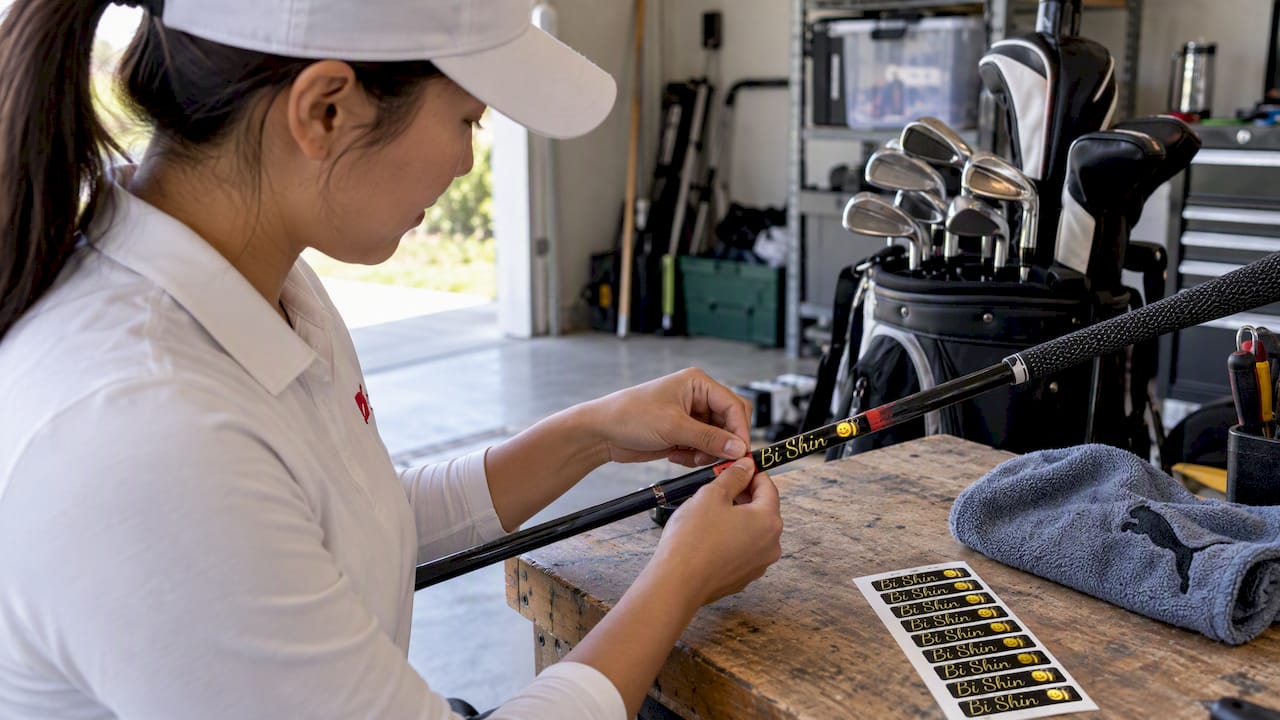
The simplest, tournament-safe way to track golf gear is a set of durable, semi-permanent personalized labels paired with a lightweight inventory list. This combination keeps every club identifiable, holds up through seasons of play, and stays within the rules that govern what you can attach to equipment. Apply the labels correctly, as outlined below, and your clubs become both unmistakably yours and simple to recover if they ever wander off.
TL;DR:
- Custom vinyl shaft labels are recommended for durability, especially in outdoor conditions, and should be placed below the grip or on the grip itself.
- USGA rules permit temporary identification attachments on the shaft and clubhead, but labels must serve only identification purposes without altering club behavior.
- Regularly clean labels with mild soap and water, protect against temperature swings, and replace them when edges lift or print fades to maintain clarity.
- Pair each label with a digital record and photos to facilitate quick recovery if clubs are misplaced or lost during play.
- Golf Blab offers personalized, durable labels for $29.99 per full set, which can be color-coded and matched with gear for easy on-course identification.
Table of Contents
- Tagging options: formats, pros and cons
- USGA rules and what they mean for labels and attachments
- How to label your clubs and gear step-by-step
- Maintain labels and avoid common failures
- Track and recover lost gear: simple inventory and on-course tactics
- Why choose custom Golf Blab labels and how to order
- A golfer’s perspective on labeling and recovery
- Sources
- FAQ
Tagging options: formats, pros and cons
Every tagging method trades off durability, visibility, and compliance a little differently, so the right choice depends on how and where you play.
- Custom stick-on labels: easy to apply and remove, affordable, but shorter-lived outdoors without a protective layer.
- Vinyl or laminated labels: resist moisture and friction far better than paper-backed stickers, making them the sturdier pick for a bag that lives in the trunk.
- Heat-shrink shaft labels: wrap tightly around the shaft for a clean, almost factory look, though they require a heat source and a bit of patience to apply well.
- Hang or tie tags: ideal for bags and headcovers since they’re removable in seconds, but too loose a fit for clubheads or shafts.
- Semi-permanent clubhead markings: offer the most lasting identification directly on the equipment, though they demand careful placement to avoid alignment marks.
- Electronic ID devices: useful for identification and inventory purposes only, and only when they serve no other function.
A daily player who wants a signature look might favor vinyl shaft labels. Someone managing a loaner set at a club or academy often leans on color-coded hang tags for quick sorting. Travelers benefit from heat-shrink durability, while tournament golfers should stick to options confirmed as temporary and identification-only, since that distinction matters once you’re inside the ropes.
USGA rules and what they mean for labels and attachments
The USGA’s interpretations allow temporary, non-permanent attachments to the shaft, such as identification decals, and permit similar identification-only attachments on the clubhead, away from the face, as long as they serve no other purpose. That single allowance is what makes personalized labeling possible without drifting into equipment modification.

One rule shapes nearly every labeling decision: identification attachments must do nothing else. The USGA’s electronic device guidance confirms that electronic ID units limited to owner information, inventory tracking, or detecting club use are permitted, provided they never emit light, sound, or vibration and perform no additional function.
Clubhead markings follow a separate standard. According to the USGA’s submission guidelines, permanent markings that differentiate a model must be clear and lasting, and stick-on labels are not recognized as official identifying markings. Personalizing a driver with a name or initials is usually fine, so long as it doesn’t effectively create a different model.

How to label your clubs and gear step-by-step
A good label job starts well before the adhesive ever touches the shaft.
- Clean the surface with a mild soap and water solution, then dry it fully. Skip sanding on painted or coated finishes, since abrading them can dull the surface or void a manufacturer’s finish warranty.
- Choose your placement. The shaft just below the grip, the grip itself, or the butt end all work well; avoid the clubface and any area near alignment marks or the crown, where the USGA’s clubhead marking guidance recommends keeping orientation indicators unobstructed.
- Apply the label. Stickers press on directly; heat-shrink wraps need gentle, even heat until they conform snugly; vinyl wraps benefit from a few minutes of light pressure to seal the edges.
- Let it cure. Give adhesive-based labels a few hours before heavy handling, and let heat-shrink pieces cool completely before gripping the club.
- Log the club. Record the club name or number, the label’s unique ID code, its color, and the date it was applied.
Pro Tip: Keep a small log on your phone with a photo of each labeled club next to its ID code, so a lost-and-found call takes seconds to confirm.
Golf Blab’s own guide to labeling clubs walks through placement and material choices in more detail if you want a visual reference while you work.
Maintain labels and avoid common failures
Labels fail for predictable reasons, and most of them are easy to prevent.
- Clean with mild soap and water, never with solvents or alcohol-based cleaners that can dissolve adhesive from underneath.
- Protect against temperature swings by keeping clubs out of a hot trunk for long stretches, which softens adhesive and invites peeling.
- Replace rather than repair once edges lift or print fades past easy reading, since a half-peeled label looks worse than a fresh one.
- Add a clear overlaminate or a thin coat of clear nail polish over paper-backed labels to extend their life outdoors.
Seasonal care matters more than most golfers expect. A label that survives a mild spring can curl fast once summer heat and humidity set in, so a quick check every few weeks keeps your identification intact.
Track and recover lost gear: simple inventory and on-course tactics
A label only helps if someone can act on it, so pair every tag with a record you can check in seconds.
- Keep a lightweight inventory, whether a spreadsheet or a phone note, tied to each label’s unique ID.
- Include a name and a contact method on labels meant for recovery, balancing visibility with your own privacy preferences.
- Color-code by set or bag so a pro shop staffer can match a stray club to its owner at a glance.
- Photograph each club next to its ID entry, which speeds up identification if a club turns up days later.
- Remove or cover identifying details before formal tournament play if local rules require it, then restore them for casual rounds.
A Mulligan+ Journal piece on tracking golf rounds offers a useful companion approach for golfers who already track performance data and want their equipment records to match.
Why choose custom Golf Blab labels and how to order
Golf Blab’s Custom Golf Club Labels turn the guidance above into a ready product: durable materials, color options, and placements designed to sit cleanly on the shaft or grip without crowding alignment marks. At $29.99 one-off, the set gives a full bag a consistent, personalized look that holds up through a season of play.
- Pick a label style that matches your bag’s palette or your own signature color.
- Color-code by club type so a quick glance tells you wedge from iron, even from across the fairway.
- Pair labels with matching gear, like the Golf Blab Under Armor Golf Hat or the Golf Blab Adidas Quarter Zip Pullover, for a complete, personalized look on the course.
Browse the full Golf Blab shop to see label colors, apparel, and gift card options side by side before placing an order.
A golfer’s perspective on labeling and recovery
I’ve watched a single misplaced wedge turn into a half-hour search more times than I can count, and almost every time, the club that came back was the one with a clear, legible label near the grip. One member at a club I played with found his 7-iron three carts down the row because his name and number were impossible to miss.
My one tip that rarely makes it into product listings: label the headcover and the shaft separately. Covers get swapped at the turn more often than clubs do, and a mismatched pair causes more confusion than a missing label ever would.
— Michael Marini
FAQ
Are stick-on labels legal for tournament play?
Temporary, non-permanent labels for identification are generally permitted on the shaft, and similar identification-only attachments are allowed on the clubhead away from the face, according to the USGA’s interpretations. Stick-on labels are not recognized as official identifying markings for model differentiation, but that distinction matters for manufacturers, not for a player labeling personal gear.
Can I use an electronic tracker to find a lost club?
Electronic devices are allowed for identification and inventory purposes only, provided they don’t emit light, sound, or vibration and perform no other function, per the USGA’s electronic device guidance. A simple identification tag paired with a personal inventory list remains the easier, lower-cost route for most golfers.
Where should I place a label so it doesn’t interfere with alignment marks?
Place labels on the shaft below the grip, on the grip itself, or at the butt end, keeping clear of the crown and any alignment indicators. The USGA’s submission guidelines note that markings near orientation features can complicate conformity checks.
How much do custom golf club labels cost?
Golf Blab’s Custom Golf Club Labels are priced at $29.99 one-off for a full set, covering an entire bag with consistent, durable identification.
What’s the best way to keep track of my golf gear over time?
Pair durable labels with a simple inventory, whether a spreadsheet or a phone note, that records each club’s unique ID, color, and purchase date. Photographing each labeled club alongside its entry makes recovery faster if a club is ever misplaced.