
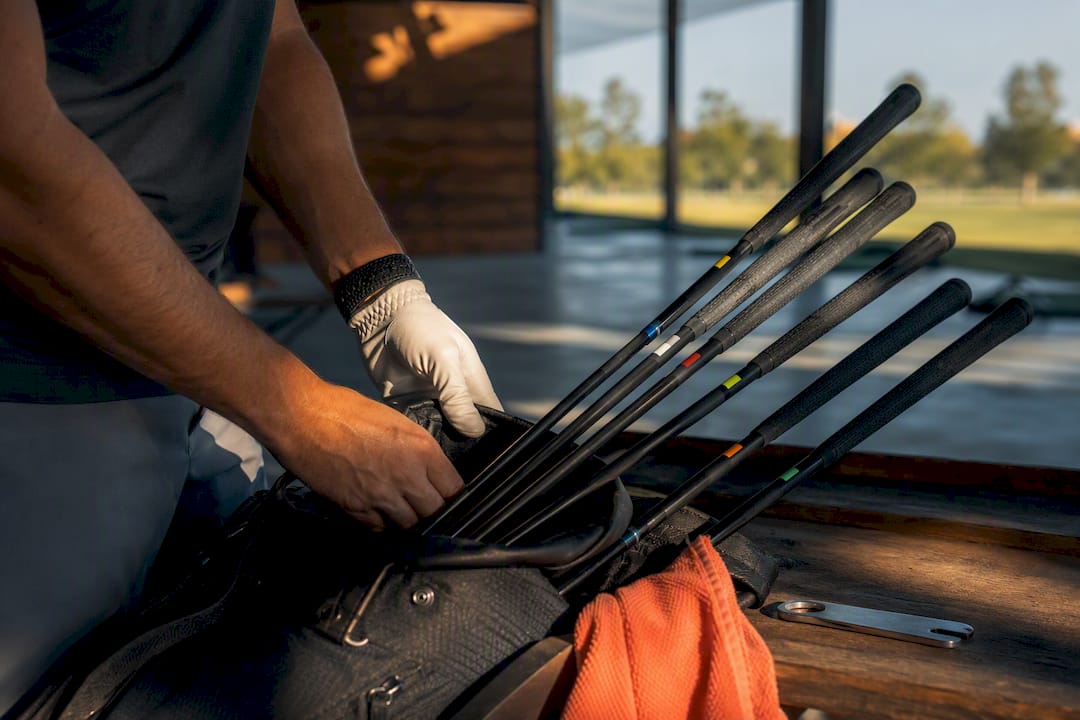
Color coded golf clubs are personalized colored labels or tags applied to your shafts to identify, organize, and personalize your set. The fastest, most reliable starting point is waterproof vinyl labels placed just below the grip, with your wedges and putter labeled first as these clubs are commonly left behind near the green.
TL;DR:
- Color-coded labels should be waterproof vinyl for durability, especially if you play frequently or in humid conditions.
- Using no more than four to six color categories helps prevent confusion and maintains quick club identification during play.
- Applying labels properly requires thorough cleaning and drying of the shaft with isopropyl alcohol to prevent peeling and ensure longevity.
- Including contact information or QR codes on labels can greatly increase the likelihood of retrieving lost clubs, but consider privacy and speed tradeoffs.
- Full set packs are usually more cost-effective than individual labels, and keeping a simple reference card helps you remember your color system over time.
Table of Contents
- Why Color Coding Your Golf Clubs Actually Helps Your Game
- Four Color Coding Systems You Can Copy Today
- Vinyl, Laminate, or Metal: Choosing the Right Label Material
- How to Apply Club Labels Without Bubbles or Peeling
- What to Check Before You Order Custom Golf Club Labels
- Fixing Peeling Labels, Fading Colors, and Mixed-Up Clubs
- An Editorial Take on the Custom Label Boom
- Where to Get Custom Color Coded Labels and Golf Gifts
- Sources
Why Color Coding Your Golf Clubs Actually Helps Your Game
A bag full of matte black shafts is a bag full of guesswork. Color coding solves that problem in two directions at once: speed on the course and protection off it. When your 7 iron wears a distinct color, you glance down instead of squinting at the number stamped near the hosel, shaving real seconds off pre-shot routines during a round with a foursome breathing down your neck.
- Faster club recognition mid round, especially in low light or when clubs are jumbled in a cart bag
- Labels that include contact information dramatically improve the odds a lost club finds its way home, and a short “reward if found” line on the label gives a good Samaritan a reason to actually make the call
- Custom colors turn a set of clubs into a personal statement, which is exactly why labels have become a favorite golf gift
- Visible phone numbers get you the fastest return path, while QR codes trade a little speed for privacy since the finder has to scan before seeing anything
That tradeoff between speed and privacy is worth thinking through before you order, not after a club goes missing at a public course you’ll never play again.
Four Color Coding Systems You Can Copy Today
Every golfer organizes differently, so pick the system that matches how you actually think about your bag, not the one that looks best on Instagram.
- By club type. Woods get one color, irons another, wedges a third, and the putter its own signature shade. This is the simplest system to maintain and the easiest for a playing partner to understand at a glance.
- By distance tier. Group clubs into “long” (driver, 3 wood, hybrids), “mid” (5 through 8 iron), and “short” (9 iron through wedges), assigning a color band to each tier. Great for players who think in yardage gaps rather than club names.
- By loft. Similar to distance tiers but built around actual loft numbers, useful if you carry an unconventional mix of hybrids and irons that don’t follow standard gapping.
- By role. Color-code around shot function instead of club category: approach clubs, scoring clubs, and recovery clubs each get a color, which suits players who think in shot shapes more than yardages.
If you swap a club mid season, relabel it into the matching category immediately rather than leaving it colorless. A half-finished system creates more confusion than no system at all.
Pro Tip: Keep a small reference card in your bag pocket listing your color key. It takes ten seconds to make and saves you from forgetting your own system three months later.
Vinyl, Laminate, or Metal: Choosing the Right Label Material
Material choice comes down to how hard you play and how much you care about the label disappearing into the shaft’s finish. Waterproof vinyl remains the default recommendation for most golfers because it’s inexpensive, easy to apply, and holds up fine through a normal season of play.
- Waterproof vinyl: best overall value, ideal for full sets and easy replacement when styles change
- Laminated thermal-transfer labels: built for heavier use, with stronger UV and moisture resistance for golfers who play year round or in humid climates
- Metal tags: engraved brass or metallic finishes give a premium look, though they’re less subtle than vinyl and can stand out against modern matte shafts
- QR code vs. visible phone number labels: QR protects your number from public view but requires an extra step from the finder; a printed number skips that step and gets a faster call
- Bag-level trackers pair well with club labels for golfers who travel by air often, since a tracker covers the whole bag while labels identify each individual club inside it
How to Apply Club Labels Without Bubbles or Peeling
Clean prep is the difference between a label that lasts a season and one that curls up by the third round.
- Wipe the shaft with isopropyl alcohol and let it dry completely. Any residue from grip solvent or sunscreen will undercut the adhesive before it ever bonds.
- Position the label roughly an inch below the grip cap, where it’s visible during your setup but won’t interfere with your hands.
- Apply from one edge and smooth toward the other with steady pressure, pushing out air as you go rather than pressing the center first.
- For adhesives that call for it, a brief application of gentle heat with a hair dryer on low can improve the bond, particularly on cooler days.
- Check labels every few weeks for lifting edges. Catching a curling corner early means a quick reseal instead of a full replacement.
Pro Tip: Apply labels indoors at room temperature. Cold shafts and humid air are the two most common reasons a fresh label fails to grip on the first try.
What to Check Before You Order Custom Golf Club Labels
Not every label supplier is built the same, and a few overlooked specs separate a set that lasts from one you’re reordering by summer.
- Confirm the adhesive is rated waterproof and UV resistant, not just water resistant, and check whether a laminate overlay is included
- Look at the customization fields: how many characters fit, how many lines of text, and how many color combinations are actually available
- Compare quantity pricing since full-set packs (typically 13 to 14 labels) usually cost less per label than ordering replacements one at a time
- Check the supplier’s return or reorder policy in case a size doesn’t fit your shaft diameter
- Confirm shipping timelines to your region before ordering ahead of a trip or a gift deadline
Buying a full-set pack up front is almost always smarter than ordering piecemeal, but keep the supplier’s reorder process in mind for the inevitable day a wedge takes a hard bounce off a cart path and the label doesn’t survive.
Fixing Peeling Labels, Fading Colors, and Mixed-Up Clubs
Peeling almost always traces back to surface prep, not the label itself. If a label lifts at the corner within the first few rounds, the shaft likely wasn’t fully dry or still had residue from grip solvent when it was applied. Strip it off, clean the shaft again with isopropyl alcohol, and let it air dry fully before reapplying. A label that peels repeatedly in the same spot on a graphite shaft may be running into a factory coating that resists adhesive. Try shifting placement an inch higher or lower to find a cleaner bonding surface.

Fading is a UV story more than a wear story. Cheaper printed vinyl without a laminate layer will dull noticeably within a season of regular play in direct sun, while laminated thermal-transfer labels hold their color far longer. If your colors are fading fast, that’s a signal to upgrade material on your next order rather than just reordering the same label.
Misidentification usually means the color system broke down somewhere, often after a mid season club swap. The fix isn’t more colors. It’s fewer categories, applied consistently. Four to six color groups is plenty for almost any bag. Beyond that, players start second guessing their own key, which defeats the purpose of color coding in the first place. When in doubt, simplify the system before you add another shade to it.
An Editorial Take on the Custom Label Boom
Most advice on golf club labels treats them purely as a lost and found tool, and that undersells what’s actually happening in golf right now. The clubs in your bag have quietly become one of the few pieces of sporting equipment a player can make entirely their own, and the personalization trend reflects something bigger than convenience. Golfers want their equipment to say something about them, the same way a custom headcover or a monogrammed glove does.
Where I’d push back on conventional wisdom is the idea that color coding is only worth the effort for competitive players tracking yardages with obsessive precision. The bigger use case is the casual golfer who just wants to stop hunting for the right wedge on a windy back nine, or the gift buyer who wants something more personal than another sleeve of balls. A curated label, cut cleanly and color matched with intention, beats a hand written Sharpie mark every time, not because the Sharpie fails functionally, but because it fails at the identity piece entirely.
The DIY route works fine if all you want is identification. But once personalization and durability both matter, a purpose built label with real adhesive engineering and a defined color palette earns its cost difference fast.
— Michael Marini
Where to Get Custom Color Coded Labels and Golf Gifts
Golf Blab’s Custom Golf Club Labels check every box this guide covers: waterproof vinyl construction, a wide color palette, and full customization down to the text and layout on each label. Ordering typically involves picking label size, choosing colors, entering text or contact details, and checking out. Full sets are usually designed to cover an entire bag, wedges and putter included.
If you’re shopping for someone else, pair labels with a Golf Blab E-Gift Card so the recipient can pick their own colors, or round out the gift with a piece from the apparel lineup. Labels are made to last through a normal season of play, and replacements are generally easy to reorder if needed.

Sources
For deeper comparisons of label materials and application techniques, Great Results Golf’s roundup covers premium options like laminated and metal tags in more detail, while Cut Sheet Labels breaks down customization specs worth comparing before you order. Both are useful next stops if you want to see application photos before committing to a system.
- Identification Labels for Golf Clubs
- Best Personalized Golf Club Labels and Identification Options – Great Results Golf
- Custom & Templated Golf Club Labels | Cut Sheet Labels