
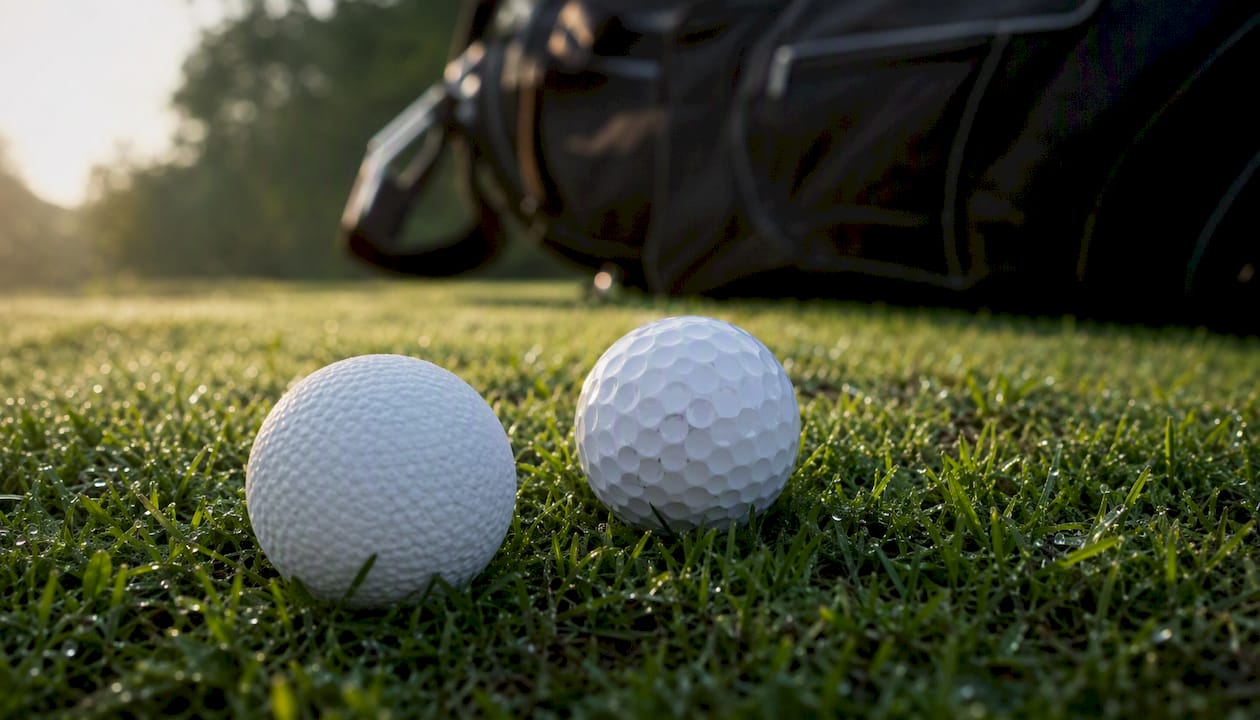
Choose urethane if you need greenside spin, softer feel, and the ability to shape shots into tight pins. Choose ionomer if you want durability, lower cost, and a ball that shrugs off cart paths and mis-hits. That’s the whole decision in a sentence, but the “why” is where your scoring actually improves.
Here’s how it breaks down by the numbers that matter most to your game:
- Handicap 0 to 12, faster swing speeds: Urethane, almost without exception. You strike the ball consistently enough to exploit the spin, and firm greens demand the stopping power urethane provides.
- Handicap 13 to 20: A hybrid approach works. Play urethane on scoring days, keep an ionomer sleeve in the bag for range sessions and rounds where ball loss is a real risk.
- Handicap 20 and up, or casual/practice rounds: Ionomer. You’ll lose fewer balls to guilt, save real money over a season, and won’t miss spin you weren’t generating consistently anyway.
- Practice vs. tournament days: Beat up ionomer balls on the range and at the local course where lost balls are common; save urethane for rounds where every stroke and every green-side decision counts.
Key Takeaways
Urethane wins on greenside spin and feel while ionomer wins on durability and cost, and the right choice depends on your strike consistency, course conditions, and how many balls you lose per round.

| Point | Details |
|---|---|
| Match cover to handicap | Low handicap and consistent strikers benefit most from urethane’s spin; high handicap players save more with ionomer. |
| Wedge spin gap is real | Urethane generates roughly 2,000 to 3,500 RPM more wedge spin than ionomer, which matters most on firm greens. |
| Driver distance barely changes | Independent testing shows carry distance stays nearly identical across cover types; fitting matters more. |
| Cold weather narrows the gap | Urethane stiffens in cold temperatures, so ionomer performs relatively better in early-season rounds. |
| Test before committing | Compare a sleeve of each on wedge shots and greenside chips, and consider Golf Blab’s labels to keep practice and play balls organized. |
Table of Contents
- Urethane vs Ionomer Golf Balls: What’s Actually Different
- Does Cover Material Change Your Driver Distance?
- Why Wedges and Putting Expose the Real Gap
- What the Test Data Actually Shows
- What Premium Spin Actually Costs You Per Round
- Matching Cover Type to Your Game
- How to Spot the Cover Type on Any Box
- When Weather Changes the Whole Equation
- A Ball Fitter’s Honest Take on Cover Choice
- A Simple Way to Keep Your Balls (and Your Bag) Organized
- Sources
Urethane vs Ionomer Golf Balls: What’s Actually Different
The difference comes down to chemistry, and it’s simpler than it sounds. Urethane is a soft, elastic material, an elastomer, that deforms slightly at impact and grips the grooves of your clubface. Ionomer, often called Surlyn in older marketing language, is a harder resin, chemically closer to a rigid thermoplastic than a rubber. That single distinction, elastic versus rigid, explains almost every performance gap discussed in this article.
Urethane’s elasticity is variable by formulation. Manufacturers can engineer it soft or firm, thick or thin, and that flexibility explains why “premium” urethane balls from different brands can still feel meaningfully different at impact. Industrial comparisons of urethane against other elastomers confirm this range: urethane’s properties shift dramatically depending on hardness and formulation, which is exactly why one tour ball can feel buttery soft while another feels notably firmer off the putter.
Cover construction matters as much as the material itself:
- Urethane covers are typically cast in thin layers, thin enough to compress and grip the grooves without adding excess spin-killing mass.
- Ionomer covers tend to run slightly thicker and are injection molded, a manufacturing process that favors durability and consistency over tactile feedback.
- Layering underneath the cover (dual-layer, three-piece, multi-layer cores) changes compression and launch independent of cover material, so cover type alone never tells the whole story.
- Sound at impact differs too. Urethane produces a duller, softer click; ionomer produces a sharper, higher-pitched crack that many golfers associate, rightly or wrongly, with less quality.
Golf Monthly’s breakdown of the two materials puts it plainly: urethane covers dominate at the premium performance tier precisely because their elasticity interacts with grooves more effectively, producing higher spin and more shot-shaping control, at the cost of price and cover longevity.
Does Cover Material Change Your Driver Distance?
Barely. This surprises most golfers, and it’s worth sitting with for a moment before you spend extra money chasing driver yards. Independent 2025 testing found that driver distance clusters tightly across cover types, meaning your swing speed, angle of attack, and driver fitting move the needle far more than whether your ball wears a urethane or ionomer skin.
Where cover type does show up off the tee is spin, and spin cuts both ways depending on your swing. Ionomer’s lower spin rate can help golfers who fight a slice or struggle with excess backspin that balloons drives and kills rollout. Lower spin plus firmer compression often means more roll after landing, which on a dry fairway can add real yards even though carry distance stayed nearly identical.
If you want to see this for yourself, don’t guess. Get on a launch monitor and watch three numbers on your driver swings: ball speed, spin rate, and launch angle. If your spin rate sits above 2,700 RPM off the tee, an ionomer ball’s lower spin characteristics might actually help you. If you’re already in an efficient window, cover material won’t move your carry distance meaningfully either way. Understanding your own golf ball trajectory on a monitor is the fastest way to stop guessing and start knowing.
Why Wedges and Putting Expose the Real Gap
This is where urethane earns its reputation, and where the material story stops being theoretical. Wedge and short-iron shots put the clubface in contact with the ball long enough, and with enough friction, for the cover’s elasticity to matter enormously. Urethane wedge spin commonly runs 8,000 to 10,000 RPM, compared to roughly 5,500 to 7,500 RPM for ionomer covers. That difference impacts whether your approach shot checks up next to the pin or skips through the back of the green into the fringe.
The tactile side matters just as much as the numbers. Urethane comes off the putter and wedge face a touch slower, giving better feedback and a softer, more controlled release on chips and putts, particularly on fast greens where touch separates a two-putt from a three-putt. Ionomer’s firmer, springier response can make delicate greenside shots harder to control, even though it’s perfectly serviceable for full shots.
- Urethane advantage: Higher spin translates to steeper descent angles on approach shots, meaning the ball drops more vertically and stops faster.
- Feel and feedback: Softer compression at impact gives better sensory information on partial shots, helping you calibrate distance control.
- Ionomer trade-off: Firmer feel and lower spin mean the ball releases and rolls more after landing, which can work against you on tucked pins but works fine on run-up approaches.
- Practice reinforcement: Short-game drills with a urethane ball teach you what real spin feedback feels like, something ionomer simply can’t replicate.
Pro Tip: Not every shot benefits from maximum spin. On a long bump-and-run or a shot into a green that slopes away from you, intentionally reach for lower spin, either by clubbing down or leaning into an ionomer ball’s natural release. More check isn’t always the better outcome; sometimes you want the ball to release and roll toward the hole rather than sit where it lands.
What the Test Data Actually Shows
Numbers settle arguments that opinions can’t. Aggregated 2025 test data comparing cover types found a consistent pattern: driver carry distances stayed close across urethane and ionomer balls, while iron and wedge spin, along with descent angle into greens, showed clear, repeatable separation favoring urethane. The MyGolfSpy 2025 ball test reported wedge spin differences in the thousands of RPM between cover types, alongside steeper, more consistent descent angles for urethane on approach shots.
| Shot type | Urethane spin range | Ionomer spin range | Practical impact |
|---|---|---|---|
| Wedge (full swing) | 8,000–10,000 RPM | 5,500–7,500 RPM | Urethane stops faster on firm greens |
| Mid-iron approach | Moderate to high | Lower | Steeper descent angle with urethane |
| Driver | Clustered, low variance | Clustered, low variance | Minimal carry distance difference |

A 2,000 to 3,500 RPM wedge-spin gap sounds abstract until you translate it onto a real green: it’s the difference between a ball that checks within a few feet of where it lands and one that releases 10 to 15 feet past the pitch mark. That gap only pays off, though, if you’re striking the center of the face consistently and playing courses firm enough for spin to matter. On soft, receptive greens, or with inconsistent contact, that RPM advantage shrinks toward irrelevance and the extra cost of urethane buys you less than you’d expect.
The takeaway from independent testing is consistent: the real separation between these materials lives in your irons and wedges, not off the tee. If your driver swing is already efficient, don’t buy urethane expecting extra carry. Buy it for what happens once you’re inside 150 yards. Tracking these performance indicators across a season tells you far more about which cover is earning its keep than any single round ever could.
What Premium Spin Actually Costs You Per Round
Here’s the math golfers skip, and it’s the one that actually determines whether urethane is worth it for you. Premium urethane balls typically retail well above ionomer models, and that price gap compounds fast if you’re someone who loses three or four balls a round. Ionomer’s harder cover resists scuffs, cart-path scrapes, and rough-play cuts far better than urethane’s softer surface, which scars more easily on hard contact with cart paths, rocks, or tree bark.
Run this quick checklist before you commit to a dozen:
- Count your lost balls per round. If you’re regularly losing four or more, ionomer’s lower per-ball cost matters more than any spin advantage you’re not consistently generating anyway.
- Check your strike consistency. Center-face contact is what lets you actually use urethane’s spin; mis-hits erase most of the benefit.
- Weigh scuff tolerance. If you play a lot of cart-path-adjacent courses or scrubby rough, ionomer’s durability advantage adds up round after round.
- Separate practice balls from play balls. There’s no reason to beat up an $4 to $5 urethane ball on the range hitting 80 wedge shots when a $2 ionomer ball does the job just as well for repetition work.
Durability and cost, according to TheGolfBallGuy’s comparison, consistently favor ionomer for beginners, high-handicap players, and anyone using golf balls primarily for volume practice rather than tournament scoring. That’s not a knock on ionomer. It’s the entire reason the material exists.
Matching Cover Type to Your Game
The decision framework is simpler than most golfers make it. Start with your handicap and swing consistency, then layer in how you actually use your rounds.
Low handicap, faster swing speed: Urethane, full stop. You’re generating consistent contact and playing courses firm enough that the extra spin translates directly into strokes saved around the green.
Mid-handicap golfer improving steadily: This is the group that benefits most from testing both. Play a sleeve of each over back-to-back rounds and pay attention specifically to how your wedge shots behave from 80 to 120 yards. That’s where you’ll feel the difference, not off the tee.
High-handicap or casual player: Ionomer, without much hesitation. You’ll save money, lose fewer balls to guilt, and the spin you’d theoretically gain from urethane rarely shows up with inconsistent strike patterns anyway.
Practice and range sessions: Ionomer, regardless of your handicap. Save urethane for rounds and short-game practice sessions where you’re specifically working on wedge feel and spin control, ideas covered well in most short-game strategy frameworks.
A smart bag carries both. Keep a sleeve of ionomer for range warmups and scramble rounds, and a sleeve of urethane reserved for tournament days or serious scoring rounds. This isn’t indecision. It’s allocation, and it’s exactly how better players actually manage their equipment.
How to Spot the Cover Type on Any Box
Manufacturers rarely print “urethane” or “ionomer” in giant letters, but the marketing language gives it away every time if you know what to look for. Balls positioned as “tour,” “tour-level,” or “spin control” are almost always urethane covered, built for players who want shot-shaping and greenside stopping power. Balls marketed around “distance,” “durable cover,” or explicit Surlyn or ionomer resin naming are built for the opposite priority: longevity and value over feel.
Compression numbers on the box or spec sheet offer a second clue, though not a perfect one. Lower compression balls tend to pair with softer urethane covers aimed at moderate swing speeds, while higher compression models often signal a firmer ionomer build meant for faster swings or maximum durability. Reading the box specs carefully before you buy saves you from assuming a “premium-looking” box automatically means urethane inside.
| Label language | Likely cover | Feel | Best for |
|---|---|---|---|
| “Tour,” “spin control,” “soft feel” | Urethane | Soft, responsive | Low to mid handicap, scoring rounds |
| “Distance,” “durable cover” | Ionomer | Firm, springy | High handicap, practice, value play |
| “Surlyn,” “ionomer resin” named directly | Ionomer | Firm | Beginners, range use |
When Weather Changes the Whole Equation
Temperature isn’t a footnote here. It’s a real variable that shifts which cover performs better on a given day. Cold weather reduces urethane’s elasticity, and as the material stiffens, the performance gap between urethane and ionomer narrows considerably. On a 40 degree morning round, you may not feel or see the spin advantage you’d get from the same ball on a humid 85 degree afternoon.
Wet turf changes the equation too, independent of temperature. When fairways and rough are soaked, less friction transfers between clubface and cover on approach shots, which mutes spin generation regardless of cover material. On soft, receptive greens after rain, the ball is going to stop quickly no matter what cover you’re playing, so urethane’s spin advantage matters less than usual. Flip that scenario to a firm, fast, dry course in peak summer, and urethane’s ability to grip and check becomes the single biggest factor in whether your approach shots hold their line.
Use this quick mental checklist before you decide what to tee up:
- Cold, early-season rounds: Ionomer performs closer to urethane than usual; save your premium balls for warmer months.
- Wet or soft conditions: Spin matters less across the board; ionomer’s durability advantage becomes the deciding factor.
- Firm, fast, dry greens: Urethane’s spin and stopping power matter most here, this is exactly the scenario it was engineered for.
- Windy conditions: Lower-spin ionomer balls can actually fly more predictably into a headwind, an underrated reason to keep a sleeve handy even if you normally play urethane.
A Ball Fitter’s Honest Take on Cover Choice
The biggest mistake golfers make with ball selection isn’t picking the wrong cover. It’s picking a cover based on what their favorite tour pro plays rather than what their own swing and short game actually demand. Watching a broadcast and assuming a $65-per-dozen urethane ball will fix an inconsistent wedge game is backward logic. Spin doesn’t create control. Consistent contact creates control, and spin simply amplifies whatever contact quality you’re already bringing to the shot.
The right approach to testing is simpler than most golfers expect. Take two sleeves, one urethane, one ionomer, to the range and hit 15 wedge shots with each from a consistent yardage, watching where the ball lands and how it reacts on the second bounce. Then take both out on the course for nine holes and pay attention specifically to par-3 approach shots and any greenside chips. You’re not looking for driver distance differences; you already know those are negligible. You’re looking for how the ball behaves once it’s within 100 yards of the pin, because that’s the only place this decision actually shows up in your scorecard.

Retest your choice whenever something in your game changes meaningfully: a new wedge setup, a swing change that alters your strike pattern, or a seasonal shift into firmer summer conditions. A cover choice that made sense last spring might not serve you the same way once your contact quality or the course conditions shift.
A Simple Way to Keep Your Balls (and Your Bag) Organized
Once you start carrying two ball types, urethane for scoring rounds, ionomer for practice and casual play, keeping your gear organized becomes its own small challenge. Golf Blab’s Custom Golf Club Labels let you mark clubs, bags, and gear with personalized identification in a range of ink colors, useful for anyone juggling different equipment setups across different rounds. If you’re serious about translating urethane’s spin advantage into actual strokes saved, working with a coach accelerates that process far faster than trial and error alone. The Play Golf with a Tour Pro experience puts you on the course with professional instruction focused on exactly the kind of shot control this article covers. And if you want to look the part while you test your ball choices, the Golf Blab Under Armor Golf Hat rounds out the bag. Start by personalizing your setup at Golf Blab’s custom labels page and take the guesswork out of managing your equipment.
Sources
- Breaking Down Golf Ball Performance By Cover Type (What The 2025 Ball Test Shows) | MyGolfSpy
- Urethane Vs Ionomer: How To Choose Your Golf Ball Cover
- How Do Ionomer Cover Golf Balls Compare To Urethane? – TheGolfBallGuy