
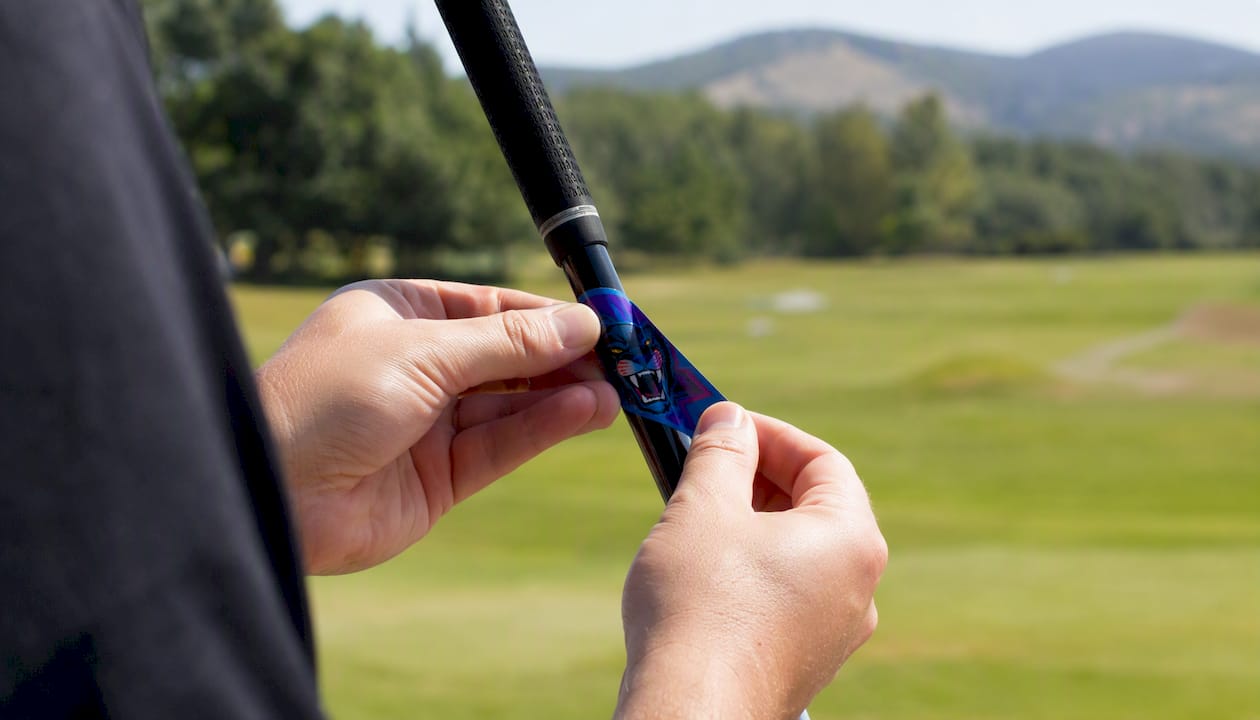
In this article, “golf bag personalization” means one specific thing: custom adhesive shaft labels applied directly to your clubs, not embroidery or hardware changes to the bag itself. The highest-value approach is a waterproof, custom-printed vinyl label placed just below the grip on each shaft, where it stays visible to you and to any finder without interfering with your swing.
Custom golf club stickers make clubs easier to identify and help protect expensive equipment from permanent loss — a low-cost layer of security that bag-level tags alone cannot replicate.
- Order or gift labels: Jump to the Ordering section for pricing and lead times, or visit the Golf Blab custom labels page to start an order now.
Key Takeaways
Custom waterproof vinyl shaft labels, applied just below the grip, are the most effective and lowest-cost way to identify and protect your golf clubs.
| Point | Details |
|---|---|
| Label placement | Apply just below the grip on the shaft, where it stays visible without affecting your swing. |
| Material standard | Choose waterproof vinyl with UV-resistant ink and strong acrylic adhesive for lasting results. |
| Label wedges first | Wedges and putters are most likely to be left behind; prioritize them before the rest of the set. |
| Order buffer for gifts | Allow 7–10 days beyond the stated production time to absorb proof approval and shipping variance. |
| Golf Blab ordering | Golf Blab offers set kits, single labels, proofing, and gift bundles with a direct online order path. |
Table of Contents
- What are your two options for golf bag personalization?
- What should you actually put on your club labels?
- Which materials and print specs actually survive on shafts?
- How do you measure shafts and pick the right label size?
- How do you apply labels cleanly for long-lasting results?
- What should you expect when ordering custom labels?
- How do you care for labels and when should you replace them?
- How do personalized labels work as gifts?
- Why Golf Blab stands out for personalized club labels
- Which design tools help you build a label you’ll love?
- What are the artwork and image resolution requirements?
- How do you match label style with your bag’s overall look?
- When labels are essential vs. when simple will do
- Ready to order your personalized golf club labels from Golf Blab?
- Sources
What are your two options for golf bag personalization?
Two practical paths exist: professionally printed custom vinyl labels and DIY solutions using label makers or printable waterproof tape.
Custom pre-printed vinyl labels arrive ready to apply, with your name, initials, or logo rendered in durable UV-resistant ink on a thin, edge-sealed substrate. They look polished, survive rain and bag chatter, and carry the kind of permanence that serious golfers and tournament players expect.

DIY/label-maker options use printable waterproof vinyl sheets or thermal-transfer tape you cut and apply yourself. They cost less upfront and work for quick gifts or casual rounds, but the print quality, adhesive strength, and edge durability rarely match a professionally produced label.
| Feature | Custom Pre-Printed Labels | DIY / Label-Maker |
|---|---|---|
| Durability | High (UV ink, strong adhesive) | Moderate (varies by material) |
| Appearance | Polished, professional | Functional, variable |
| Privacy control | Full (you design the content) | Full |
| Speed to apply | Ready on arrival | Requires cutting and prep |
| Cost | Moderate per set | Low upfront |
| Best for | Competitive players, travelers, gifts | Casual rounds, quick identification |
Quick decision: if you travel with your clubs, compete regularly, or are buying a gift for an event, choose custom pre-printed labels. For a weekend player who just wants a name on a spare wedge, a DIY waterproof label will do the job.
What should you actually put on your club labels?
The most common label contents fall into a few clear categories, each serving a different purpose on the course.
- Full name or initials: the baseline for identification at a glance
- Mobile phone number: the fastest path to a return when a club is found
- “Reward if found” line: a short phrase that motivates finders to act
- QR code: links to a return form or contact page, keeping your number private
- Club type or spec note: loft, shaft flex, or lie angle for fitting reference
- Color-coded numbering: a sequential system (e.g., red for wedges, blue for irons) that lets you confirm a full set in seconds
Color-coding by club family is underused and genuinely useful. A quick visual sweep of your bag tells you immediately if a wedge is missing before you leave the green.
Pro Tip: A visible phone number returns clubs faster, but a QR code protects your privacy. Use a phone number on clubs you carry in public competitions; use a QR code linked to a return form on clubs stored at a club or shared facility.
Font size matters more than most golfers expect. A label read from arm’s length needs at least 8-point type in a high-contrast color, with a clean sans-serif face. Logos work well when they are simple and bold; intricate artwork loses legibility at small label sizes.
Which materials and print specs actually survive on shafts?
Waterproof custom vinyl labels with UV-resistant print and strong acrylic adhesive perform best under course conditions, including sweat, rain, towel wiping, and the constant friction of clubs shifting in a bag.
When evaluating any label product, look for these features:
- Waterproof vinyl substrate: resists moisture absorption and won’t soften or curl at edges
- UV-resistant inks: prevent fading after repeated sun exposure across a season
- Thin profile: avoids a raised edge that catches on bag dividers and lifts over time
- Strong acrylic adhesive: bonds to both steel and graphite without requiring heat
- Clear laminate or edge-sealed finish: adds a protective layer over the print surface
A good label is thin, edge-sealed, and complements the club’s look rather than appearing as a temporary sticker. Clear protector tape over the label extends life on high-wear clubs like wedges, though thick tape can add unwanted bulk if applied carelessly.
Pro Tip: On graphite shafts, wipe the surface with isopropyl alcohol and let it dry fully before applying. Graphite’s smooth finish releases adhesive more readily than steel, so surface prep is the single biggest factor in long-term adhesion.
For restoration work, replacement shaft labels should match the original model and size and be applied straight after removing all old adhesive residue, particularly when the rest of the club is in good cosmetic condition.
How do you measure shafts and pick the right label size?
Getting the size right before you order saves a second round of production costs.
- Clean the shaft with a dry cloth to remove grip residue and dust.
- Identify the available band area between the bottom of the grip tape and the top of the ferrule (or the first step on a steel shaft).
- Measure that band length with a flexible tape measure; note the shaft diameter at the center of that zone.
- Record measurements for at least two clubs of the same type to confirm consistency across the set.
- Photograph the shaft area for reference when reviewing digital proofs.
Typical label dimensions by club type:
| Club Type | Label Width | Label Height |
|---|---|---|
| Driver / Fairway Wood | 2.5 in | 0.75 in |
| Hybrid | 2.0 in | 0.75 in |
| Iron (long) | 1.75 in | 0.625 in |
| Iron (short) / Wedge | 1.5 in | 0.5 in |
| Putter | 1.5 in | 0.5 in |
Pro Tip: Order a single proof label before committing to a full set. Apply it to your most-used iron, live with it for a round, and confirm the size and adhesion before the full kit ships.
When choosing between a single-size kit and a mixed-size set, most iron sets share one label size, while drivers and putters often need their own dimensions. Protective clear covers are worth adding for wedges specifically, since those clubs see the most ground contact and bag friction.

How do you apply labels cleanly for long-lasting results?
Clean application is mostly about patience and surface prep. Rushing either step is the most common reason labels lift within a few weeks.
- Wipe the shaft band area with isopropyl alcohol on a lint-free cloth.
- Allow 60 seconds of dry time before touching the surface.
- Hold the label against the shaft without peeling to confirm alignment and centering.
- Peel the backing from one short edge only, anchor that edge to the shaft, and roll the label on slowly.
- Smooth from the anchored edge outward using a credit card or your thumbnail, pressing firmly to eliminate air pockets.
- Apply a strip of clear protector tape over the label on high-wear clubs.
Common mistakes that shorten label life:
- Applying to a shaft that still has grip-tape residue or moisture
- Letting the label overlap the ferrule or grip tape edge
- Pressing down the center before the edges are anchored, trapping air underneath
- Rushing the alcohol dry time in cold or humid conditions
Pro Tip: For graphite, use lighter pressure when smoothing. Aggressive rubbing can scuff the shaft finish beneath the label’s edge. A soft cloth over the credit card protects both.
If bubbles appear after application, lift the nearest edge gently with a fingernail, smooth the bubble toward that edge, and re-press. Lifting edges respond well to a small drop of clear adhesive applied with a toothpick, pressed flat, and allowed to cure for an hour.
What should you expect when ordering custom labels?
Production typically takes 3–5 business days, with rush options available for tight deadlines. Shipping adds time on top of production, so plan accordingly.
- Single labels: generally lower per-unit cost for small quantities; useful for replacing one lost club or testing a design
- Full-set kits: better per-label value and arrive sized and matched for the whole bag
- Price factors: full-color printing, metallic or foil finishes, logo complexity, and small batch runs all increase cost
- Artwork specs: vector files (AI, EPS, SVG) are preferred; high-resolution PNG at 300 dpi minimum for logos
- Order flow: submit measurements and artwork, approve a digital proof, confirm shipping method, and allow the production window
Ordering checklist: shaft measurements recorded, artwork file ready, proof approved before production begins, shipping deadline confirmed against the event date.
How do you care for labels and when should you replace them?
Labels on frequently used wedges typically show wear within one season of regular play. Labels on fairway woods or rarely-touched long irons can last two seasons or more with basic care.
Cleaning and care:
- Wipe labels with a damp cloth and mild soap; rinse with clean water and pat dry
- Avoid acetone, harsh solvents, or abrasive polishing cloths directly over the label surface
- Do not use a pressure washer on labeled shafts
Replacement timeline guidance:
- Inspect labels at the start of each season for edge lifting, fading, or cracking.
- Replace wedge and putter labels first; they absorb the most wear.
- When replacing, remove all old adhesive with isopropyl alcohol before applying the new label.
- For travel, apply a strip of clear protector tape over each label before packing clubs in a travel bag.
Carry a small set of spare labels in your travel kit. A single lost wedge on a trip is far more expensive than a replacement label.
How do personalized labels work as gifts?
Personalized club labels are among the most practical golf gifts available, and they scale from a single-club gesture to a full-set presentation.
- Occasions: birthdays, groomsmen gifts, tournament prizes, Father’s Day, and holiday bundles all work naturally
- Recipients: any golfer who owns their own clubs, from beginners to competitive amateurs
- Presentation ideas: a printed gift card tucked into a headcover, a curated label set with initials and a color theme, or a label kit bundled with a branded hat or bag tag
- Timing: with production at 3–5 business days, order at least 10 days before the event to absorb any proof-approval or shipping variance
For gift buyers who want flexibility, a Golf Blab e-gift card lets the recipient choose their own label design, ink color, and text, which removes the guesswork around shaft sizes entirely.
Why Golf Blab stands out for personalized club labels
Golf Blab’s custom golf club labels combine material integrity with genuine design flexibility, making them a natural choice for both individual golfers and gift buyers.
- Material and print specs: waterproof vinyl, UV-resistant inks, and strong adhesive matched to both steel and graphite shafts
- Design options: multiple ink colors, logo upload capability, and a proofing step before production begins
- Set kits and singles: order a matched set or a single replacement label without minimum-quantity pressure
- Partnership credibility: Golf Blab’s collaboration with LPGA pro Mariel Galdiano reflects a commitment to the competitive side of the game, not just casual play. The Play Golf with a Tour Pro experience extends that connection into the community.
- Educational ecosystem: beyond labels, Golf Blab’s instructional content and golf club personalization resources give buyers context for why labeling matters at every level of play.
Which design tools help you build a label you’ll love?
Most professional label vendors, including Golf Blab, offer a browser-based design interface where you enter text, choose fonts and ink colors, and upload a logo file. These tools preview the label at actual size before you submit, which is the most reliable way to catch font-size problems or color clashes before production.
For golfers who want more control, Adobe Illustrator and Canva both support custom artboard sizes that match label dimensions. Canva’s free tier handles text-and-color designs well; Illustrator is the better choice when you are working with a complex logo that needs to stay crisp at small sizes.
What are the artwork and image resolution requirements?
Vector files are the standard for label printing because they scale to any size without losing sharpness. Submit artwork as AI, EPS, or SVG whenever possible.
When a vector file is not available, a high-resolution raster image works as a fallback. Use PNG or TIFF at 300 dpi minimum, sized at the actual print dimensions. A logo that looks sharp on a screen at 72 dpi will print blurry at label scale; always export at print resolution before submitting.
Color mode matters too. Most label printers work in CMYK, so convert RGB files before uploading to avoid unexpected color shifts between your screen preview and the finished label.
How do you match label style with your bag’s overall look?
A label that clashes with the club’s finish or the bag’s color palette draws the eye for the wrong reason. The goal is a label that reads as intentional, not incidental.
Start with the dominant color in your bag or headcovers and choose a label ink that either matches or complements it. A black bag with silver hardware pairs naturally with a white or silver label; a bright-colored bag invites a bolder label accent. Matte finishes on labels tend to read as more refined alongside premium club finishes, while gloss works well on cavity-back irons with a high-polish look.
Font choice carries the same weight as color. A serif font signals tradition and formality; a clean sans-serif reads as modern and athletic. Pick one and use it consistently across the set, since mixing typefaces across clubs creates visual noise rather than a cohesive identity.
When labels are essential vs. when simple will do
Labels are not purely decorative, and the distinction between essential and optional matters when you are deciding how much to invest.
Wedges and your putter deserve durable, professionally printed labels first. Those clubs spend the most time near greens and in shared spaces, making them the most likely to be left behind or picked up by mistake. The rest of the set follows naturally once the high-risk clubs are covered.
- Choose a visible phone number when you play public courses or travel; choose a QR code when your clubs stay at a private club or shared facility.
- Invest in replacement labels when a club is otherwise in excellent cosmetic condition; a worn label on a pristine shaft signals neglect more than a missing label on a beat-up club does.
A full set of custom labels costs less than a single replacement wedge. Viewed that way, labeling is not a style choice — it is low-cost insurance for equipment that represents a meaningful investment.
Ready to order your personalized golf club labels from Golf Blab?
Golf Blab makes the order process direct: choose a single label or a full shaft label kit, upload your text or logo, approve a digital proof, and select your shipping speed. For gift orders, add a branded Under Armour golf hat or an e-gift card to round out the presentation.
Production runs 3–5 business days. Order your custom golf club labels today and give your clubs the identity they deserve.
Sources
- Benefits of Using Golf Club Stickers
- Identification Labels for Golf Clubs
- Golf Club Labels – Get Organized And Identify Your Clubs – The Brassie