
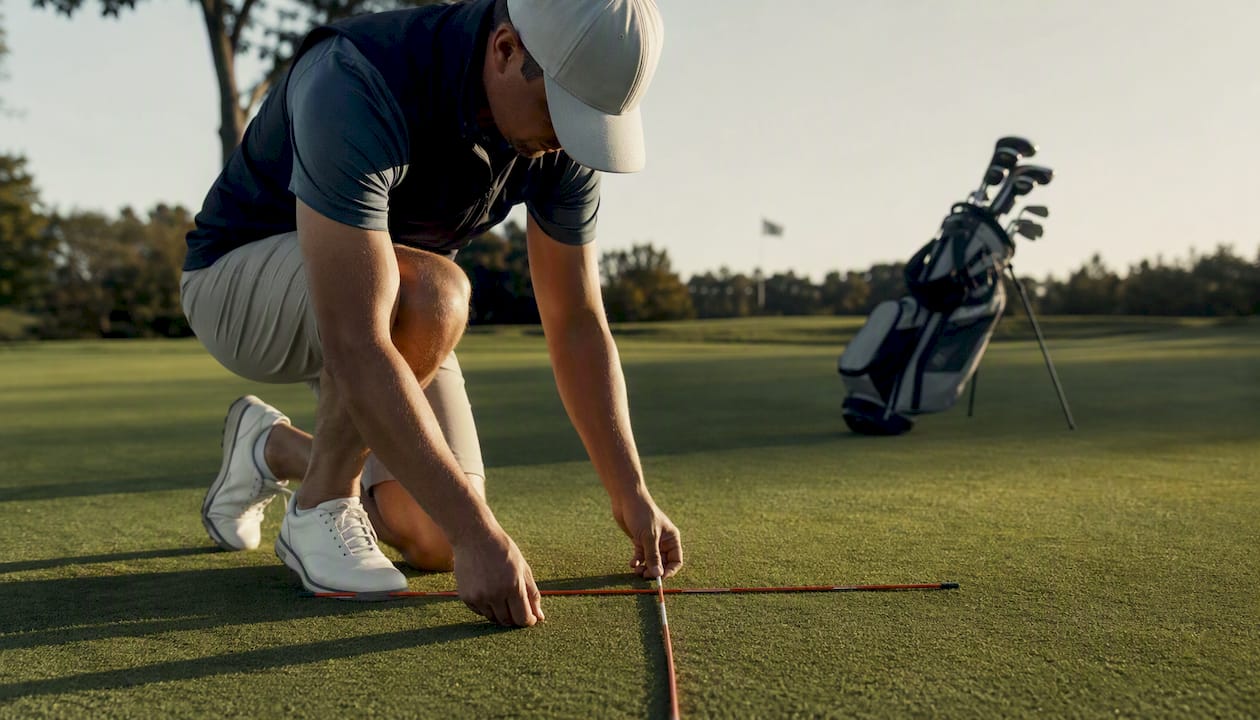
The single most effective move you can make as a new golfer is to choose one feedback-rich training aid that targets your primary fault, then follow a focused two-week practice plan built around it. Not five aids. One. Here is a shortlist of the tools that consistently deliver for beginners:
- Alignment sticks — fix aim, setup, and swing path
- Orange Whip (or similar rhythm trainer) — build tempo and connection
- Tour Striker Smart Ball — correct arm connection and contact
- PuttOut Pressure Trainer — sharpen putting stroke and distance control
- Impact tape or an impact bag — reveal exactly where the clubface strikes the ball
Your next step: identify your single biggest fault (aim, contact, tempo, or putting), pick the matching aid from the list above, and start the two-week plan outlined in this article.
Table of Contents
- Why do training aids actually help beginners — and when don’t they?
- The best beginner training aids: what each fixes, a quick drill, and what it costs
- What mistakes do beginners most often make with training aids?
- Key Takeaways
- Why focused practice beats a bag full of gadgets
- Golf Blab makes the beginner plan easier to follow
- Useful sources and where to buy training aids in the U.S.
Why do training aids actually help beginners — and when don’t they?
Training aids work when they provide clear, immediate feedback on one specific movement and are used within a purposeful practice structure. That condition is non-negotiable. A device sitting in your bag between range sessions produces nothing, as Practical Golf’s research on training aids makes plain: effectiveness depends entirely on integrating the tool into a structured routine, not on owning it.
The 80/20 rule applies here with particular force. GolfDecode’s breakdown of swing fundamentals makes the case that roughly 80% of a beginner’s progress comes from mastering grip, posture, and alignment before attempting any complex swing change. That means most of your practice time belongs to those three pillars, with a training aid serving as a reinforcement tool rather than a shortcut past them. Pair this with Golf Blab’s guide to playing consistently, which walks through the foundational setup steps in plain language.
Statistic callout: The Orange Whip rhythm trainer is trusted by over 500,000 golfers worldwide, including PGA and LPGA professionals who use it for warm-ups and tempo training — a signal of how broadly the value of rhythm-focused practice is recognized.
When are aids not worth it? Three situations stand out. First, when you buy multiple devices at once and split your attention across all of them. Second, when the aid offers no clear, immediate signal — a vague “feel” device with no visual or tactile cue rarely changes behavior. Third, when you skip the fundamentals entirely and use an aid to paper over a setup problem that a proper grip or stance correction would solve faster. Golf Digest’s training aid recommendations reinforce this point: non-ball drills and movement rehearsal often outperform endless ball-striking for beginners who have not yet built a repeatable motion.
The best beginner training aids: what each fixes, a quick drill, and what it costs
Alignment sticks
What it fixes: Aim, ball position, swing path, and posture. These are the most versatile tools in a beginner’s kit, and at roughly $10–$20 for a pair, they are also the most affordable.

Quick drill: Place one stick along your toe line pointing at the target. Place a second stick perpendicular to it, indicating ball position. Hit five shots, then check whether your divots and foot line match the sticks. This single drill exposes aim errors that most beginners carry for years without knowing.
Pros: Immediate visual feedback, portable, works at home or on the range. Cons: Requires some self-coaching to interpret correctly.
Golf Blab’s alignment tips guide pairs directly with this drill and offers five practical variations.
Orange Whip (rhythm and connection trainer)
What it fixes: Tempo, sequencing, and the feeling of a connected swing. The weighted ball at the end of a flexible shaft forces your body to move in sync rather than letting the arms race ahead.

Quick drill: Make 20 slow-motion swings, focusing on the counterweight swinging freely through impact. If the ball jerks or stops, your tempo is off. Smooth, pendulum-like motion is the target.
Pros: Immediate physical feedback, doubles as a warm-up tool, widely used by tour players. Cons: Priced at roughly $109–$119 in the U.S., which is a meaningful investment for a beginner.
Tour Striker Smart Ball
What it fixes: Arm connection, early extension, and the dreaded “chicken wing” through impact. The inflatable ball sits between your forearms and falls out the moment your arms separate incorrectly.
Quick drill: Place the ball between your forearms and make half-swings, keeping it in place through impact. Ten connected reps, then hit five balls without it and try to replicate the feel.
Pros: Immediate tactile feedback, works indoors. Cons: Takes a few sessions to feel natural; some beginners find it restricts their motion at first.
PuttOut Pressure Trainer
What it fixes: Putting stroke path, face angle at impact, and distance control. The parabolic return cup sends a perfectly struck putt back to you and rejects off-center hits.
Quick drill: From six feet, make 20 putts and count how many return cleanly. Track that number daily. MightyGolfer’s beginner swing guide notes that beginners who track simple metrics like putts started on line see measurable improvement within weeks.
Pros: Compact, works on any carpet, under $40. Cons: Does not replicate green speed variation.
Impact tape and impact bag
What it fixes: Centeredness of contact and clubface awareness. Impact tape (applied to the clubface) shows exactly where the ball strikes; an impact bag builds the feel of a solid, decelerating-free hit.
Quick drill: Apply tape to a 7-iron and hit 10 shots. Circle the strike pattern. A cluster toward the heel or toe reveals a path or setup problem that no amount of feel-based practice will fix as quickly as seeing it in print. ProGolfInsider’s swing breakdown highlights impact-bag drills as one of the most reliable ways to build clubface control for beginners.
Pros: Cheap (tape under $10, bags around $30–$50), brutally honest feedback. Cons: Impact bags require space and a firm surface.
Comparison table
| Training aid | What it fixes | Ease of use | Immediate feedback | Portability | Typical U.S. price | How to practice |
|---|---|---|---|---|---|---|
| Alignment sticks | Aim, path, setup | Very easy | Visual (stick position) | High | $10–$20 | Toe-line and ball-position drill |
| Orange Whip | Tempo, connection | Easy | Physical (counterweight feel) | Medium | $109–$119 | 20 slow-motion swings per session |
| Tour Striker Smart Ball | Arm connection, impact | Moderate | Tactile (ball drops) | High | $40–$50 | Half-swing connection reps |
| PuttOut Pressure Trainer | Putting stroke, face angle | Very easy | Visual (return or reject) | Very high | $30–$40 | 20 putts from 6 ft, count returns |
| Impact tape / impact bag | Strike location, clubface | Easy | Visual (tape mark) | High (tape) / Low (bag) | $10–$50 | 10-shot tape review per session |

Buying tips for beginners: Prioritize simplicity, a clear feedback signal, and portability. If you cannot tell within five swings whether the aid is working, it is the wrong tool for your current stage. Less-explored options can also offer targeted benefits worth trying, as MyGolfSpy’s guide to underrated training aids demonstrates.
What mistakes do beginners most often make with training aids?
Most beginners make the same handful of errors, and each one is correctable once you can name it.
- Ignoring setup basics. No training aid compensates for a fundamentally flawed grip or stance. If your grip is off, an impact bag will show you a bad strike pattern but cannot tell you why. Fix the foundation first.
Safety note: Avoid forcing your body into positions that cause joint discomfort. Training aids should guide natural movement, not override it. If an aid creates pain in your wrist, elbow, or lower back, stop and consult a teaching professional before continuing.
Key Takeaways
The most effective approach to beginner golf training is to identify one specific fault, choose a single feedback-rich aid that targets it, and follow a structured two-week plan with measurable checkpoints.
| Point | Details |
|---|---|
| One aid, one fault | Pick a single training aid that addresses your primary setup or contact problem before buying anything else. |
| 80/20 fundamentals first | Spend most practice time on grip, posture, and alignment; use the aid to reinforce those basics, not replace them. |
| Track a simple metric | Measure centered strikes, putts returned, or tempo consistency each session so progress is visible, not just felt. |
| Pair with a lesson | Book a 30-minute check-in at the end of Week 2 to validate changes and set the next phase of improvement. |
| Golf Blab resources | Golf Blab’s Play Golf with a Tour Pro experience and lesson content pair directly with this two-week plan as a coached next step. |
Why focused practice beats a bag full of gadgets
The golf industry has a quiet problem: it sells the idea that better equipment produces better golf. Training aids are not immune to that logic. Walk into any golf retailer and you will find dozens of devices, each promising to fix a different fault, each competing for the same beginner’s attention and budget.
What the evidence actually shows is more humbling and more hopeful at the same time. Beginners improve fastest when they narrow their focus to one movement, one feedback signal, and one measurable outcome per practice block. The discomfort of that early learning phase — where you are consciously trying to change something that feels wrong before it feels right — is not a sign that the aid is failing. It is the sign that learning is happening.
The deeper issue is that gadgets can become a form of avoidance. Buying a new device feels like progress. Using it without a plan, without metrics, and without a coach’s occasional input does not produce progress — it produces the illusion of it. A structured development pathway that pairs focused solo practice with periodic coaching is what separates golfers who genuinely improve from those who plateau after their first season.
The two-week plan in this article is not complicated. It is deliberately simple, because simplicity is what beginners actually need. One aid, one fault, one number to beat each session. That is the whole framework. And when Week 2 ends and you sit down with a coach who can see your phone recordings and your progress notes, the conversation becomes something far more productive than “I’ve been practicing but I’m not sure it’s working.”
Golf Blab makes the beginner plan easier to follow
Pairing a training aid with the right lesson context is what separates a two-week experiment from a genuine improvement arc. Golf Blab offers exactly that combination: instructional content built for beginners, a money-back guaranteed lesson program, and a Play Golf with a Tour Pro experience that gives you direct, personalized feedback from a professional.
Beyond lessons, Golf Blab’s Custom Golf Club Labels let you mark your clubs with a personal identity that makes every practice session feel like yours, not a borrowed set. The Golf Blab Under Armour Golf Hat rounds out the gear side for beginners who want to show up to the range with intention. These are not afterthoughts — they are part of building the habit of showing up, which is the real engine of improvement.
Ready to pair your training aid practice with a coached check-in? Book your lesson through Golf Blab’s lesson program and bring your two weeks of progress notes with you.
Useful sources and where to buy training aids in the U.S.
Recommended external references:
- Best golf training aids
- Golf training aids — Practical Golf
- Golf swing basics — GolfDecode
- The perfect golf swing breakdown from setup to follow-through — ProGolfInsider
- Three golf training aids you haven’t tried but should — MyGolfSpy
- Training aids I like — Golf Digest
- Golf Lessons FAQ | Cost, Process & Game Evaluations — GOLFTEC
- How to swing a golf club: 5 steps for beginners — MightyGolfer
Golf Blab internal resources:
- Golf alignment tips: Five practical alignment drills for beginners
- Why video analysis transforms your game: How to record and review your swing at home
- Golf stance explained: Detailed setup and posture guidance
Where to buy training aids in the U.S.:
| Retailer type | Examples | What you’ll find | Price range |
|---|---|---|---|
| Online general retail | Amazon, Walmart.com | Alignment sticks, impact tape, PuttOut | $10–$50 |
| Specialty golf retail | Golf Galaxy, PGA Tour Superstore | Full range including Orange Whip, Smart Ball | $10–$120 |
| Direct from brand | OrangeWhip.com, TourStriker.com | Full product lines with instructional content | $40–$50 |
| Golf Blab | golf-blab.com | Lessons, labels, apparel, and instructional content | Varies |
Purchasing checklist before you buy: