
TL;DR:
- Many adult golfers seek lessons to break through skill plateaus and enjoy the game more confidently. Personalized coaching provides targeted feedback, correcting mistakes early and accelerating progress. Ongoing instruction fosters lifelong growth, enjoyment, and sustained improvement in golf performance.
Most golfers assume lessons are a beginner’s tool. You take a few to learn the basics, then you’re on your own. That thinking is costing you strokes, confidence, and honestly, a lot of fun on the course. The naked truth is that adult golfers pursue lessons to sharpen skills and deepen their enjoyment of the game, regardless of where they currently stand. Whether you’re a 25-handicapper struggling with consistency or a 10-handicap player stuck at the same scoring level for years, professional instruction has something real to offer you.
Table of Contents
- The real reasons adults seek golf lessons
- How lessons accelerate skill development and consistency
- Personalization: Tailoring lessons to individual needs
- Long-term benefits: Confidence, enjoyment, and lifelong growth
- Why the best golfers never stop learning: A fresh perspective
- Take the next step: Find the right lesson for you
- Frequently asked questions
Key Takeaways
| Point | Details |
|---|---|
| Lessons benefit all levels | Adult golfers gain from lessons in skill, confidence, and game enjoyment regardless of experience. |
| Personalized instruction accelerates progress | Tailored approaches help golfers break plateaus and reach their unique goals faster. |
| Long-term enjoyment grows | Ongoing lessons foster lifelong improvement and greater satisfaction with the game. |
| Choosing the right lesson is key | Matching your learning style with lesson format maximizes results and value. |
The real reasons adults seek golf lessons
Let’s cut through the noise. Most adults who sign up for lessons aren’t starting from scratch. They’re players who have hit a wall, lost their confidence, or simply want to enjoy the game more. And that’s not a weakness. That’s smart thinking.
Think about it this way. If your car starts pulling to one side, you don’t just drive it harder hoping it corrects itself. You take it to someone who can diagnose the problem and fix it. Golf is no different. Bad habits compound over time, and the longer you wait, the more deeply they get baked into your muscle memory.
Here’s what motivates most adult golfers to finally book that lesson:
- Breaking a stubborn plateau after months or years at the same handicap level
- Rebuilding confidence after a stretch of poor rounds that shook their enjoyment
- Fixing a specific flaw like a persistent slice, poor chipping, or a yippy putting stroke
- Preparing for a special event like a club championship or a golf trip they’ve been planning
- Simply wanting to enjoy the game more because frustration has been winning lately
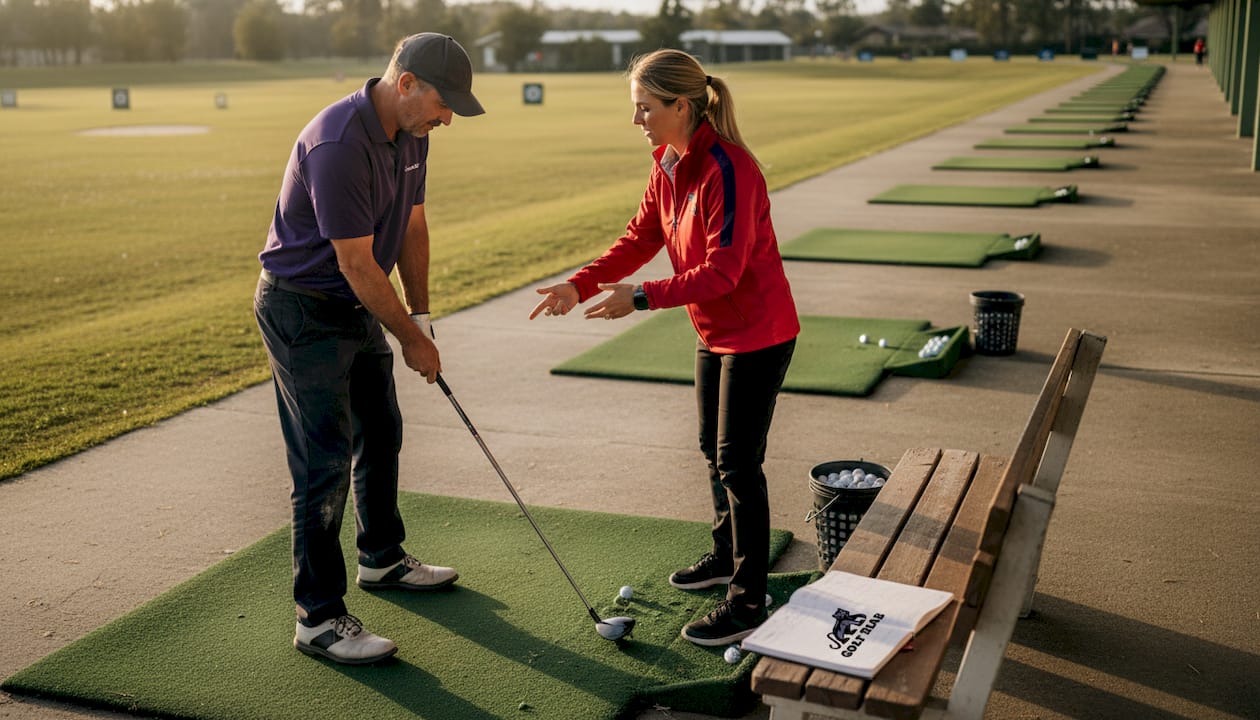
Understanding what a golf coach does for your game changes the entire conversation. A great coach isn’t there to overhaul everything you do. They’re there to identify the one or two things that are holding you back the most and give you a clear path forward.
“The biggest misconception in golf is that once you’ve played for a few years, you’ve learned all you can. In reality, that’s usually when the most meaningful improvement becomes possible.” — Golf Blab coaching team
The personalized feedback you get from a professional is something no YouTube video or golf buddy can replicate. Those golf pro tips you find online are often generic, and generic advice can actually make your specific problem worse.
Pro Tip: Before your first lesson, write down the three things that frustrate you most about your game. That list becomes your instructor’s starting point and saves you both valuable time.
How lessons accelerate skill development and consistency
Here’s where things get interesting. Most golfers practice the wrong way. They go to the range, hit a bucket of balls, feel pretty good, and call it a day. But without structured feedback, you’re just reinforcing whatever you’re already doing, including the mistakes.
Structured guidance through lessons accelerates improvement in a way that self-directed practice simply can’t match. A coach watches your swing from multiple angles, spots the root cause of your problems (not just the symptoms), and gives you targeted drills that fix the actual issue.

Let’s compare the two approaches honestly:
| Factor | Self-directed practice | Coached sessions |
|---|---|---|
| Feedback quality | None or guesswork | Real-time, specific |
| Error correction | Errors compound | Errors caught early |
| Skill progression | Slow or stagnant | Structured and measurable |
| Accountability | None | Built in |
| Efficiency | Low | High |
| Enjoyment boost | Moderate | Significant |
The difference is stark. When you practice without feedback, you can spend years grinding away at the range without ever moving the needle. When a coach is involved, even one session can change the trajectory of your game.
Here’s a practical progression that most coached adult golfers follow:
- Assessment session where your coach identifies your current strengths and the specific gaps holding you back
- Focused technique work targeting your biggest weakness first, not a laundry list of fixes all at once
- On-course application where you actually use what you’ve learned in a real round or simulated playing situation
- Review and adjustment so the coach can see what transferred from the lesson to the course
- Refinement and new goals once the initial improvement has been locked in
This kind of progression is what separates real improvement from the endless cycle of range sessions that go nowhere.
Building solid practice routines for performance is something coaches help you design specifically for your schedule and goals. Not everyone has three hours a day to practice. A good coach builds a plan around your real life.
Pro Tip: Ask your instructor to give you one drill and one swing thought to take away from each session. Two things. That’s it. Trying to remember ten things on the course is a recipe for paralysis.
You can even start seeing results by committing to practice at home between lessons. Short daily sessions reinforcing what your coach taught you accelerate progress dramatically compared to waiting until your next range visit.
Personalization: Tailoring lessons to individual needs
This is where professional instruction really earns its value. No two adult golfers are the same. A 55-year-old with limited shoulder mobility has completely different physical needs than a 35-year-old who’s an athlete. A golfer who’s played for 20 years and developed deeply ingrained habits needs a different approach than someone who picked up the game two years ago.
Personalized approaches genuinely enhance the effectiveness of golf lessons in ways that generic instruction never can. A skilled instructor doesn’t apply the same template to every student. They observe, ask questions, and adapt.
Here’s what smart lesson personalization actually looks like in practice:
| Golfer profile | Primary focus area | Coaching approach |
|---|---|---|
| Senior with mobility limits | Maintaining swing arc | Modified setup and rotation drills |
| High-handicapper beginner | Contact and alignment | Simplified fundamentals, lots of repetition |
| Mid-handicapper with plateau | Course management | Strategy-based instruction alongside technique |
| Low-handicapper chasing scratch | Short game sharpness | Detailed wedge and putting refinement |
| Returning golfer after a break | Rust removal | Confidence rebuilding and tempo restoration |
The right instructor asks about your goals on the first day. Do you want to break 90? Compete in your club’s member-guest? Simply enjoy a round without embarrassing yourself in front of your boss? Those goals shape everything about how instruction is delivered.
Personalization also means respecting your learning style. Some golfers are visual learners who respond well to video analysis. Others are feel-based players who need descriptive cues rather than technical explanations. A good coach reads you and adjusts accordingly.
When you’re deciding between formats, it’s worth exploring the difference between clinics versus private lessons to figure out what matches your goals and budget. Group clinics offer terrific value for social learners who enjoy the energy of other students. Private lessons give you undivided, laser-focused attention.
Here’s what to look for when personalizing your learning experience:
- A coach who asks about your specific goals before the first swing is taken
- Flexibility in lesson format, whether on the range, short game area, or on the course itself
- A willingness to explain why a change is being made, not just issuing orders
- Adjustments that account for your physical limitations without making you feel limited
- Regular check-ins to evaluate whether the approach is working for you
Pro Tip: Tell your instructor about any physical limitations upfront. A coach who knows about your bad knee or tight back can build a swing that works with your body, not against it. This saves you pain and frustration in the long run.
Long-term benefits: Confidence, enjoyment, and lifelong growth
Here’s something the golf industry doesn’t say loudly enough. Lessons aren’t just about technique. They fundamentally change how you feel on the golf course. And that emotional shift is often more valuable than the technical improvement.

When you follow smart golf strategy, and your ball goes where you intend more often than not, something shifts inside you. You walk onto the first tee with a completely different energy. Confidence isn’t just a nice feeling. It directly affects your decision-making, your tempo, and your ability to recover from a bad hole without letting it ruin the rest of your round.
The long-term benefits that consistently coached golfers report include:
- Sustained confidence that carries over from the range to the course and stays there
- More consistent ball striking that makes every round more predictable and enjoyable
- Better decision-making because you understand your game well enough to know when to be aggressive and when to lay up
- Deeper enjoyment of every round because frustration decreases when you have tools to manage your game
- Stronger social connections since you’re no longer embarrassed to play with better golfers
“Golf is a game you play for life. The golfers who invest in lessons consistently aren’t just trying to get better. They’re protecting their enjoyment of the game for decades to come.”
Think about updating your golf equipment alongside your lessons. Better gear combined with better technique creates a compounding effect. You stop blaming your clubs and start trusting your swing.
There’s also a fascinating lesson in looking at how junior golfers benefit from early instruction. Young players who get good coaching early develop confidence and mental resilience that shapes their entire relationship with the game. Adults can experience the exact same transformation. It’s never too late, and the benefits look remarkably similar regardless of age.
Pro Tip: Keep a simple round-by-round journal after you start lessons. Track your fairways hit, greens in regulation, and putts per round. You’ll see the improvements faster than you expect, and that data becomes incredibly motivating when progress feels slow.
Why the best golfers never stop learning: A fresh perspective
Here’s an opinion that might sting a little. A lot of adult golfers resist lessons because they see them as an admission of failure. “I’ve been playing for 15 years. Shouldn’t I have figured this out by now?” That mindset keeps more golfers stuck than any bad habit ever could.
Look at the best players in the world. Tour professionals, people who have dedicated their entire lives to this game, still work with swing coaches, short game coaches, mental coaches, and fitness trainers every single week. They aren’t doing that because they’re bad at golf. They’re doing it because they understand that improvement requires outside perspective, regardless of how good you already are.
The golfers who embrace lifelong learning through ongoing coaching support share a specific mindset. They see each lesson not as a fix for something broken but as an investment in a game they love. There’s a real difference between those two frames, and it changes everything about how you engage with instruction.
The uncomfortable truth is that most plateaus in amateur golf aren’t physical limitations. They’re mental ones. The belief that you’re “too old to change” or “too set in your ways” is far more limiting than your actual swing. We’ve seen 60-year-olds drop five strokes in a season after finally committing to consistent instruction. The body adapts more readily than the ego does.
At Golf Blab, we’ve always believed that the frustration golfers feel, the kind that makes you want to snap a club after a triple bogey, is almost always rooted in a feeling of helplessness. That feeling disappears when you have a coach, a plan, and clear evidence that you’re improving. The game becomes fun again. Genuinely, deeply fun.
Growth in golf isn’t linear, and that’s worth accepting early. You’ll have breakthroughs, followed by plateaus, followed by new breakthroughs. The players who keep getting better are simply the ones who don’t quit on the process during the flat stretches. A good coach keeps you grounded and focused when the progress feels invisible.
Take the next step: Find the right lesson for you
You’ve been reading about the benefits of professional instruction, and maybe something clicked. Maybe you’ve been thinking about booking lessons for months but kept putting it off. Here’s a simple truth: the best time to invest in your game is right now, not after next season, not after you buy new clubs, and not after you “get a little better first.”

At Golf Blab, we’ve built a learning center full of resources designed specifically for adult golfers who are serious about improving. Whether you’re starting fresh or trying to break through a stubborn plateau, we have structured paths that meet you exactly where you are. Explore our available lesson packages and find a format that fits your goals, your schedule, and your budget. We back everything with a money-back guarantee because we’re confident the instruction works, and we want you to feel that confidence before you commit.
Frequently asked questions
Do adult golf lessons work for beginners and experienced players?
Yes, adult lessons benefit both new and experienced golfers by offering tailored instruction that meets each player where they are. Adult golfers at every level see real improvements in skill and enjoyment when instruction is properly personalized.
How do I know if private or group lessons are better for me?
Consider your learning style and specific goals first. Personalized lesson formats offer the best fit when you match them to how you learn best, with private sessions providing focused individual attention and group clinics offering a social, shared learning environment.
Will lessons help me fix common mistakes in my game?
Professional coaching targets your specific weaknesses rather than applying generic fixes, which is why it works so much better than self-correction. Structured guidance from a coach identifies the root cause of your errors and gives you concrete drills to correct them efficiently.
How often should adult golfers take lessons for best results?
Consistency is the single biggest driver of lasting improvement in adult golf. Even monthly lessons, combined with focused practice in between, deliver significantly better results than sporadic sessions whenever frustration peaks.