
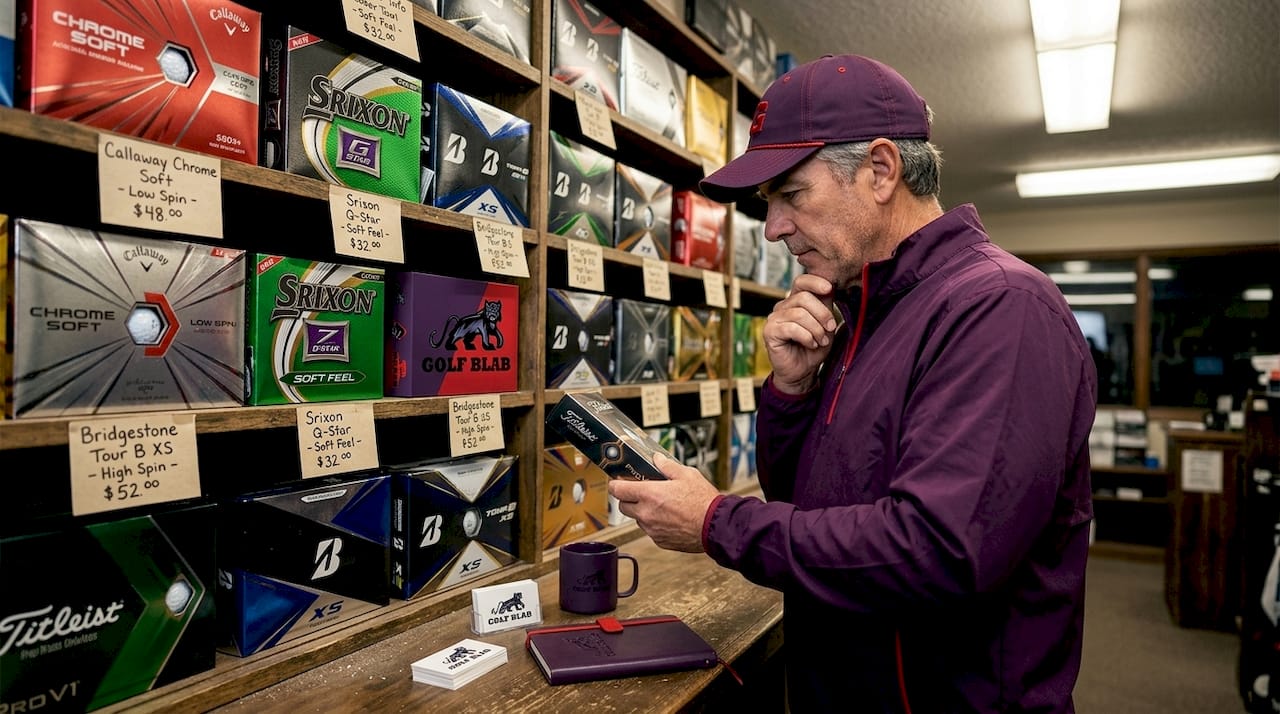
TL;DR:
- Choosing the right golf ball is crucial for optimizing performance and consistency on the course.
- Match ball compression and cover material to your swing speed, skill level, and playing conditions.
- Test multiple options in real play and track results before committing to a specific golf ball.
You’ve finally got your swing feeling smooth, your club selection is dialed in, and you’re ready to go low. Then the round starts and something still feels off. Shots balloon in the wind. Your irons don’t stop where you expect. Putts feel dead off the face. Most golfers immediately blame their swing or their clubs, but here’s what nobody tells you: the golf ball sitting in your pocket could be the real problem. Choosing the right golf ball isn’t a minor detail. It’s one of the most impactful decisions you’ll make on the course, and most players never give it a second thought.
Table of Contents
- Why the right golf ball matters
- What you need to know before choosing a golf ball
- Step-by-step: How to select the best golf ball for your game
- Common mistakes and troubleshooting tips
- What to expect after making the right choice
- A golfer’s perspective: Why advice alone is not enough
- Take the next shot with Golf Blab
- Frequently asked questions
Key Takeaways
| Point | Details |
|---|---|
| Know your needs | Understanding your skill level and swing speed is crucial for picking the right ball. |
| Test before buying | Trying a few golf balls on the course helps you make the best choice for your play style. |
| Avoid common mistakes | Don’t rely on branding or price—performance matters most. |
| Monitor your results | Track your game improvement to reassess your golf ball choice as your skills grow. |
Why the right golf ball matters
Let’s get one thing straight. A golf ball isn’t just a small white sphere you smack down the fairway. It’s a precision piece of equipment, and every construction choice inside it, from the core to the cover, directly affects how it flies, how it spins, and how it feels when you make contact.
Golf ball construction affects three critical performance areas: flight trajectory, spin rate, and control around the greens. A ball that doesn’t match your swing speed or playing style isn’t just uncomfortable to hit. It’s actively working against you. Learning about golf ball trajectory is one of the fastest ways to understand why ball selection changes everything.
Here’s a stat that might surprise you: over 50% of amateur golfers never change ball type throughout their playing years. They grab whatever is on sale, whatever their buddy recommends, or whatever they find in the cart path bushes. That’s not a strategy. That’s leaving performance on the table.
Take a look at how different ball types stack up at a glance:
| Ball Type | Best For | Key Benefit | Typical Swing Speed |
|---|---|---|---|
| 2-piece distance ball | Beginners, high handicappers | Maximum distance, durability | Under 90 mph |
| 3-piece mid-range ball | Mid-handicap players | Balance of distance and feel | 85 to 100 mph |
| 4 to 5-piece tour ball | Low handicappers, scratch players | High spin, precision control | 100 mph or more |
| Low compression ball | Seniors, juniors, slower swings | Soft feel, reduced effort | Under 80 mph |
The right ball doesn’t just match your skill. It matches your game style, your course conditions, and even your goals for the round. That’s the kind of detail that separates golfers who keep improving from those who plateau.
What you need to know before choosing a golf ball
Before you walk into a golf shop or browse online, you need to understand a few core concepts. This isn’t about memorizing technical specs. It’s about knowing what to look for so you don’t get talked into something that doesn’t fit your game.
Compression is the biggest factor most golfers overlook. Compression refers to how much the ball deforms when struck. A low compression ball (70 or below) squishes more and is easier to compress with a slower swing, which means more energy transfer and better distance for players with moderate swing speeds. A high compression ball (90 and above) requires a faster, more powerful swing to get the same benefit. Choosing wrong here is like buying shoes two sizes off. Technically it works, but it never feels right.
Cover material is your second major consideration. Urethane covers, found on most premium tour balls, offer superior feel and spin control, especially around the greens. Ionomer covers, used on most entry-level and mid-range balls, are more durable and forgiving but offer less short game feel. If you’re still working on basic ball-striking, the extra spin from urethane can actually hurt you, turning a slight mishit into a bigger miss.
Here’s what to look for before buying:
- Swing speed: Determine whether you have a slow (under 85 mph), moderate (85 to 100 mph), or fast (over 100 mph) swing
- Skill level: Beginners need forgiveness, while advanced players need feel and control
- Budget: Premium balls cost $40 to $55 a dozen; mid-range options land at $20 to $35
- Playing frequency: If you lose several balls a round, premium balls are expensive mistakes
- Course conditions: Wet or cold conditions call for softer, lower compression balls
One trap that catches a lot of golfers is overvaluing brand and appearance. A premium brand logo on a ball doesn’t automatically mean it’s the right ball for your game. Pairing the right ball with the right golf club types creates a system that works together rather than fighting itself.
Pro Tip: Buy a sleeve of three different balls and play a short practice round with each. You’ll feel the difference far more clearly than any spec sheet will tell you.

Step-by-step: How to select the best golf ball for your game
Choosing a golf ball shouldn’t feel like guesswork. Following a clear process eliminates the noise and gets you to the right answer faster. Good golf club selection follows a similar logic, and the same patient, methodical approach works for balls too.
Step 1: Assess your swing speed and skill level
Be honest here. Most golfers overestimate their swing speed. If you’re not regularly tracking it, get a reading at a local shop or use a launch monitor. Your swing speed determines the compression range you need.
Step 2: Identify your biggest weakness
Are you losing distance off the tee? Struggling to hold greens with your irons? Can’t get the ball to stop near the pin on chips? Your weakness narrows down what ball characteristic matters most.
Step 3: Test two to three models in real conditions
Don’t test balls on the range only. The putting green and short game area reveal the most about a ball’s feel. Play a full practice round with each model. Understanding every type of golf shot you’ll face helps you evaluate each ball fairly.
Step 4: Track your results with data
Use a simple scorecard note or a shot-tracking app. Log your driving distance, greens in regulation, and proximity from the hole on chips and pitches. After a few rounds with each ball, the data tells the story.
Step 5: Choose the ball that delivers the most consistent results
Not the one that gave you one great drive. The one that consistently performs across all areas of your game. Consistency beats occasional brilliance every single time.
| Step | What to Do | Why It Matters |
|---|---|---|
| 1 | Measure swing speed | Determines compression fit |
| 2 | Identify your game weakness | Focuses your priorities |
| 3 | Test 2 to 3 models in real play | Real conditions reveal real performance |
| 4 | Track performance data | Removes guesswork and emotion |
| 5 | Commit to the best consistent performer | Builds repeatable results |

Pro Tip: After testing, stick with your chosen ball for at least ten rounds before evaluating again. You need enough data to see a real pattern, not just a good day or a bad day.
Common mistakes and troubleshooting tips
Even golfers who know better fall into these traps. Watch for them in your own game.
- Buying in bulk before testing: Picking up three dozen of a ball because it was on sale, before you know it works for you, is one of the most common and expensive mistakes
- Playing premium balls before your game is ready: A $50-per-dozen urethane ball punishes mishits harder than an ionomer ball will. If you’re still spraying the ball around, a more forgiving option will serve you better
- Ignoring performance data: Feelings lie. Data doesn’t. If you feel like a ball is performing well but your scores and stats haven’t changed, the feeling is misleading you
- Switching too often: Changing balls every few rounds means you never build a reliable baseline. You can’t separate ball performance from swing variation if you’re always changing the variable
- Chasing what tour pros use: Tour players have swing speeds most amateurs will never reach. A ball engineered for 120 mph club head speed doesn’t work the same way at 85 mph
Smart golf strategy tips always come back to this principle: eliminate variables. The right ball, chosen through actual testing, is one of the easiest variables to lock down.
“Consistency beats hype. The best golf ball is the one that repeatedly helps you hit your targets, not the one with the most impressive marketing or the fanciest packaging.” — Golf Blab
What to expect after making the right choice
Getting this decision right pays off faster than most people expect. Here’s what you can realistically anticipate after selecting and committing to the right golf ball for your game.
1. Improved confidence from the first tee
When you know your ball is matched to your swing, you stop second-guessing the equipment. That mental freedom is worth more than most golfers realize. Confidence before a shot dramatically reduces tension, which directly improves your swing.
2. Measurable distance gains or improved control
Depending on what was mismatched before, some golfers see immediate distance gains from switching to a properly fitted lower compression ball. Others notice that their iron shots start holding greens more reliably. The gain depends on where the mismatch was, but there will be a gain.
3. More consistent feel throughout the round
One of the quieter benefits of playing the right ball is how uniform each shot feels. You stop getting surprised by odd results, and that lets you build real calibration between your swing effort and the ball’s response.
4. A clearer baseline for tracking progress
Once you stop changing balls, your performance data becomes meaningful. Round-to-round improvement becomes visible because you’re measuring the same system. That’s how you know your practice is actually translating to better golf.
5. Better decision-making on when to reassess
You’ll know when it’s time to switch balls. Reassess your choice when your swing speed increases significantly, when you move to a different course environment long-term, when your handicap drops by several strokes, or when new equipment changes the way you play. Following your ball trajectory trends over time makes that decision obvious rather than arbitrary.
A golfer’s perspective: Why advice alone is not enough
Here’s the part most golf guides skip. Reading about compression ratios and cover materials is useful. But information alone doesn’t improve your game. What actually moves the needle is testing, feeling, and trusting your own experience.
We’ve seen countless golfers absorb every piece of advice available and still spin their wheels because they never actually test anything under real pressure. Standing on the 18th tee with a two-shot lead tells you far more about a ball than a practice session ever will. Real conditions reveal real performance.
There’s also an uncomfortable truth about ball switching. Most golfers who struggle with consistency aren’t being hurt by the wrong ball. They’re being hurt by constantly searching for the magic ball that fixes everything. That magic ball doesn’t exist. What exists is a ball that fits your game right now, and the discipline to stick with it long enough to build genuine confidence.
The conventional wisdom says to keep upgrading to tour balls as fast as possible. We’d push back on that. A mid-range ball that matches your current swing speed and skill level, played with confidence and consistency, will outperform a premium tour ball played with doubt. Every time. A deeper look at trajectory data backs this up. Your comfort with the ball matters as much as its construction specs.
At Golf Blab, we’ve seen this pattern repeat itself too many times to ignore. Players get caught up in what the pros are playing instead of what their own game actually needs. Personal comfort and personal confidence are factors that no spec sheet accounts for, and they’re the difference between a ball that looks right on paper and a ball that actually performs for you on the course.
Take the next shot with Golf Blab
We built Golf Blab specifically for golfers who are done guessing and ready to make real, measurable improvements. Whether you’re picking your first ball or reassessing your setup as your game evolves, the right information and the right tools make all the difference.

Explore our collection of expert golf tips alongside our curated lineup of performance gear, branded accessories, and instructional resources. From swing mechanics to smart equipment choices, we’ve got resources built for every stage of your game. Browse our shop for performance golf balls, custom club labels, and training tools designed to help real golfers play better golf. Your next improvement starts with one smart decision.
Frequently asked questions
How often should I change the type of golf ball I use?
Switch golf balls when your swing speed or skill level significantly changes, or when your current ball consistently fails to meet your on-course needs. Avoid switching just because something new catches your eye.
Does weather affect which golf ball I should play?
Yes, cold or wet weather compresses a ball less effectively, which can reduce distance and alter flight. Lower compression balls respond better in colder conditions, helping maintain a more predictable feel and performance.
What’s the difference between 2-piece and multilayer golf balls?
A 2-piece ball prioritizes distance and durability, making it ideal for beginners and high handicappers. Multilayer balls are engineered for spin separation and feel, giving skilled players more precise control on approach shots and around the greens.
Are more expensive golf balls always better?
Not at all. A premium tour ball can actually hurt your game if your swing speed doesn’t support its compression rating. Choose the ball that fits your current skill and swing, not the one with the biggest price tag or the most recognizable name.